The week in quantum

Weekly Reports

A weekly perspective on quantum computing through published research and developments across the field. Upcoming dates are in the Quantum Catalyst Calendar.

Two reports a week, on one line: the research above it, the news below.

Search everything →

Weekly Publications

Where research is concentrating, how technologies connect, and which findings matter for public companies.

Browse publication reviews →

Weekly News

Company announcements, funding and engineering progress, with the evidence behind the headlines.

Browse news reports →

Oct 17–232026Latest

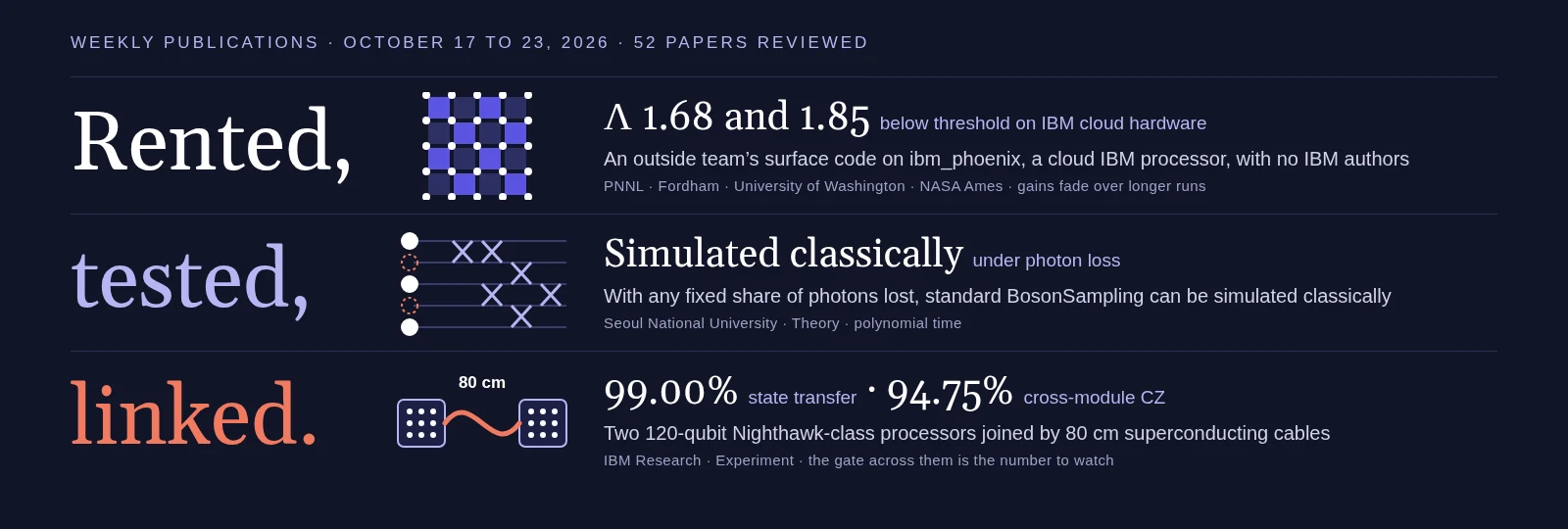
Rented, tested, linked: weekly quantum research for October 17 to 23, 2026. Rented: an outside team’s surface code on ibm_phoenix, a cloud IBM processor, below threshold with Λ of 1.68 and 1.85. Tested: with any fixed share of photons lost, standard BosonSampling can be simulated classically. Linked: two IBM processors joined by 80 cm superconducting cables, 99.00% state transfer and 94.75% cross-module CZ.

Weekly Publications · October 17–23, 2026

Rented, tested, linked

Weekly quantum research for October 17 to 23, 2026: below-threshold error correction on a rented IBM chip by outside researchers, with Quantinuum’s color code for scale; reality checks on quantum advantage, from BosonSampling under photon loss to classical post-processing of QuEra’s Aquila; and links between machines from 80 centimeters to 17 kilometers.
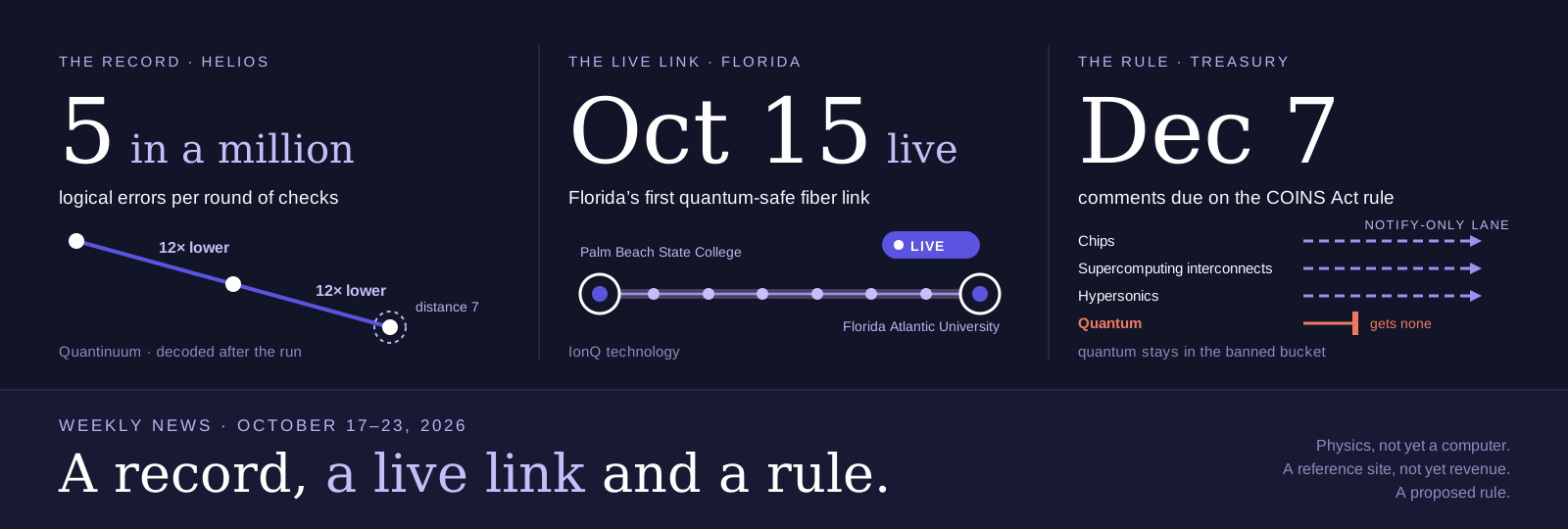
A record, a live link and a rule: Weekly News for October 17 to 23, 2026. About 5 in a million logical errors per round of checks on Quantinuum’s Helios, falling about 12 times each time the code grew, decoded after the run; October 15, when Florida’s first quantum-safe fiber link, between Palm Beach State College and Florida Atlantic University using IonQ technology, went live; December 7, when comments are due on the Treasury’s proposed COINS Act rule, where chips, supercomputing interconnects and hypersonics get a notify-only lane and quantum gets none.

Weekly News · October 17–23, 2026

A record, a live link and a rule

Quantinuum’s Helios color-code record and its offline decoding, the classical stack that has to keep pace, Florida’s quantum-safe link on IonQ technology, and the Treasury’s proposed COINS Act rule keeping quantum investment in China banned; plus Sundar Pichai’s five-year horizon and IBM’s $1 billion Anderon award.

Oct 10–162026

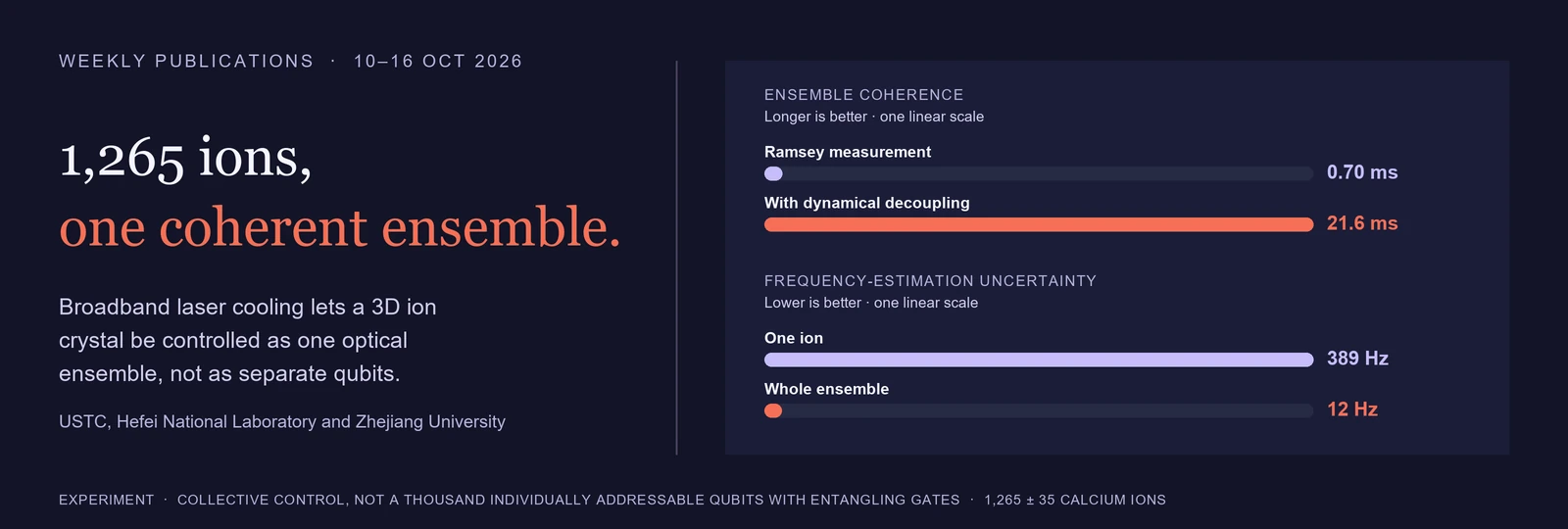
1,265 ions, one coherent ensemble: in a three-dimensional trapped-ion crystal, ensemble coherence rises from 0.70 milliseconds in a Ramsey measurement to 21.6 milliseconds with dynamical decoupling, and frequency-estimation uncertainty falls from 389 hertz for one ion to 12 hertz for the ensemble. Collective control, not a thousand individually addressable qubits with entangling gates.

Weekly Publications · October 10–16, 2026

More qubits, harder control

A 1,265-ion crystal under coherent control, encoded addition that beats its physical circuit but discards attempts, second-long defect lifetimes, deterministic photon fusion and AI-designed quantum arithmetic.

Three kinds of progress: capital, with IonQ’s roughly $2 billion equity package closed on October 16 and Qilimanjaro’s €19.6 million first close; hardware in place, with ORCA’s PT-3 live in London and D-Wave’s Advantage2 inaugurated in Como; and customers, with NTT DOCOMO’s second D-Wave application now nationwide and INmune Bio as QCi’s first pharmaceutical customer. The amounts are not added together.

Weekly News · October 10–16, 2026

From financing to working systems

IonQ’s Elisity deal and $2 billion financing, ORCA’s PT-3 beside GPUs, D-Wave’s Como inauguration, DOCOMO’s nationwide rollout, manufacturing renewals and post-quantum migration dates.

Oct 3–92026

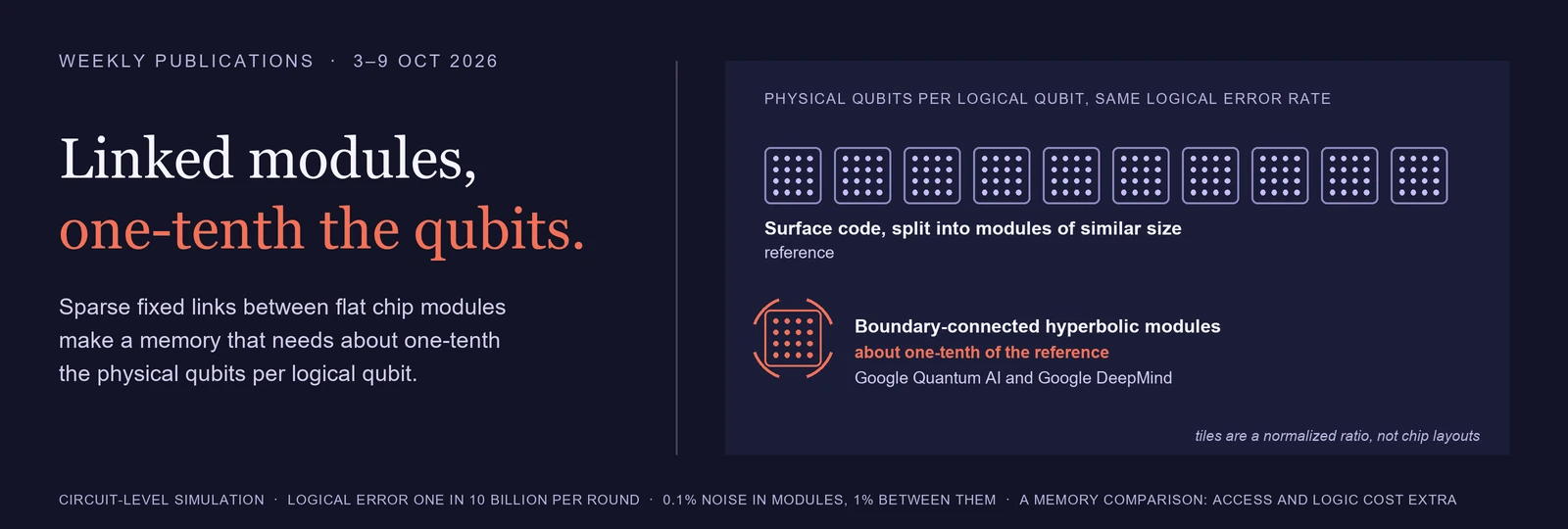
Linked modules, one-tenth the qubits: ten module tiles for a surface code split into modules beside a single tile for Google’s boundary-connected hyperbolic modules, which need about one-tenth the physical qubits per logical qubit at the same logical error rate in circuit-level simulation.

Weekly Publications · October 3–9, 2026

The cost of connecting quantum components

A tenfold leaner memory from wired-together modules, error correction around a chip’s weak spots, a kilohertz link between two qubit technologies, and the real price of a usable magic state. With selected research from Google, IBM and IonQ.

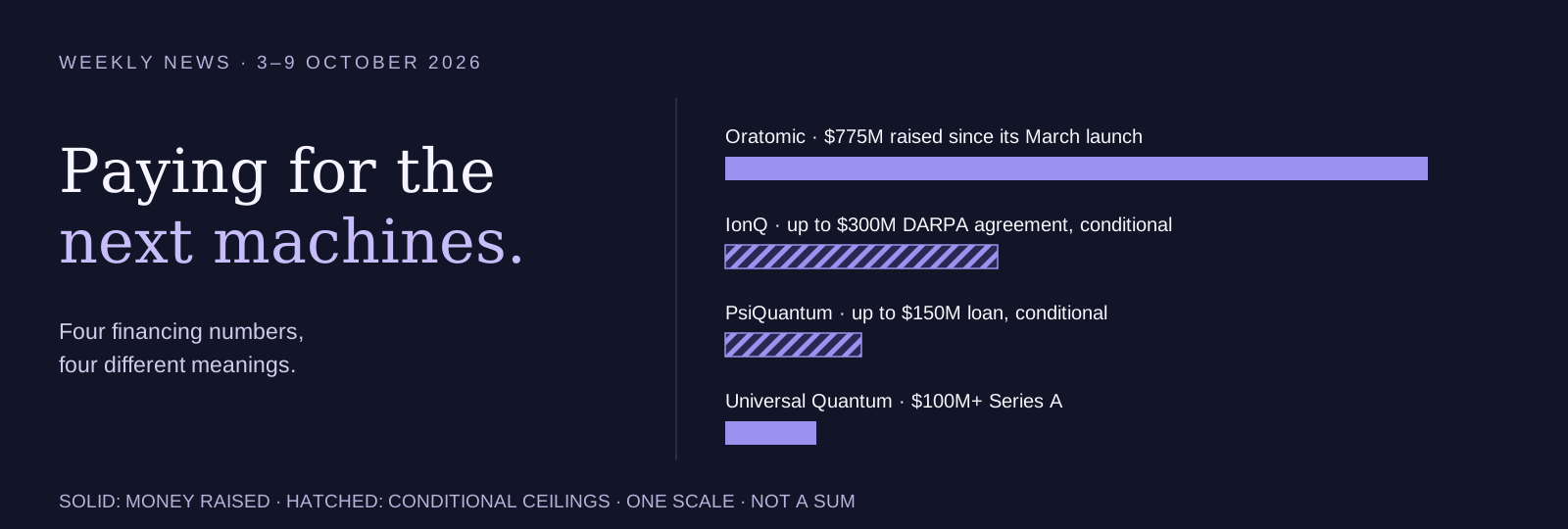
Four financing figures on one scale: Oratomic, 775 million dollars raised since its March launch; IonQ, a DARPA agreement worth up to 300 million dollars, conditional; PsiQuantum, a loan of up to 150 million dollars, conditional; Universal Quantum, a Series A of more than 100 million dollars.

Weekly News · October 3–9, 2026

Paying for the next machines

DARPA’s Stage C and DOE’s priority applications, four financing figures that mean different things, foundries and packaging, tools for cloud access, and KQC’s proposed listing.

Sep 26 – Oct 22026

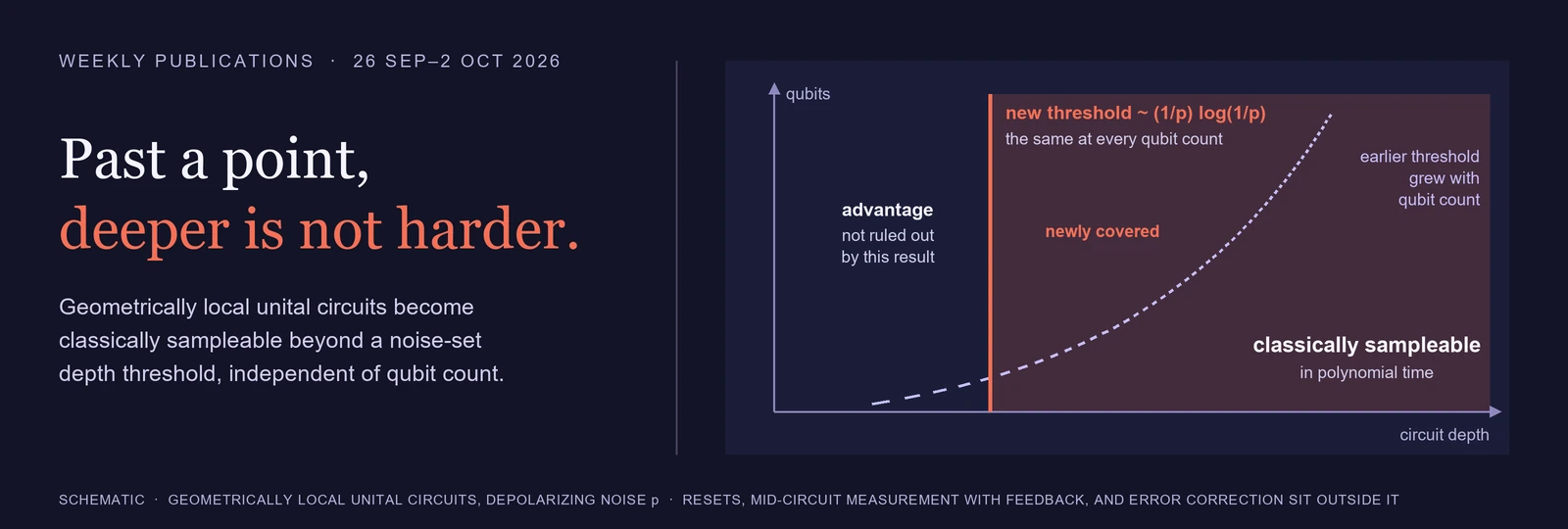
Past a point, deeper is not harder: a schematic of circuit depth against qubit count. An earlier classical-sampling threshold grew with qubit count; the new threshold, scaling as (1/p) log(1/p), is the same at every qubit count, and noisy unital circuits beyond it are classically sampleable in polynomial time under the theorem’s assumptions.

Weekly Publications · September 26 – October 2, 2026

Break-even, dequantization and the control stack

A claimed chemistry break-even on 120 qubits, a new classical-sampling limit for noisy unital circuits, and spin-qubit initialization without local reservoirs. With selected research from IBM, QuEra and RIKEN.

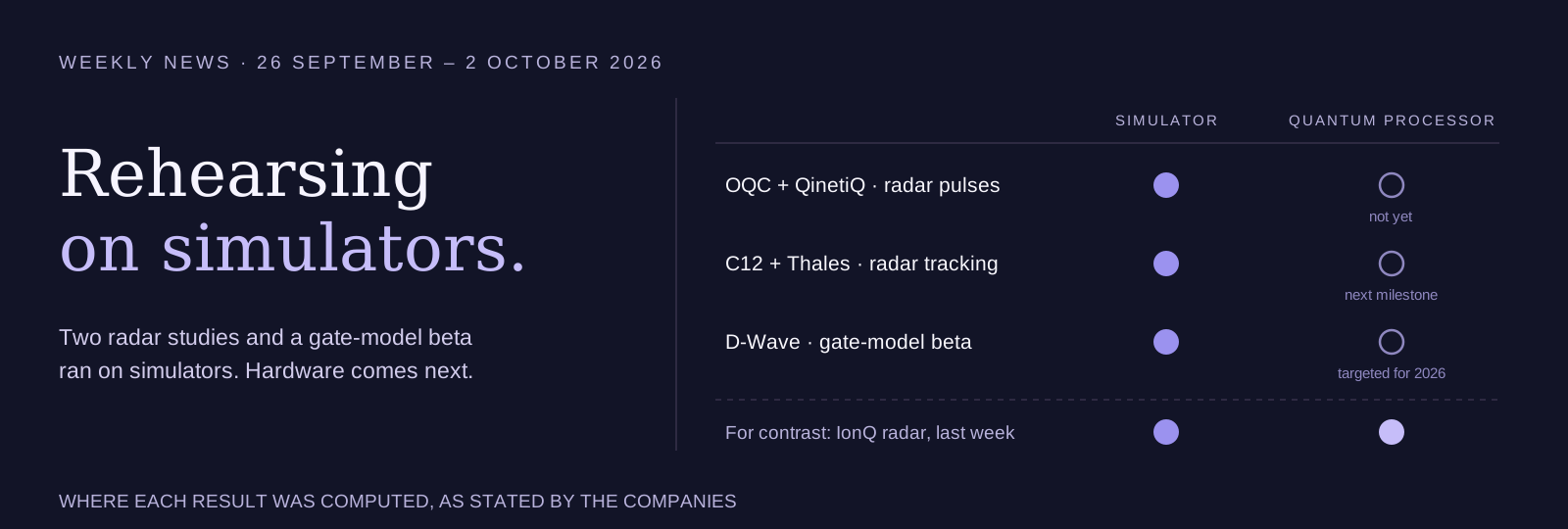
Where each result was computed: OQC and QinetiQ's radar study, C12 and Thales's radar tracking and D-Wave's gate-model beta all ran on simulators, not quantum processors. For contrast, IonQ's radar study the previous week ran on both.

Weekly News · September 26 – October 2, 2026

Rehearsing on simulators

Five takeaways from a week of simulated results, plans for error correction and new institutions: radar studies and a gate-model beta on simulators, tools that let customers work ahead of deployment, Pasqal’s first public month and a shared lab in Albuquerque.

Sep 19–252026

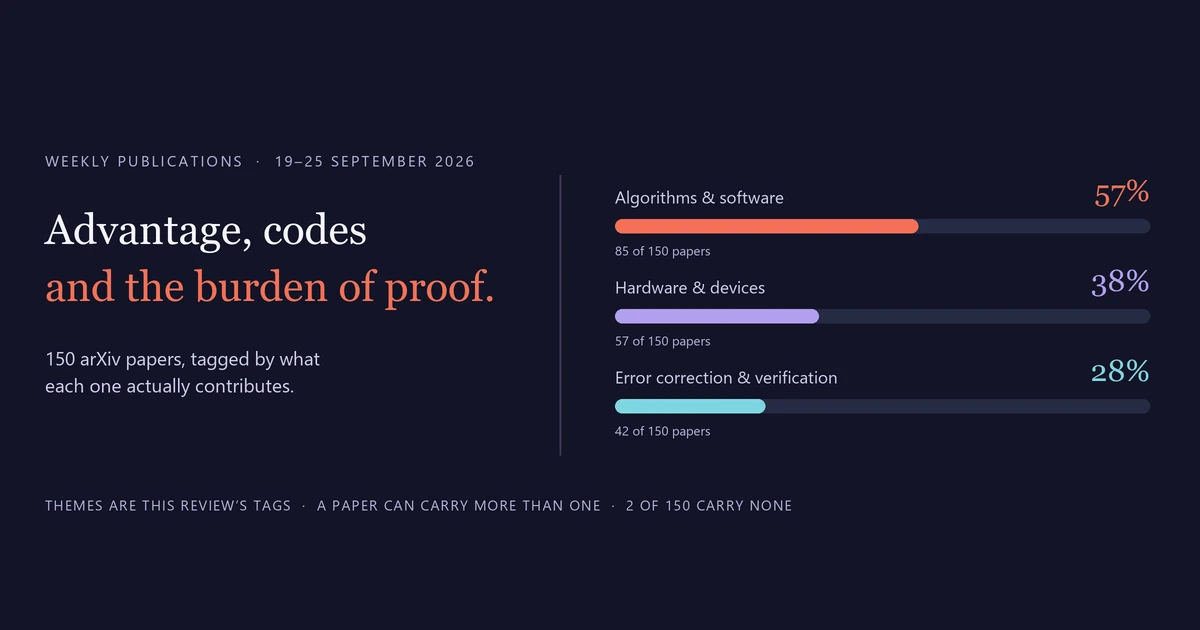
The review title beside three bars: 57% of the week's papers tagged algorithms and software, 38% hardware and devices, 28% error correction and verification.

Weekly Publications · September 19–25, 2026

Advantage, codes and the burden of proof

A quantum advantage claim run through a standard cloud queue, a fast-moving front in new error-correcting codes, and error correction moving into the hardware stack. With selected research from BlueQubit on IBM hardware, MIT and a photonic processor in orbit.

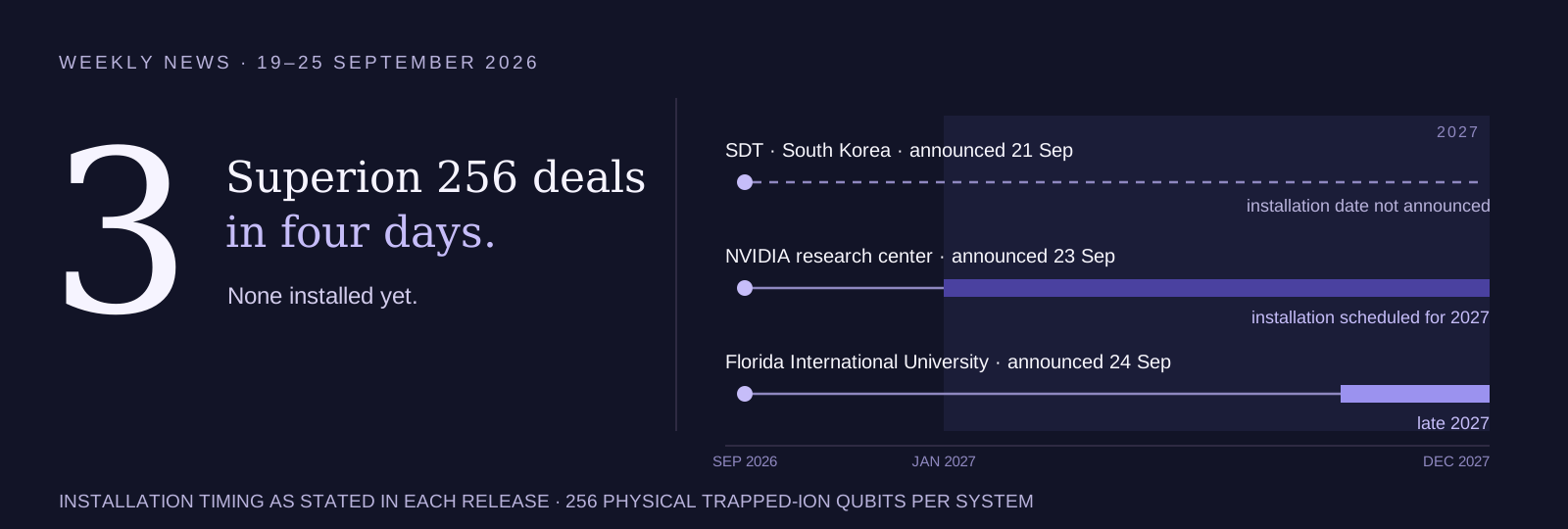
Three Superion 256 deals in four days, none installed yet: SDT in South Korea announced September 21 with no installation date; NVIDIA's research center announced September 23 for installation in 2027; Florida International University announced September 24 for late 2027.

Weekly News · September 19–25, 2026

Signed now, running later

Five takeaways from a week of deals, logical qubits and public money: three IonQ Superion deals, two with 2027 installation dates, 30 logical qubits on Infleqtion’s Sqale, workload-specific results, Germany’s and Maryland’s programs, and half-year numbers.

Sep 12–182026

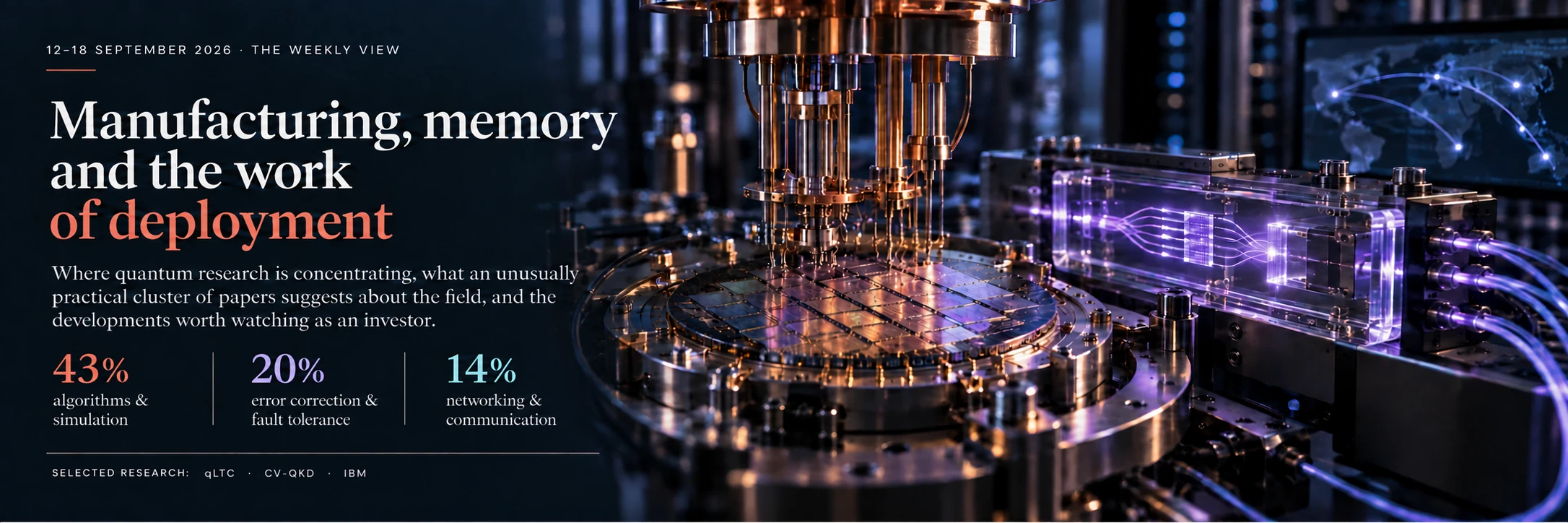
Illustrated wafer under a cryogenic probe assembly beside a glowing photonic module, with the review title and headline percentages.

Weekly Publications · September 12–18, 2026

Manufacturing, memory and the work of deployment

Wafer-scale statistics, a 90% optical memory and quantum signals sharing fiber with 10 Gbps traffic: this week’s research made deployment constraints measurable. With selected research from the University of Illinois, LuxQuanta and IBM.

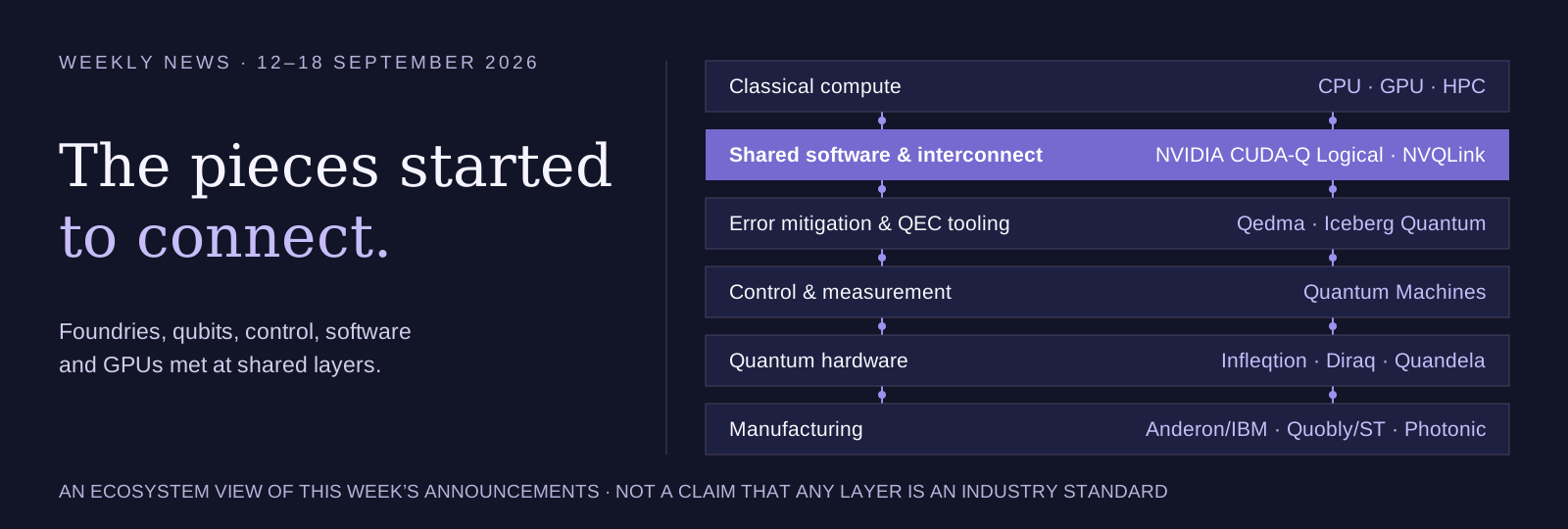
The pieces started to connect: six linked layers of this week’s announcements, from manufacturing (Anderon and IBM, Quobly and STMicroelectronics, Photonic) through quantum hardware, control, error-correction tooling and NVIDIA’s CUDA-Q Logical and NVQLink, up to classical CPU, GPU and HPC computing.

Weekly News · September 12–18, 2026

The week the pieces started to connect

Five takeaways from quantum computing’s push toward shared infrastructure: a common CUDA-Q software layer, 300 mm quantum manufacturing, a hybrid engineering workflow and new regional deployments.

Sep 5–112026

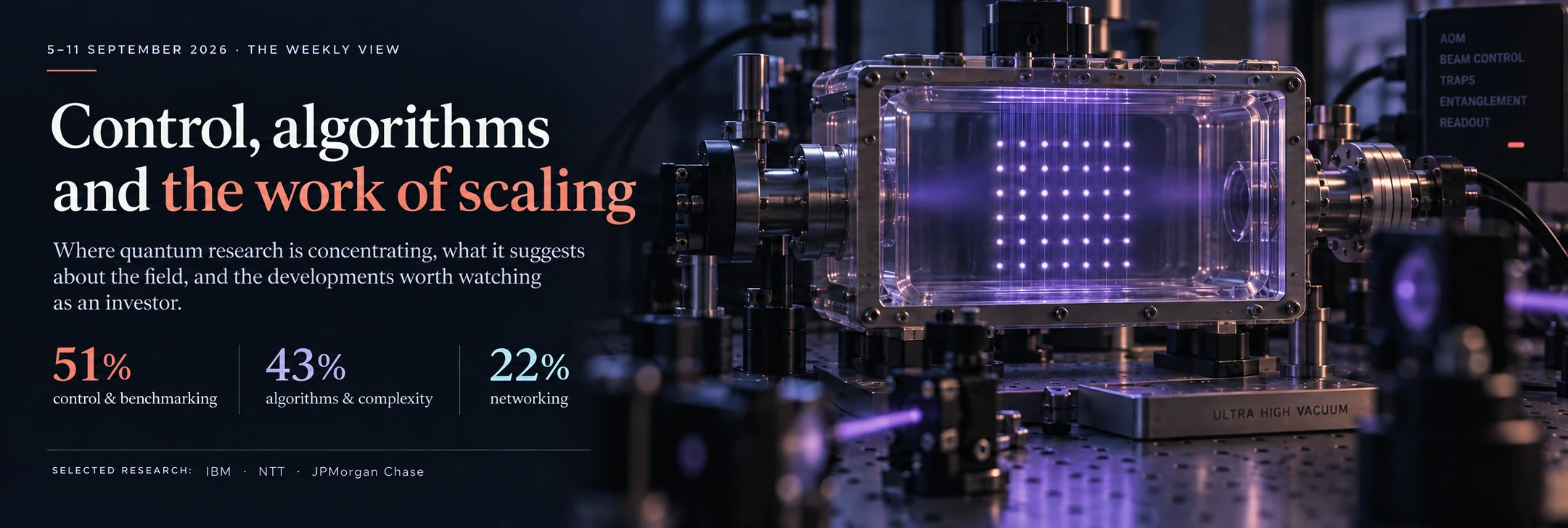
Illustrated vacuum chamber containing a purple-lit array, beside the review title and headline percentages.

Weekly Publications · September 5–11, 2026

Control, algorithms and the work of scaling

The systems around the qubit come into focus: control, the cost of quantum algorithms, and the connections needed to scale. With selected research from IBM, NTT, and JPMorgan Chase.

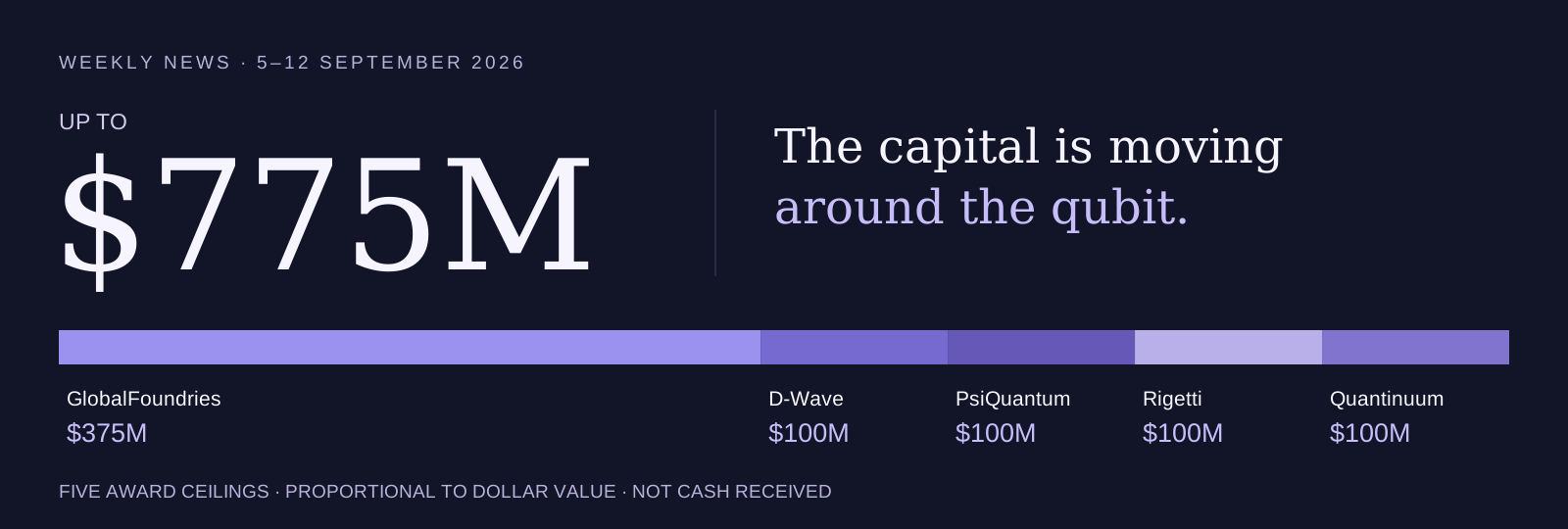
Up to $775 million in five CHIPS awards. GlobalFoundries: $375 million; D-Wave, PsiQuantum, Rigetti and Quantinuum: $100 million each.

Weekly News · September 5–12, 2026

The $775 million week

Six takeaways from quantum computing’s industrial buildout: CHIPS awards, foundries, software integration and the classical control needed to make larger quantum systems work.