October 17 to 23, 2026
A record, a live link and a rule
A week of error-correction records decoded after the fact, quantum-safe links going live, and Washington writing the rules for quantum investment.
Quantum was tested in the lab, in the field and in Washington this week. Quantinuum posted its best error-correction numbers yet but decoded them after the run; a quantum-safe link on IonQ technology went live in Florida; and the Treasury proposed a rule that keeps US quantum investment in China and other countries of concern banned. The question for investors: what is working, and what is still a plan?
Error correction
Error correction gets hard numbers, and a classical bill
Quantinuum: a color-code record, decoded after the run
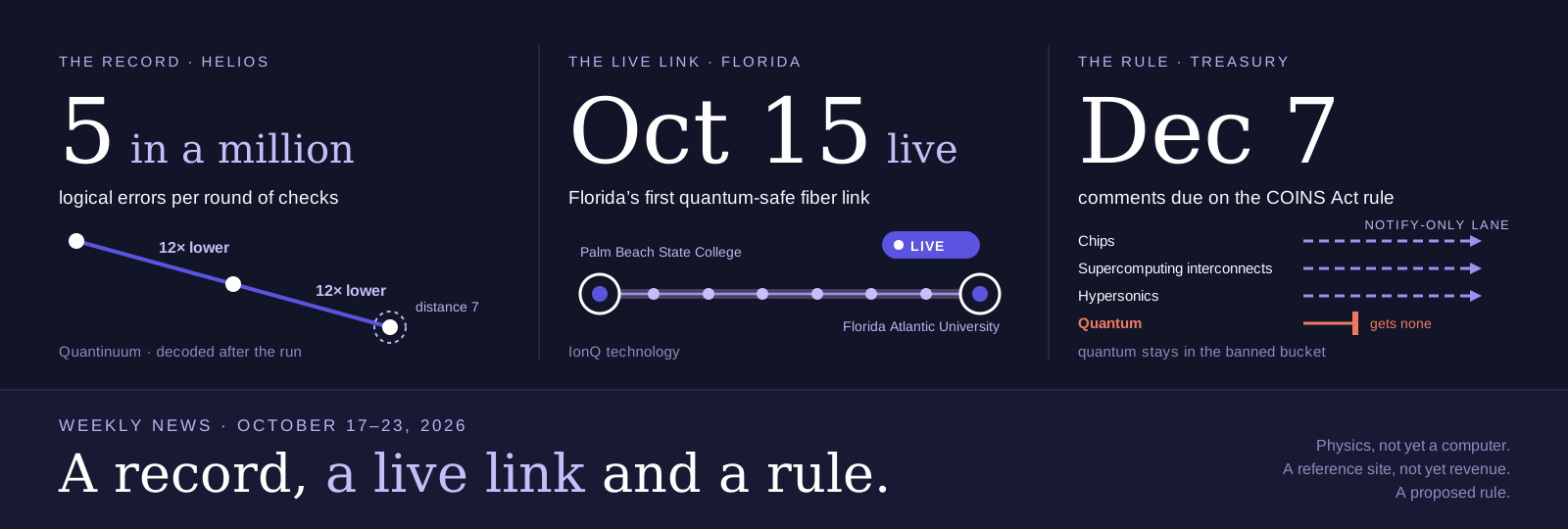
On October 19, Quantinuum reported a color code on its Helios trapped-ion processor with about five logical errors per million rounds of checks, with errors falling about 12 times each time the code grew. The paper adds: “all decoding in this work has been done offline,” like proofreaders who read the pages only after the press stops.
Quantinuum announcement, Oct 19 ↗ · arXiv 2610.24077, Oct 20 ↗
The classical machinery that has to keep pace
SEEQC said a chip-based pre-decoder in front of NVIDIA’s Ising decoder cut decoding latency and logical error rate by about 50%, in a simulated stack. Qblox measured round trips between its controllers and NVIDIA GPUs below 4.0 µs.
SEEQC announcement, Oct 22 ↗ · Qblox announcement, Oct 22 ↗
For investors, the next record that matters is one set while the machine computes. Until then, ask where the decoding happened and who owns the classical stack.
Security
Quantum-safe security goes live before the threat
Florida’s quantum-safe link on IonQ technology
On October 21, Palm Beach State College announced that the first segment of what it calls the nation’s first statewide quantum-safe network went live October 15, linking the college to Florida Atlantic University with IonQ quantum key distribution technology. A $1 million FloridaCommerce grant backs it; IonQ’s share isn’t disclosed. Nodes at Miami Dade College and FAU’s Jupiter campus are planned within about three months.
Post-quantum code on the attackers’ side
On October 21, Kaspersky reported that malware in a campaign it attributes to North Korea’s Lazarus group uses ML-KEM-1024, the NIST post-quantum standard; Kaspersky says the group “seems to have adopted more secure post-quantum cryptography faster than many legitimate security products.”
Kaspersky release, Oct 21 ↗ · Securelist, Oct 21 ↗
The counterweight: how far the threat still is
Iceberg Quantum’s Pinnacle 1.2 estimates RSA-2048 in 3.7 days on about 72,000 physical qubits at a 1 µs cycle, or 32 days on 2.1 million at 1 ms; simulation only, on machines that do not exist yet.
For IonQ, Florida is a reference site, not yet a revenue line; the test is whether the next two nodes arrive on schedule.
Policy
Washington writes the rules and signs the checks
US Treasury. Proposed COINS Act rule; quantum stays prohibited for US investment in China and other countries of concern; comments due December 7. Treasury ↗
OMB. Federal agencies’ post-quantum migration plans due under M-26-15. OMB M-26-15 ↗
DARPA. Xanadu provisionally approved for up to $10 million more under the Quantum Benchmarking Initiative. Xanadu (SEC exhibit) ↗
Treasury: quantum stays in the banned bucket
On October 22, the Treasury proposed the rule implementing the COINS Act, which wrote the outbound-investment program into law in December 2025. Chips, supercomputing interconnects and hypersonics get a notify-only lane; quantum gets none. Quantum computers, critical components “such as a dilution refrigerator or two-stage pulse tube cryocooler,” and software for designing or controlling them would be prohibited, as would quantum networks built to scale up quantum computers or for secure communications such as quantum key distribution. Quantum was already prohibited under the Part 850 rules in force since January 2025; the proposal keeps it there and widens the list. Comments are due December 7, and the current rules stay in force until a final rule.
Treasury release, Oct 22 ↗ · Proposed rule ↗
Plans and contracts
Under OMB memo M-26-15, federal agencies owed the White House their post-quantum migration plans by October 22: plans, not migrations, with inventory the first step. Xanadu said DARPA provisionally approved up to $10 million more under the Quantum Benchmarking Initiative; the company says it may not receive the full amount.
OMB M-26-15 ↗ · Xanadu (SEC exhibit), Oct 19 ↗
For holders of US quantum stocks, the proposed rule changes less than the headline suggests; the money signal is in the agency contracts that follow the plans.
Briefly
Also this week
Sundar Pichai · Oct 21
On the Sources podcast, Google’s CEO said he sees “practical commercial applications in a 5-year time frame,” with Google Cloud negotiating deals then; in February 2025 he said 5 to 10 years.
IBM · Oct 21
Said the $1 billion Commerce Department award for Anderon, its quantum wafer foundry, closed in September; Quantum Day is December 10.
Honeywell · Oct 22
A $147 million third-quarter loss from its Quantinuum stake; its nine-month results include a $6,629 million deconsolidation gain booked earlier in the year, accounting, not cash.
NVIDIA and Jülich · Oct 19
A 104-qubit simulation of magic-state cultivation on 8,192 GPUs, a design tool.
Quantinuum and Oracle · Oct 22
Helios in an OCI beta program.
IQM · Oct 20 to 23
AI calibrated a 20-qubit chip; cloud time for Germany’s DLR via Bechtle; an IQM Spark for Madrid with Telefónica.
Google Quantum AI · Oct 21
A Kaggle competition for smaller, verifiable circuits; deadline not yet confirmed.
Alice & Bob · Oct 20
First PROQCIMA results; logical errors not yet below threshold.
Coherence Quantum · Oct 20
A €2.78 million seed for cryogenic signal conditioning.
Anthropic · Oct 20
Pre-authentication ML-DSA-44 code in OpenSSH 10.4, fixed in 10.6.
Capella Space · Oct 20
Two satellites of the IonQ company launched; radar imaging, not quantum.
This week’s research, with the three papers worth reading, is on the Publications page.
Conclusion
The weekly view
What is working, and what is still a plan? A record decoded after the run is physics, not yet a computer; a live link is a reference site, not yet revenue; a proposed rule mostly restates a ban already in force. The milestone to watch is the first error-correction record set while the machine computes. That is when a plan starts to become a result.
Quantinuum and IQM report third-quarter results.
Comments due on Treasury’s COINS Act rule.
IBM’s Quantum Day, where it promised more detail on its progress.
The next two Florida nodes, if the three-month plan holds.