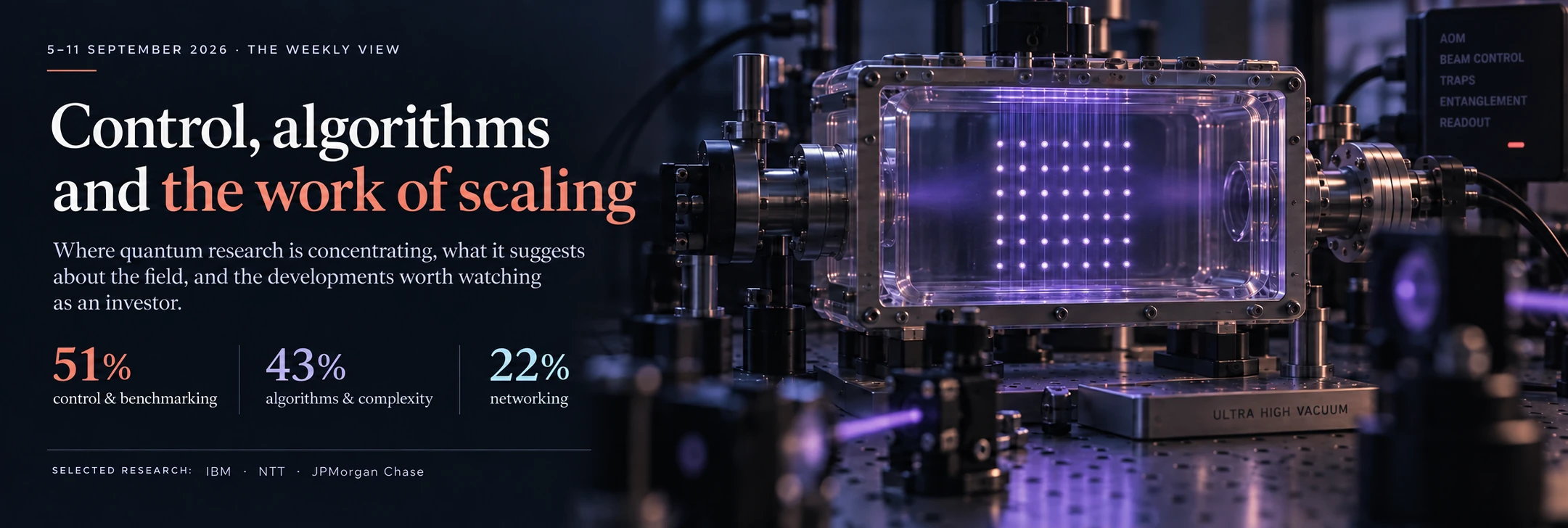
Where quantum research is concentrating, what it suggests about the field, and the developments worth watching as an investor.
84 (51%) control & benchmarking70 (43%) algorithms & complexity36 (22%) networkingSelected research ↓
This week’s review brings the systems around the qubit into focus. Research on control, algorithms and connections between processors features prominently. The common question is practical: what has to work together for a quantum computation to become useful?
The balance of topics suggests a useful focus for investors: how processor performance translates into reliable operations, manageable overhead and credible applications. This issue covers 164 publications. Counts below describe this reviewed collection, with percentages retained in the brief overview to show proportions.
Control is the largest research theme.84 publications address control, readout or benchmarking. This broad category reaches across hardware platforms.
Algorithms bring the cost of execution into focus.70 publications address algorithms and complexity, while 27 address error correction and fault tolerance. Their relationship is central to practical resource requirements.
Connections are part of the scaling problem.36 publications address networking and distributed computing. Its overlap with photonic technology connects communication, integration and processor architecture.
Where the research connects
Counts from 164 reviewed publications
The overlap between leading themes
25 publications fall outside these three themes. Areas, including the overlaps, are proportional to publication counts. Each region shows only its combination of labels.
Technology families
Photonic / continuous-variable36
Superconducting18
Neutral atoms / Rydberg7
Semiconductor / solid-state7
Trapped ions3
010203040
These platform counts also overlap. The photonic category includes communications and continuous-variable work, giving it a broader scope than a single computing platform.
Bars use a common scale from 0 to 40 publications.
Theme totals include overlaps, so a publication can contribute to more than one theme. The seven Venn regions count each publication once; together with the 25 outside these themes, they total 164.
From a promising device to a working system
Control and benchmarking occupy the largest share of this review. The category’s breadth matters: it includes theoretical work as well as measurement and engineering. Its prominence directs attention toward how performance is established and maintained.
For companies, the relevant questions are repeatability, calibration effort and the cost of producing useful results. A headline gate-fidelity figure becomes more informative alongside an account of how the machine behaves over a complete workload.
Algorithms and hardware must meet in the same cost estimate
The large share of algorithmic research puts application claims alongside questions about complexity and implementation. The bridge between them is the complete resource estimate: physical operations, logical qubits, runtime and the overhead of fault tolerance.
Progress can mean discovering a better method or establishing where a hoped-for speedup faces a hard limit. Both help readers assess commercial expectations. The selected JPMorgan Chase research below is an example of the latter.
A wider view of the hardware race
36 publications address photonic and continuous-variable technology; 18 address superconducting technology. The remaining platform counts are smaller in this window. These counts capture the mix of this review and should be read alongside the scope of each category.
Networking’s presence adds another dimension to the race: the ability to connect systems and integrate them into usable infrastructure. My focus for subsequent weeks would be whether research on connectivity, control and error management keeps converging around practical operating constraints.
The research footprint
Countries and regions represented in the review
A global view of participation
Hover, tap, or choose a country or region.
United States32reviewed publications
Reviewed publications
010203040
Not represented in this review
Affiliation locations; a cross-border collaboration can contribute to several countries. Country or region information is available for 148 of 164 reviewed publications. Hong Kong / China (1 publication) is a combined location label and is not shaded on the map. Map: Natural Earth.
The geographic spread is a way to follow where research teams are participating. A stronger longer-term signal would be the recurrence of institutions, collaborations and shared technical priorities.
Corporate research contributes at different points in the system: IBM in dynamic circuits, NTT in photonic error diagnosis, and JPMorgan Chase in the theoretical limits of optimization.
The team demonstrates error detection for dynamic circuits on IBM hardware. The method improves the quality of retained results by identifying and discarding problematic runs.
Why it matters. The commercial question is how better results balance against the extra executions needed. This is a system-level trade-off to watch as IBM develops useful workloads.
NTT Basic Research Laboratories and Toyota Central R&D Labs.
Understanding the errors in a photonic system
The researchers combine a physical model with parameter optimization to identify error sources in entangled photon states, then test the predicted improvements.
Why it matters. More reliable error diagnosis could help with calibration and operation. The follow-up is whether the approach transfers reliably across devices and conditions.
JPMorgan Chase Global Technology Applied Research co-authors
Finding the limits of quantum optimization
This theoretical study establishes lower bounds on quantum queries for a specified class of high-accuracy convex optimization problems.
Why it matters. For investors following financial applications, useful evidence includes limits on potential speedups. The result helps frame which assumptions an application claim must satisfy.
The next useful comparison is whether these themes persist: a sustained focus on operating reliability, more realistic estimates of application costs, and progress in connecting quantum systems. Repeated evidence across comparable weeks would make those observations more informative.
This issue provides a baseline. As the series grows, the emphasis will be on changes in the balance of research and their implications for companies. The Research Board provides the wider context for the technologies and businesses involved.