Five takeaways from a week of simulated results, plans for error correction and new institutions.
Last week’s report followed IonQ’s Superion deals: signed now, running later. This week the rehearsals moved onto simulators. Two defense radar studies and D-Wave’s gate-model beta ran on classical machines standing in for quantum ones, and a new planning tool sizes fault-tolerant computers that do not exist yet. Around them, error correction moved into partnerships and roadmaps, Pasqal finished its first month as a public company, and New Mexico opened a shared quantum lab.
Much of the week was practice for hardware that is still being built.
01
Applications
Two radar studies, both on simulators
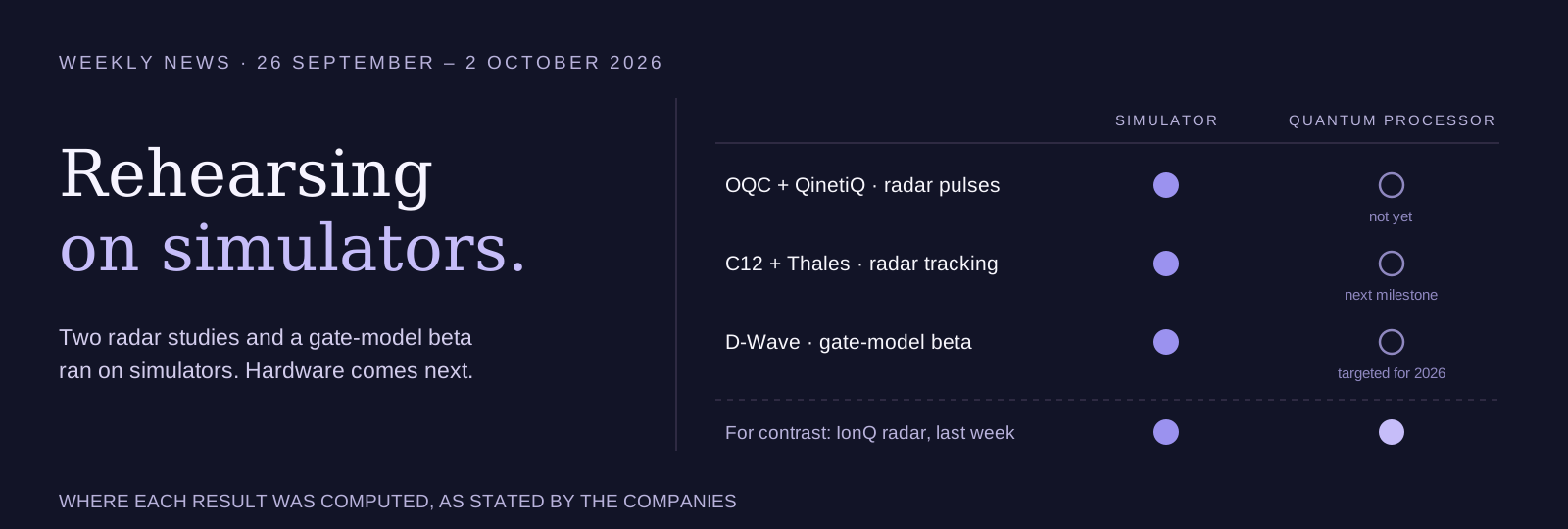
Defense radar was the week’s favorite application, and both studies stopped short of quantum hardware. Last week IonQ’s radar model ran on a real processor; this week’s results sit one step earlier on the same path.
OQC · QinetiQ
Separating mixed radar pulses
Ran on: OQC’s Toshiko simulator
Sorting pulses from several emitters that arrive at once. The hybrid pipeline produced a higher overall V-measure, a combined clustering score, than an Alan Turing Institute benchmark and an equivalent classical model. Completeness improved, while homogeneity dipped slightly.
Tracking many targets at once, for air defense and drone-traffic management. End-to-end run time is estimated at about 50 milliseconds under the companies’ assumptions, including an active qubit-reset protocol. The next milestone is a demonstration on C12’s physical processor.
The investor question: do these radar workflows keep their edge once they move from simulators onto noisy hardware?
02
Products
Working ahead of deployment
Three launches let customers prepare before full deployment, each in a different way: a simulator available now for D-Wave’s planned gate-model hardware, QCi’s Dirac-3S optimizer hardware shipping from November, and Classiq’s planning software for fault-tolerant machines that do not exist yet.
QCi’s optimizer capacityProblem variables, company figures · one 0–10,000 scale
Current QCi system
1,000
Dirac-3S · first shipments November 2026
~10,000
02,5005,0007,50010,000
QCi says Dirac-3S was the only solver it tested to reach the optimum on every synthetic instance it tested, against Projected Gradient Descent and the commercial solver Hexaly. These are company-reported benchmarks, not independent verification. QCi · 1 October ↗
Simulator beta · 17-qubit hardware targeted for 2026
D-Wave gate-model beta
A simulator, not a processor: it models D-Wave’s planned dual-rail superconducting gate-model hardware, whose roadmap targets a 17-physical-qubit system in 2026. Access is through its Leap cloud and Ocean software. First users: BBVA, FirstQFM, Florida Atlantic University and the Jülich Supercomputing Centre.
Turns a logical program into a fault-tolerant execution plan and estimates the physical qubits, error-correction cycles, code distance, run time and accumulated error it would need.
Error correction moves into plans and partnerships
No new error-corrected computation this week, but the plans got more specific. QuEra put dates on its fault-tolerance roadmap.
QuEra’s neutral-atom roadmap · Libra is a target, not a result
2022
Aquila
The first generation on QuEra’s roadmap.
2025
Gemini
The second generation.
2028
Libra · target
QuEra says it is targeting fault tolerance by late 2027 or early 2028. Libra is designed, in QuEra’s words, to perform “a million quantum calculations without a single error”: a design goal, not a measured result. QuEra says it will be the first fault-tolerant computer on Amazon Braket.
The two will explore pairing Riverlane’s real-time error-correction tools, Deltaflow and Deltakit, with Infleqtion’s neutral-atom platform, Superstaq compiler and qLDPC library. A workshop comes first, to define possible demonstrators for the UK’s quantum-computing programme.
Alice & Bob and ENS Lyon demonstrated two-photon dissipation, the mechanism that stabilizes cat qubits, driven by a steady DC voltage instead of the usual microwave signal. It is a new tool for building cat qubits, not a stabilized cat qubit itself. Voltage lines are compact, easy to wire and produce little heat inside the refrigerator, the company says.
Outside reviewers of Infleqtion’s 30-logical-qubit result stressed the same caveat: errors were detected and those runs discarded, so the test of active error correction is still ahead. One such review ↗
04
Public markets
Pasqal’s first month as a public company
Listed on Nasdaq in August, Pasqal spent September building the basics of a public company and resetting its relationship with the French state.
Pasqal since listingCompany announcements and filings
Lists on Nasdaq as PSQL.
First-half results: €4.9 million revenue, €59.2 million operating loss. Last week’s report
Ends its part in France’s LSQUARE (PROQCIMA) defense program after completing the first phase’s technical objectives. French agencies SGPI and DGE asked it to propose a civil R&D program for neutral-atom fault-tolerant computing: a request, not an award. Release ↗
Appoints Florence Lao, formerly general counsel of Deezer, as Chief Legal Officer.
Appoints Roger L. Chuchen, formerly of AudioCodes, to build its investor-relations function. Release ↗
The investor question: can a civil fault-tolerance program replace the defense track, and on what terms?
05
Infrastructure
A shared quantum lab opens in Albuquerque
Last week it was Maryland; this week, New Mexico. The Roadrunner Quantum Lab gives startups shared dilution refrigerators, a multi-node quantum network and a testbed, so they do not each have to build their own.
Networking · EU funding
€47.5M for QIA
The Quantum Internet Alliance’s next 42-month phase, with more than 50 institutions, aims to link two metropolitan quantum networks over long-distance fiber using quantum repeaters. Qblox builds the control stack.
A multi-million-dollar development partnership on a modular cryogenic prototype, intended as an alternative to industrial-scale cryoplants in future quantum data centers. The goal is a mass-manufacturable module for photon detectors.
Access to CEA-Leti’s FAMES pilot line for new process flows, alongside Quobly’s existing STMicroelectronics partnership. The announcement gives no new technical result or funding amount.
Last week the deals arrived before the machines. This week much of the application work happened on simulators, while products, planning tools and error-correction roadmaps moved ahead of the hardware they target. Pasqal and New Mexico spent the week building institutions.
For the simulator-backed claims, the next test is whether the same workloads survive on real processors.