
Xanadu + AMD · Backline
<3 µs
Company-reported sub-3 µs end-to-end control latency, including configurations using standard AMD CPUs.
5–12 September 2026
Six takeaways from quantum computing’s industrial buildout.
The interesting news this week was the machinery around the qubits: foundries, fabrication, control electronics, cryogenics, photonics and software. Governments and companies are building the industrial infrastructure they expect larger quantum computers to need.
The factory is arriving before the product. That is the central reading of this week’s announcements. Funding, prototypes and roadmaps show where the industry is investing; useful quantum computation still has more to prove.
Capital & supply chains
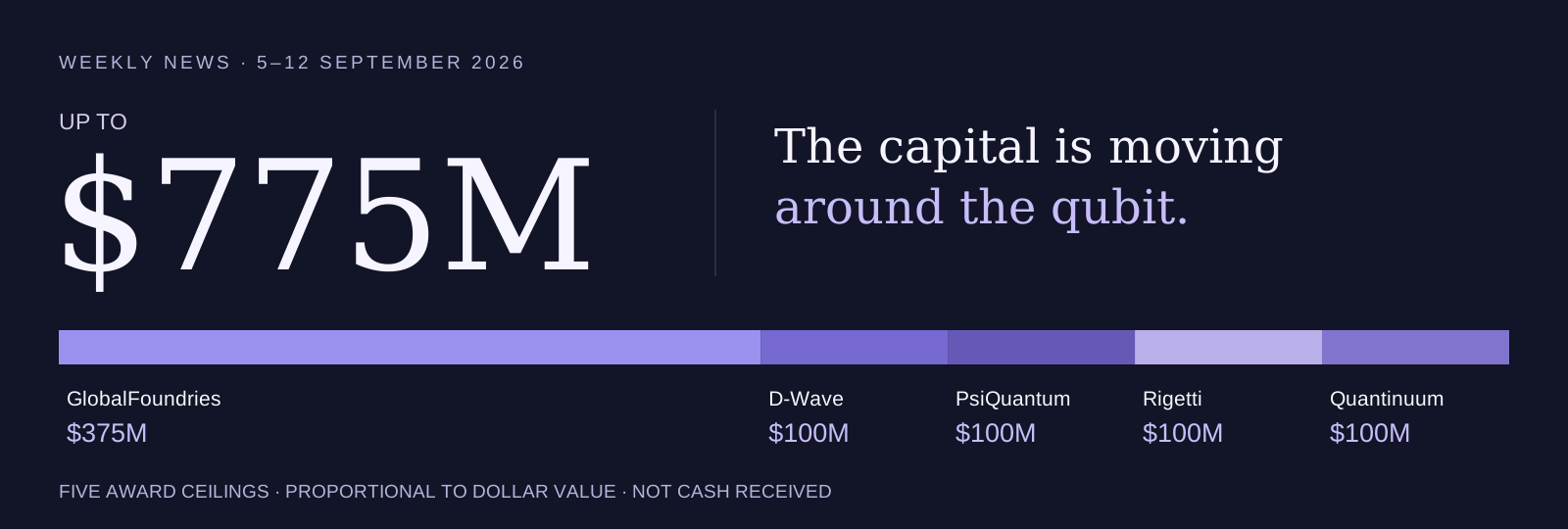
Five finalized CHIPS awards put manufacturing at the center of the week. GlobalFoundries accounts for up to $375 million; D-Wave, PsiQuantum, Rigetti and Quantinuum account for up to $100 million each.
The programs reach into fabrication, packaging, optical components, cryogenics and control electronics. The common problem is repeatability: turning an excellent laboratory device into a process with controlled yield, cost and variation.
The investor question: can industrial capacity turn into reliable, economical production?
Quantum semiconductor manufacturing capacity intended to serve several hardware approaches.
Manufacturing and engineering for both annealing and gate-model superconducting roadmaps.
Optical switches, single-photon detectors and advanced packaging for photonic systems.
Readout electronics, expanded cryogenic capacity and chip fabrication.
Next-generation ion traps and electronics with GlobalFoundries using 300 mm wafers, plus lasers and optical components with Monarch Quantum.
All bars share a $0–400 million scale. These are maximum award amounts, not cash already received or company revenue.
The software layer
Alice & Bob and Hyperion Research’s work, informed by interviews with 15 HPC practitioners, points to the integration work still ahead. Compilers, schedulers, data exchange and familiar workflows all need to be ready when the hardware arrives.
Deploying an immature software stack could weaken confidence in quantum computing. A processor in a refrigerator becomes useful only when the surrounding computing environment can operate it.
A simplified dependency diagram, not a product architecture.
Classical control
Measurement, decoding and feedback must keep pace with the quantum machine. A fast link is one part of the complete cycle.
Xanadu + AMD · Backline
Company-reported sub-3 µs end-to-end control latency, including configurations using standard AMD CPUs.
Qblox + Riverlane · Full QEC loop
Company-reported round trips from Surface-17 to Surface-161, including readout integration. Physical control hardware used emulated qubit measurement data.
Different scopes and setups: these figures are not a like-for-like speed ranking. Qblox’s separate sub-650 ns figure describes LINQ cluster-wide feedback; it is not the duration of the complete QEC loop. Neither result by itself demonstrates a fault-tolerant quantum computer.
Manufacturing
SkyWater Quantum Solutions offers a merchant foundry route from custom development toward repeatable manufacturing. Initial processes cover superconducting and cryogenic integration and silicon-nitride photonics, with Qolab an early customer. Yield, cost and repeatability still have to be demonstrated.
Owned manufacturing
IonQ owns the foundry. SkyWater can serve both its parent and outside customers.
Foundry announcement ↗Process collaboration
The collaboration targets photonic-chip fabrication imperfections and optical loss. No loss improvement was demonstrated in the announcement.
Collaboration announcement ↗Marks show the guidance ranges on a common $0–500 million scale. The new outlook includes SkyWater from 31 July 2026 and eliminates intercompany revenue. This comparison is not organic growth. IonQ’s guidance update ↗
IonQ also reports that its first integrated 256-qubit QPUs have been fabricated at SkyWater and that ions have been trapped in prototype Superion systems. Customer deliveries are a 2027 target. Superion announcement ↗
Competing architectures
Tin-vacancy centers integrated with photonic circuits
Fujitsu’s reported operating temperature is warmer than the millikelvin regime of superconducting processors. That may relax part of the cooling burden, but it does not establish a system-level advantage.
Roadmaps & results
IQM’s LUMI-IQ plan describes staged deployment through 2029. These are announced targets, not results achieved during this review week.
Halocene H4 installation with early error-correction capabilities.
Upgrades aimed at lower logical error rates and faster feedback.
Halocene H5 with full logical operations.
Physical and logical qubits are different units of capability. IQM’s deployment plan ↗ · What is a logical qubit?
Across the announcements covered here, I found no comparable new breakthrough in demonstrated logical-qubit performance, or a new quantum-advantage demonstration that changed the near-term computing picture. That is an observation about this review’s coverage, not an exhaustive count of everything published worldwide.
The weekly view
Manufacturing capacity, faster classical control and deeper HPC integration are advancing. Many performance claims remain company-reported, and the largest milestones are still future targets.
The industry is building the factory around the quantum computer. Now the quantum computer has to justify the factory.