
← All publication reviewsWeekly Publications

November 7 to 13, 2026 · The weekly view

Faster decoders, AI programs
and chemistry runs

Many groups worked on decoding errors fast enough, AI agents designed and proved quantum programs while fair baselines erased most gains from quantum layers in AI models, and chemistry runs leaned on classical supercomputers.

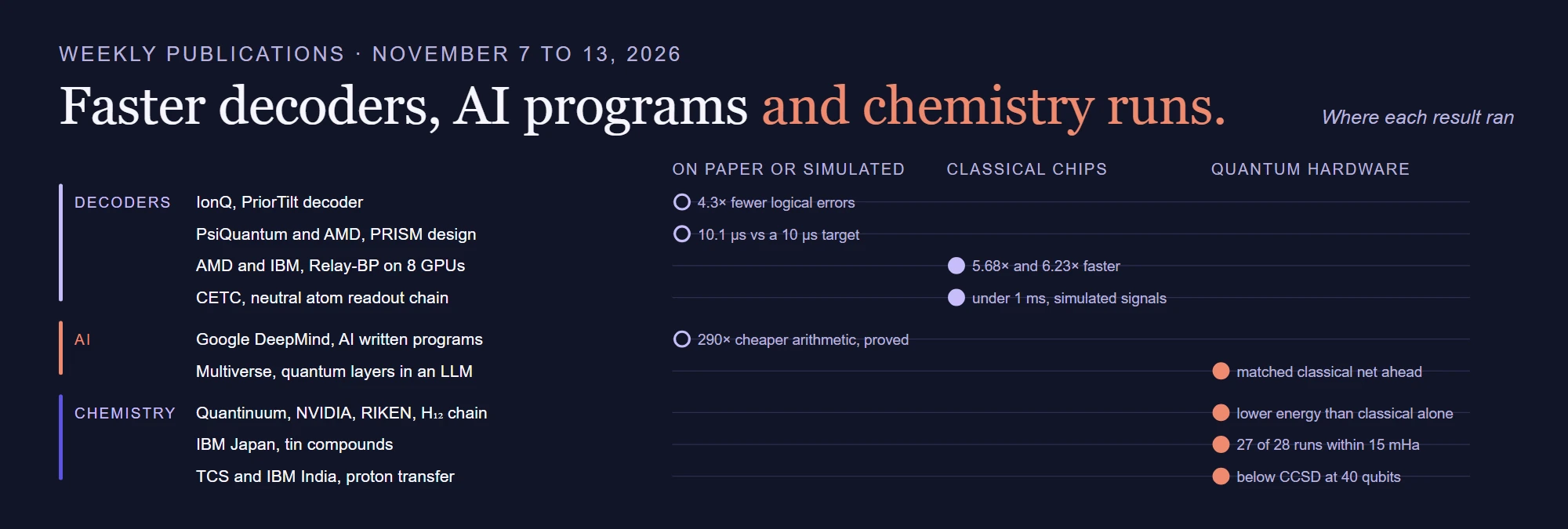
Faster decoders, AI programs and chemistry runs: Weekly Publications for November 7 to 13, 2026. A table shows where each highlighted result ran. On paper or in simulation: IonQ's PriorTilt decoder with 4.3 times fewer logical errors, PsiQuantum and AMD's PRISM design at 10.1 microseconds against a 10 microsecond target, and Google DeepMind's AI written programs with 290 times cheaper arithmetic, proved. On classical chips: AMD and IBM's Relay-BP decoder on eight GPUs, 5.68 and 6.23 times faster, and CETC's neutral atom readout chain, under 1 millisecond with simulated signals. On quantum hardware: Multiverse's quantum layers in a language model, where a matched classical network stayed ahead, and chemistry runs from Quantinuum, NVIDIA and RIKEN, IBM Japan, and TCS with IBM India.
55% algorithms & software51% hardware & devices32% error correction & verificationSelected research ↓

I went through the work I collected from arXiv’s listings this week and looked for the connections between papers. It is a selected research corpus, not a count of all quantum papers published worldwide. The charts cover its quantum technology subset, about half of the week's listings, and the themes overlap: 55% of that subset concerns algorithms or software, 51% hardware or devices, and 32% error correction or verification. Every highlight below is an arXiv preprint.

Three results frame the week.

  1. Decoders, the classical programs that find errors in real time, got faster and more accurate, but mostly in simulation rather than on a running quantum computer.IonQ · AMD Research and IBM Research · Shanghai Zhongqi Wuliang Quantum Technology and CETC · Simulation and classical hardware benchmarks
  2. AI agents wrote quantum programs and proved them correct and cheaper, while quantum layers inside AI models did not beat matched classical baselines.Google DeepMind and Google Quantum AI · Multiverse Computing and the University of Toronto · Theory with formal proofs; simulation and a hardware run
  3. Chemistry on current machines left the heavy calculation to classical computers, and no result is yet a clean win over the best classical methods.Quantinuum, NVIDIA and RIKEN · IBM Japan, Mitsubishi Chemical and Keio University · TCS Research and IBM Research India · Experiments

Where the research connects

Shares of the quantum technology subset of collected arXiv work

The overlap between this week’s themes

Proportional overlap between three leading research themesAreas, including all seven overlap regions, are approximately proportional to each region’s share of the quantum technology subset. Algorithms and software only: 27%; Hardware and devices only: 29%; Algorithms and hardware, without error correction: 12%; Algorithms and error correction, without hardware: 13%; Hardware and error correction, without algorithms: 6%; All three themes: 3%; Error correction and verification only: 9%. Outside these themes: 0%.Algorithms & software55% of the subsetHardware & devices51% of the subsetError correction & verification32% of the subsetAlgorithms and software only: 27% of the subset27%Hardware and devices only: 29% of the subset29%Algorithms and hardware, without error correction: 12% of the subset12%Algorithms and error correction, without hardware: 13% of the subset13%Hardware and error correction, without algorithms: 6% of the subset6%All three themes: 3% of the subset3%Error correction and verification only: 9% of the subset9%
Share base: the quantum technology subset of this week’s collected arXiv work. Areas, including the overlaps, are approximately proportional to the theme shares. Labels are rounded percentages of that subset. Each region shows only its combination of labels.

Hardware papers, by platform

  • Cross-platform or unassigned30%
  • Photonics30%
  • Superconducting23%
  • Neutral atoms6%
  • Semiconductor & spin6%
  • Other hardware3%
  • Trapped ions2%

Every paper in the hardware & devices theme, counted once under its primary platform, so the shares add up to 100%.

Bars show each platform’s share of the hardware theme, on a common scale from 0 to 30%.

The charts share one base: the quantum technology subset of the arXiv work I collected, about half of the week's listings, with foundations, many body physics and mathematics papers outside it. Within it there are three overlapping editorial themes: 55% algorithms and software, 51% hardware and devices, and 32% error correction and verification. One paper can belong to more than one theme, so the shares add to more than 100%. These are topic shares, not an assessment of scientific maturity or a comparison with last week. The platform chart covers only work tagged hardware and devices, including device studies, sensing and networking experiments, and control research. Unassigned work stays unassigned rather than being forced into a technology.

The research footprint

Verified affiliation shares within the resolved subset

A global view of participation

72% coverage of the quantum technology subset of collected arXiv work. Shares below cover only fully resolved author country sets. Hover, tap, or choose a country or region.

United States32%of the fully resolved subset · 72% coverage
Verified author affiliation shares by country and regionDarker purple means a larger percentage within the fully resolved author country subset, covering 72% of the quantum technology subset of collected arXiv work. Gray is no verified affiliation in this subset, not an absence of research. A paper may contribute to multiple countries. No comparison with last week.Afghanistan: no verified affiliation in the resolved subset; not an absence of researchAlbania: no verified affiliation in the resolved subset; not an absence of researchAlgeria: no verified affiliation in the resolved subset; not an absence of researchAmerican Samoa: no verified affiliation in the resolved subset; not an absence of researchAndorra: no verified affiliation in the resolved subset; not an absence of researchAngola: no verified affiliation in the resolved subset; not an absence of researchAnguilla: no verified affiliation in the resolved subset; not an absence of researchAntigua and Barb.: no verified affiliation in the resolved subset; not an absence of researchArgentina: no verified affiliation in the resolved subset; not an absence of researchArmenia: no verified affiliation in the resolved subset; not an absence of researchAruba: no verified affiliation in the resolved subset; not an absence of researchAshmore and Cartier Is.: no verified affiliation in the resolved subset; not an absence of researchAustralia: 2% of the fully resolved subsetAustria: 2% of the fully resolved subsetAzerbaijan: no verified affiliation in the resolved subset; not an absence of researchBahamas: no verified affiliation in the resolved subset; not an absence of researchBahrain: no verified affiliation in the resolved subset; not an absence of researchBangladesh: 1% of the fully resolved subsetBarbados: no verified affiliation in the resolved subset; not an absence of researchBelarus: no verified affiliation in the resolved subset; not an absence of researchBelgium: no verified affiliation in the resolved subset; not an absence of researchBelize: no verified affiliation in the resolved subset; not an absence of researchBenin: no verified affiliation in the resolved subset; not an absence of researchBermuda: no verified affiliation in the resolved subset; not an absence of researchBhutan: no verified affiliation in the resolved subset; not an absence of researchBolivia: no verified affiliation in the resolved subset; not an absence of researchBosnia and Herz.: no verified affiliation in the resolved subset; not an absence of researchBotswana: no verified affiliation in the resolved subset; not an absence of researchBr. Indian Ocean Ter.: no verified affiliation in the resolved subset; not an absence of researchBrazil: 4% of the fully resolved subsetBritish Virgin Is.: no verified affiliation in the resolved subset; not an absence of researchBrunei: no verified affiliation in the resolved subset; not an absence of researchBulgaria: no verified affiliation in the resolved subset; not an absence of researchBurkina Faso: no verified affiliation in the resolved subset; not an absence of researchBurundi: no verified affiliation in the resolved subset; not an absence of researchCabo Verde: no verified affiliation in the resolved subset; not an absence of researchCambodia: no verified affiliation in the resolved subset; not an absence of researchCameroon: no verified affiliation in the resolved subset; not an absence of researchCanada: 4% of the fully resolved subsetCayman Is.: no verified affiliation in the resolved subset; not an absence of researchCentral African Rep.: no verified affiliation in the resolved subset; not an absence of researchChad: no verified affiliation in the resolved subset; not an absence of researchChile: 1% of the fully resolved subsetChina: 20% of the fully resolved subsetColombia: no verified affiliation in the resolved subset; not an absence of researchComoros: no verified affiliation in the resolved subset; not an absence of researchCongo: no verified affiliation in the resolved subset; not an absence of researchCook Is.: no verified affiliation in the resolved subset; not an absence of researchCosta Rica: no verified affiliation in the resolved subset; not an absence of researchCroatia: no verified affiliation in the resolved subset; not an absence of researchCuba: no verified affiliation in the resolved subset; not an absence of researchCuraçao: no verified affiliation in the resolved subset; not an absence of researchCyprus: no verified affiliation in the resolved subset; not an absence of researchCzechia: 1% of the fully resolved subsetCôte d'Ivoire: no verified affiliation in the resolved subset; not an absence of researchDem. Rep. Congo: no verified affiliation in the resolved subset; not an absence of researchDenmark: 2% of the fully resolved subsetDjibouti: no verified affiliation in the resolved subset; not an absence of researchDominica: no verified affiliation in the resolved subset; not an absence of researchDominican Rep.: no verified affiliation in the resolved subset; not an absence of researchEcuador: no verified affiliation in the resolved subset; not an absence of researchEgypt: no verified affiliation in the resolved subset; not an absence of researchEl Salvador: no verified affiliation in the resolved subset; not an absence of researchEq. Guinea: no verified affiliation in the resolved subset; not an absence of researchEritrea: no verified affiliation in the resolved subset; not an absence of researchEstonia: no verified affiliation in the resolved subset; not an absence of researchEthiopia: no verified affiliation in the resolved subset; not an absence of researchFaeroe Is.: no verified affiliation in the resolved subset; not an absence of researchFalkland Is.: no verified affiliation in the resolved subset; not an absence of researchFiji: no verified affiliation in the resolved subset; not an absence of researchFinland: 1% of the fully resolved subsetFr. Polynesia: no verified affiliation in the resolved subset; not an absence of researchFr. S. Antarctic Lands: no verified affiliation in the resolved subset; not an absence of researchFrance: 4% of the fully resolved subsetGabon: no verified affiliation in the resolved subset; not an absence of researchGambia: no verified affiliation in the resolved subset; not an absence of researchGeorgia: no verified affiliation in the resolved subset; not an absence of researchGermany: 14% of the fully resolved subsetGhana: no verified affiliation in the resolved subset; not an absence of researchGreece: no verified affiliation in the resolved subset; not an absence of researchGreenland: no verified affiliation in the resolved subset; not an absence of researchGrenada: no verified affiliation in the resolved subset; not an absence of researchGuam: no verified affiliation in the resolved subset; not an absence of researchGuatemala: no verified affiliation in the resolved subset; not an absence of researchGuernsey: no verified affiliation in the resolved subset; not an absence of researchGuinea: no verified affiliation in the resolved subset; not an absence of researchGuinea-Bissau: no verified affiliation in the resolved subset; not an absence of researchGuyana: no verified affiliation in the resolved subset; not an absence of researchHaiti: no verified affiliation in the resolved subset; not an absence of researchHeard I. and McDonald Is.: no verified affiliation in the resolved subset; not an absence of researchHonduras: no verified affiliation in the resolved subset; not an absence of researchHong Kong: 4% of the fully resolved subsetHungary: no verified affiliation in the resolved subset; not an absence of researchIceland: no verified affiliation in the resolved subset; not an absence of researchIndia: 6% of the fully resolved subsetIndian Ocean Ter.: no verified affiliation in the resolved subset; not an absence of researchIndonesia: 1% of the fully resolved subsetIran: 2% of the fully resolved subsetIraq: no verified affiliation in the resolved subset; not an absence of researchIreland: no verified affiliation in the resolved subset; not an absence of researchIsle of Man: no verified affiliation in the resolved subset; not an absence of researchIsrael: 2% of the fully resolved subsetIsrael: 2% of the fully resolved subsetItaly: 5% of the fully resolved subsetJamaica: no verified affiliation in the resolved subset; not an absence of researchJapan: 4% of the fully resolved subsetJersey: no verified affiliation in the resolved subset; not an absence of researchJordan: no verified affiliation in the resolved subset; not an absence of researchKazakhstan: no verified affiliation in the resolved subset; not an absence of researchKenya: no verified affiliation in the resolved subset; not an absence of researchKiribati: no verified affiliation in the resolved subset; not an absence of researchKosovo: no verified affiliation in the resolved subset; not an absence of researchKuwait: no verified affiliation in the resolved subset; not an absence of researchKyrgyzstan: no verified affiliation in the resolved subset; not an absence of researchLaos: no verified affiliation in the resolved subset; not an absence of researchLatvia: no verified affiliation in the resolved subset; not an absence of researchLebanon: no verified affiliation in the resolved subset; not an absence of researchLesotho: no verified affiliation in the resolved subset; not an absence of researchLiberia: no verified affiliation in the resolved subset; not an absence of researchLibya: no verified affiliation in the resolved subset; not an absence of researchLiechtenstein: no verified affiliation in the resolved subset; not an absence of researchLithuania: no verified affiliation in the resolved subset; not an absence of researchLuxembourg: no verified affiliation in the resolved subset; not an absence of researchMacao: 1% of the fully resolved subsetMacedonia: no verified affiliation in the resolved subset; not an absence of researchMadagascar: no verified affiliation in the resolved subset; not an absence of researchMalawi: no verified affiliation in the resolved subset; not an absence of researchMalaysia: no verified affiliation in the resolved subset; not an absence of researchMaldives: no verified affiliation in the resolved subset; not an absence of researchMali: no verified affiliation in the resolved subset; not an absence of researchMalta: no verified affiliation in the resolved subset; not an absence of researchMarshall Is.: no verified affiliation in the resolved subset; not an absence of researchMauritania: no verified affiliation in the resolved subset; not an absence of researchMauritius: no verified affiliation in the resolved subset; not an absence of researchMexico: no verified affiliation in the resolved subset; not an absence of researchMicronesia: no verified affiliation in the resolved subset; not an absence of researchMoldova: no verified affiliation in the resolved subset; not an absence of researchMonaco: no verified affiliation in the resolved subset; not an absence of researchMongolia: no verified affiliation in the resolved subset; not an absence of researchMontenegro: no verified affiliation in the resolved subset; not an absence of researchMontserrat: no verified affiliation in the resolved subset; not an absence of researchMorocco: no verified affiliation in the resolved subset; not an absence of researchMozambique: no verified affiliation in the resolved subset; not an absence of researchMyanmar: no verified affiliation in the resolved subset; not an absence of researchN. Cyprus: no verified affiliation in the resolved subset; not an absence of researchN. Mariana Is.: no verified affiliation in the resolved subset; not an absence of researchNamibia: no verified affiliation in the resolved subset; not an absence of researchNauru: no verified affiliation in the resolved subset; not an absence of researchNepal: no verified affiliation in the resolved subset; not an absence of researchNetherlands: 4% of the fully resolved subsetNew Caledonia: no verified affiliation in the resolved subset; not an absence of researchNew Zealand: no verified affiliation in the resolved subset; not an absence of researchNicaragua: no verified affiliation in the resolved subset; not an absence of researchNiger: no verified affiliation in the resolved subset; not an absence of researchNigeria: no verified affiliation in the resolved subset; not an absence of researchNiue: no verified affiliation in the resolved subset; not an absence of researchNorfolk Island: no verified affiliation in the resolved subset; not an absence of researchNorth Korea: no verified affiliation in the resolved subset; not an absence of researchNorway: no verified affiliation in the resolved subset; not an absence of researchOman: no verified affiliation in the resolved subset; not an absence of researchPakistan: 1% of the fully resolved subsetPalau: no verified affiliation in the resolved subset; not an absence of researchPanama: no verified affiliation in the resolved subset; not an absence of researchPapua New Guinea: no verified affiliation in the resolved subset; not an absence of researchParaguay: no verified affiliation in the resolved subset; not an absence of researchPeru: no verified affiliation in the resolved subset; not an absence of researchPhilippines: 1% of the fully resolved subsetPitcairn Is.: no verified affiliation in the resolved subset; not an absence of researchPoland: 2% of the fully resolved subsetPortugal: 1% of the fully resolved subsetPuerto Rico: no verified affiliation in the resolved subset; not an absence of researchQatar: no verified affiliation in the resolved subset; not an absence of researchRomania: no verified affiliation in the resolved subset; not an absence of researchRussia: 3% of the fully resolved subsetRwanda: no verified affiliation in the resolved subset; not an absence of researchS. Geo. and the Is.: no verified affiliation in the resolved subset; not an absence of researchS. Sudan: no verified affiliation in the resolved subset; not an absence of researchSaint Helena: no verified affiliation in the resolved subset; not an absence of researchSaint Lucia: no verified affiliation in the resolved subset; not an absence of researchSamoa: no verified affiliation in the resolved subset; not an absence of researchSan Marino: no verified affiliation in the resolved subset; not an absence of researchSaudi Arabia: 1% of the fully resolved subsetSenegal: no verified affiliation in the resolved subset; not an absence of researchSerbia: no verified affiliation in the resolved subset; not an absence of researchSeychelles: no verified affiliation in the resolved subset; not an absence of researchSiachen Glacier: no verified affiliation in the resolved subset; not an absence of researchSierra Leone: no verified affiliation in the resolved subset; not an absence of researchSingapore: 2% of the fully resolved subsetSint Maarten: no verified affiliation in the resolved subset; not an absence of researchSlovakia: 1% of the fully resolved subsetSlovenia: no verified affiliation in the resolved subset; not an absence of researchSolomon Is.: no verified affiliation in the resolved subset; not an absence of researchSomalia: no verified affiliation in the resolved subset; not an absence of researchSomaliland: no verified affiliation in the resolved subset; not an absence of researchSouth Africa: no verified affiliation in the resolved subset; not an absence of researchSouth Korea: 3% of the fully resolved subsetSpain: 3% of the fully resolved subsetSri Lanka: no verified affiliation in the resolved subset; not an absence of researchSt-Barthélemy: no verified affiliation in the resolved subset; not an absence of researchSt-Martin: no verified affiliation in the resolved subset; not an absence of researchSt. Kitts and Nevis: no verified affiliation in the resolved subset; not an absence of researchSt. Pierre and Miquelon: no verified affiliation in the resolved subset; not an absence of researchSt. Vin. and Gren.: no verified affiliation in the resolved subset; not an absence of researchSudan: no verified affiliation in the resolved subset; not an absence of researchSuriname: no verified affiliation in the resolved subset; not an absence of researchSweden: 1% of the fully resolved subsetSwitzerland: 2% of the fully resolved subsetSyria: no verified affiliation in the resolved subset; not an absence of researchSão Tomé and Principe: no verified affiliation in the resolved subset; not an absence of researchTaiwan: 1% of the fully resolved subsetTajikistan: no verified affiliation in the resolved subset; not an absence of researchTanzania: no verified affiliation in the resolved subset; not an absence of researchThailand: 1% of the fully resolved subsetTimor-Leste: no verified affiliation in the resolved subset; not an absence of researchTogo: no verified affiliation in the resolved subset; not an absence of researchTonga: no verified affiliation in the resolved subset; not an absence of researchTrinidad and Tobago: no verified affiliation in the resolved subset; not an absence of researchTunisia: no verified affiliation in the resolved subset; not an absence of researchTurkey: 1% of the fully resolved subsetTurkmenistan: no verified affiliation in the resolved subset; not an absence of researchTurks and Caicos Is.: no verified affiliation in the resolved subset; not an absence of researchU.S. Virgin Is.: no verified affiliation in the resolved subset; not an absence of researchUganda: no verified affiliation in the resolved subset; not an absence of researchUkraine: 1% of the fully resolved subsetUnited Arab Emirates: no verified affiliation in the resolved subset; not an absence of researchUnited Kingdom: 5% of the fully resolved subsetUnited States: 32% of the fully resolved subsetUruguay: no verified affiliation in the resolved subset; not an absence of researchUzbekistan: no verified affiliation in the resolved subset; not an absence of researchVanuatu: no verified affiliation in the resolved subset; not an absence of researchVatican: no verified affiliation in the resolved subset; not an absence of researchVenezuela: no verified affiliation in the resolved subset; not an absence of researchVietnam: 1% of the fully resolved subsetW. Sahara: no verified affiliation in the resolved subset; not an absence of researchWallis and Futuna Is.: no verified affiliation in the resolved subset; not an absence of researchYemen: no verified affiliation in the resolved subset; not an absence of researchZambia: no verified affiliation in the resolved subset; not an absence of researchZimbabwe: no verified affiliation in the resolved subset; not an absence of researcheSwatini: no verified affiliation in the resolved subset; not an absence of researchÅland: no verified affiliation in the resolved subset; not an absence of research
Share of the fully resolved subset
0%10%20%30%40%
No verified affiliation in resolved subset
Affiliation locations, conditional on fully resolved author country sets covering 72% of the quantum technology subset of collected arXiv work. A paper may contribute to several countries, so shares may add to more than 100%. Not comparable with last week. Map: Natural Earth.

Author country sets could be fully resolved for 72% of the quantum technology subset, and the map covers only that subset. Each paper counts once per verified country or region, so shares add to more than 100%. These are author affiliations, not hardware suppliers or company headquarters, and gray does not mean an absence of research. Coverage differs from last week, so this is not a week over week comparison.

Three themes worth reading closely

Selected research, with company context

IonQ

Company authors

AMD

Company authors

IBM

Company authors

IonQ; AMD Research and IBM Research; Shanghai Zhongqi Wuliang Quantum Technology and CETC's 32nd Research Institute with other Chinese partners. PsiQuantum and AMD appear in a related decoder paper.

1. Error correction moves onto classical chips

Many groups worked on the decoder, the classical program that reads error signals and decides what went wrong before the next round. IonQ's PriorTilt changes a small share of a standard decoder's starting estimates. In simulations with circuit level noise, it gave fewer logical errors than IBM's Relay-BP decoder and a beam search decoder at every point tested, and on IBM's gross code at a physical error rate of 0.1%, a logical error rate 4.3 times lower than Relay-BP's. It has not been run on hardware.

AMD Research and IBM Research spread Relay-BP across eight AMD GPUs (arXiv 2611.16285) for speedups of 5.68 and 6.23 times over one GPU, which speeds up decoder testing, not a decoder on a quantum computer. Shanghai Zhongqi Wuliang Quantum Technology and CETC's 32nd Research Institute built a readout and decoding chain for neutral atom machines (arXiv 2611.15104) that finished in under a millisecond after the camera exposure for small codes, on real hardware fed with simulated error signals.

PsiQuantum and AMD's PRISM decoder, covered in this week's news, reaches 10.1 microseconds per block against the paper's own 10 microsecond target, also on simulated noise (arXiv 2611.13630).

Most decoder speed claims this week came from simulation. The next test is the same decoder keeping up with a real machine's cycle time.

PriorTilt: Decoding quantum LDPC codes with sparse perturbations of belief propagation priors ↗

arXiv listing November 11 · Simulation

Google

Company authors

Multiverse Computing

Company authors

Google DeepMind and Google Quantum AI; Multiverse Computing and the University of Toronto, run on an IBM Heron processor

2. AI writes quantum programs, and quantum layers in AI meet fair baselines

A Google DeepMind and Google Quantum AI team built a library of quantum programs in the Lean theorem prover. Teams of Gemini 4 agents wrote new programs against formal specifications and proved their correctness and cost. Against earlier baselines, the current version reports cost reductions of 290 times for quantum arithmetic, up to 2.55 times for parallel search, and 11, 8 and 2.5 times for simulations relevant to fusion, photochemistry and drug metabolism.

The second version, posted November 9, raised the parallel search figure from up to 1.4 times. All results are proved resource estimates for future error corrected machines; none ran on hardware.

The other direction looked less promising. Multiverse Computing and the University of Toronto replaced eight transformer blocks of a 30 billion parameter language model with a quantum module (arXiv 2611.15250), trained in simulation and then run on an IBM Heron processor. A classical network with the same number of parameters stayed a few percent ahead, and circuits with entanglement switched off also did better. In two other simulations, matched controls did as well as the quantum part: a frozen circuit in stock ranking (arXiv 2611.10801) and a classical network in sign language recognition (arXiv 2611.10544).

AI is cutting algorithm costs on paper. When quantum layers are added to AI models and tested against fair baselines, the advantage is not there yet.

Discovering formally verified quantum programs with AI ↗

arXiv listing November 9 · Theory with formal proofs

Quantinuum

Company authors

IBM

Company authors

NVIDIA

Company authors

Quantinuum, NVIDIA and RIKEN; IBM Japan, Mitsubishi Chemical and Keio University; TCS Research and IBM Research India

3. Chemistry on today's machines leans on classical computers

Most of the chemistry used the same split: the quantum computer suggests which electron arrangements matter, and a classical computer does the heavy calculation. Quantinuum, NVIDIA and RIKEN used measurements from the Reimei trapped ion machine to add arrangements that a classical method missed. For a stretched chain of 12 hydrogen atoms, this lowered the energy compared with the classical method alone at the same budget, an experiment on hardware with a small molecule.

IBM Japan, Mitsubishi Chemical and Keio trained AI models that generate circuits, with an IBM Heron processor in the training loop at 46 and 70 qubits (arXiv 2611.13755). For models of tin compounds used in chip lithography, 27 of 28 runs landed within 15 milliHartree of a classical reference. TCS Research and IBM Research India ran proton transfer dynamics on IBM Heron r3 processors (arXiv 2611.11084); at 40 qubits, with heavy classical processing, the energies came out below a standard classical method, CCSD.

Chemistry is the first use case companies are selling. Each result here depends heavily on classical computing, and none is a clean win over the best classical methods yet.

Quantum Residual Exploration for Selected Configuration Interaction ↗

arXiv listing November 10 · Experiment

Also this week

What I would watch next

The week's common thread was the classical computer next to the quantum one. I want decoder papers to report latency on a running machine, AI written programs to reach hardware, quantum layers to beat fair classical stand ins, and chemistry results to face the best classical methods. Watch for a decoder that keeps up with a real machine's cycle time, and for a chemistry run that a classical method cannot match. For background, see What is a decoder? and What is quantum error correction?