
← All publication reviews Weekly Publications

November 14 to 20, 2026 · The weekly view

Logical operations, faster decoders
and networks in the field

Error correction moved from storing logical qubits to operating on them, many groups built the classical hardware that has to keep pace, and network experiments moved onto deployed fiber.

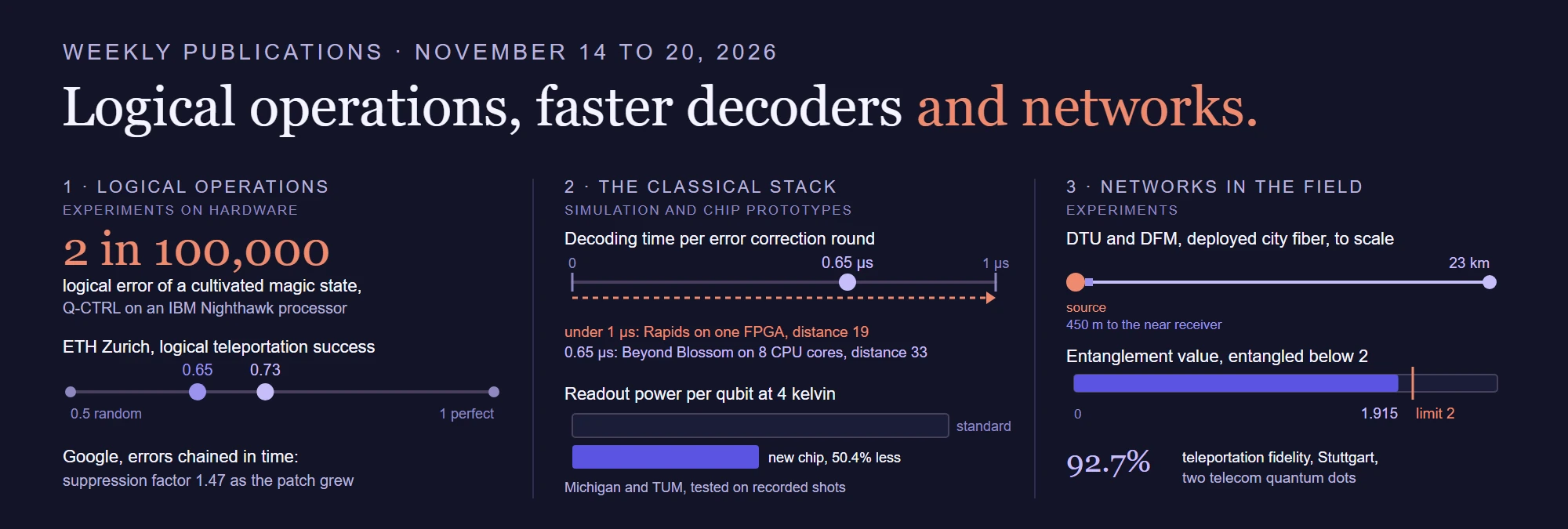
Logical operations, faster decoders and networks: Weekly Publications for November 14 to 20, 2026. Three columns on a dark navy ground. Logical operations, in experiments on hardware: Q-CTRL's cultivated magic state on an IBM Nighthawk processor at a logical error of 2 in 100,000, ETH Zurich's logical teleportation success of 0.65 and 0.73 on a scale from 0.5, a random guess, to 1, perfect, and Google's errors chained in time with a suppression factor of 1.47. The classical stack, in simulation and chip prototypes: decoding time per round on a 0 to 1 microsecond scale, 0.65 microseconds for Beyond Blossom on 8 CPU cores at distance 33 and under 1 microsecond for Rapids on one FPGA at distance 19, and a Michigan and TUM readout chip using 50.4% less power per qubit at 4 kelvin. Networks in the field, in experiments: DTU and DFM's 23 km and 450 m of deployed city fiber drawn to scale, with an entanglement value of 1.915 below the limit of 2, and Stuttgart's 92.7% teleportation fidelity with two telecom quantum dots.
54% algorithms & software 45% hardware & devices 32% error correction & verification Selected research ↓

I went through all the work I collected from arXiv’s listings this week and looked for the connections between papers. It is a selected research corpus, not a count of all quantum papers published worldwide. The charts cover its quantum technology subset, about half of the week's listings, and the themes overlap: 54% of that subset concerns algorithms or software, 45% hardware or devices, and 32% error correction or verification. Every highlight below is an arXiv preprint unless it is marked as a journal paper.

Three results frame the week.

  1. Error correction moved from storing logical qubits to operating on them, with magic states, teleportation and errors in time tested on superconducting chips. Q-CTRL on IBM hardware · ETH Zurich and the Paul Scherrer Institute · Google Quantum AI · Experiments
  2. Decoders, control and readout electronics, the classical hardware that has to keep pace with error correction, got faster and leaner, mostly in simulation and on chip prototypes. UC Berkeley and Harvard · NVIDIA · University of Michigan and TUM · QuEL · USTC · Simulation and prototypes
  3. Quantum network experiments moved onto deployed fiber and telecom wavelengths, with security proofs that still come with narrow assumptions. DTU and DFM · University of Stuttgart · Max Planck Institute of Quantum Optics · Toshiba Europe · NIST · Experiments and one proposal

Where the research connects

Shares of the quantum technology subset of collected arXiv work

The overlap between this week’s themes

Proportional overlap between three leading research themesAreas, including all seven overlap regions, are approximately proportional to each region’s share of the quantum technology subset. Algorithms and software only: 31%; Hardware and devices only: 29%; Algorithms and hardware, without error correction: 8%; Algorithms and error correction, without hardware: 12%; Hardware and error correction, without algorithms: 6%; All three themes: 2%; Error correction and verification only: 11%. Outside these themes: 0%.Algorithms & software54% of the subsetHardware & devices45% of the subsetError correction & verification32% of the subsetAlgorithms and software only: 31% of the subset31%Hardware and devices only: 29% of the subset29%Algorithms and hardware, without error correction: 8% of the subset8%Algorithms and error correction, without hardware: 12% of the subset12%Hardware and error correction, without algorithms: 6% of the subset6%All three themes: 2% of the subset2%Error correction and verification only: 11% of the subset11%
Share base: the quantum technology subset of this week’s collected arXiv work. Areas, including the overlaps, are approximately proportional to the theme shares. Labels are rounded percentages of that subset. Each region shows only its combination of labels.

Hardware papers, by platform

  • Cross-platform or unassigned32%
  • Photonics32%
  • Superconducting20%
  • Semiconductor & spin6%
  • Neutral atoms5%
  • Trapped ions3%
  • Other hardware2%

Every paper in the hardware & devices theme, counted once under its primary platform, so the shares add up to 100%.

Bars show each platform’s share of the hardware theme, on a common scale from 0 to 40%.

The charts share one base: the quantum technology subset of the arXiv work I collected, about half of the week's listings, with foundations, many body physics and mathematics papers outside it. Within it there are three overlapping editorial themes: 54% algorithms and software, 45% hardware and devices, and 32% error correction and verification. One paper can belong to more than one theme, so the shares add to more than 100%. These are topic shares, not an assessment of scientific maturity or a comparison with last week. The platform chart covers only work tagged hardware and devices, including device studies, sensing and networking experiments, and control research. Unassigned work stays unassigned rather than being forced into a technology.

The research footprint

Verified affiliation shares within the resolved subset

A global view of participation

75% coverage of the quantum technology subset of collected arXiv work. Shares below cover only fully resolved author country sets. Hover, tap, or choose a country or region.

United States33%of the fully resolved subset · 75% coverage
Verified author affiliation shares by country and regionDarker purple means a larger percentage within the fully resolved author country subset, covering 75% of the quantum technology subset of collected arXiv work. Gray is no verified affiliation in this subset, not an absence of research. A paper may contribute to multiple countries. No comparison with last week.Afghanistan: no verified affiliation in the resolved subset; not an absence of researchAlbania: no verified affiliation in the resolved subset; not an absence of researchAlgeria: <1% of the fully resolved subsetAmerican Samoa: no verified affiliation in the resolved subset; not an absence of researchAndorra: no verified affiliation in the resolved subset; not an absence of researchAngola: no verified affiliation in the resolved subset; not an absence of researchAnguilla: no verified affiliation in the resolved subset; not an absence of researchAntigua and Barb.: no verified affiliation in the resolved subset; not an absence of researchArgentina: no verified affiliation in the resolved subset; not an absence of researchArmenia: no verified affiliation in the resolved subset; not an absence of researchAruba: no verified affiliation in the resolved subset; not an absence of researchAshmore and Cartier Is.: no verified affiliation in the resolved subset; not an absence of researchAustralia: 3% of the fully resolved subsetAustria: 2% of the fully resolved subsetAzerbaijan: no verified affiliation in the resolved subset; not an absence of researchBahamas: no verified affiliation in the resolved subset; not an absence of researchBahrain: no verified affiliation in the resolved subset; not an absence of researchBangladesh: <1% of the fully resolved subsetBarbados: no verified affiliation in the resolved subset; not an absence of researchBelarus: no verified affiliation in the resolved subset; not an absence of researchBelgium: <1% of the fully resolved subsetBelize: no verified affiliation in the resolved subset; not an absence of researchBenin: no verified affiliation in the resolved subset; not an absence of researchBermuda: no verified affiliation in the resolved subset; not an absence of researchBhutan: no verified affiliation in the resolved subset; not an absence of researchBolivia: no verified affiliation in the resolved subset; not an absence of researchBosnia and Herz.: no verified affiliation in the resolved subset; not an absence of researchBotswana: no verified affiliation in the resolved subset; not an absence of researchBr. Indian Ocean Ter.: no verified affiliation in the resolved subset; not an absence of researchBrazil: 1% of the fully resolved subsetBritish Virgin Is.: no verified affiliation in the resolved subset; not an absence of researchBrunei: no verified affiliation in the resolved subset; not an absence of researchBulgaria: <1% of the fully resolved subsetBurkina Faso: no verified affiliation in the resolved subset; not an absence of researchBurundi: no verified affiliation in the resolved subset; not an absence of researchCabo Verde: no verified affiliation in the resolved subset; not an absence of researchCambodia: no verified affiliation in the resolved subset; not an absence of researchCameroon: no verified affiliation in the resolved subset; not an absence of researchCanada: 2% of the fully resolved subsetCayman Is.: no verified affiliation in the resolved subset; not an absence of researchCentral African Rep.: no verified affiliation in the resolved subset; not an absence of researchChad: no verified affiliation in the resolved subset; not an absence of researchChile: no verified affiliation in the resolved subset; not an absence of researchChina: 18% of the fully resolved subsetColombia: no verified affiliation in the resolved subset; not an absence of researchComoros: no verified affiliation in the resolved subset; not an absence of researchCongo: no verified affiliation in the resolved subset; not an absence of researchCook Is.: no verified affiliation in the resolved subset; not an absence of researchCosta Rica: no verified affiliation in the resolved subset; not an absence of researchCroatia: no verified affiliation in the resolved subset; not an absence of researchCuba: no verified affiliation in the resolved subset; not an absence of researchCuraçao: no verified affiliation in the resolved subset; not an absence of researchCyprus: no verified affiliation in the resolved subset; not an absence of researchCzechia: 1% of the fully resolved subsetCôte d'Ivoire: no verified affiliation in the resolved subset; not an absence of researchDem. Rep. Congo: no verified affiliation in the resolved subset; not an absence of researchDenmark: 4% of the fully resolved subsetDjibouti: no verified affiliation in the resolved subset; not an absence of researchDominica: no verified affiliation in the resolved subset; not an absence of researchDominican Rep.: no verified affiliation in the resolved subset; not an absence of researchEcuador: no verified affiliation in the resolved subset; not an absence of researchEgypt: <1% of the fully resolved subsetEl Salvador: no verified affiliation in the resolved subset; not an absence of researchEq. Guinea: no verified affiliation in the resolved subset; not an absence of researchEritrea: no verified affiliation in the resolved subset; not an absence of researchEstonia: no verified affiliation in the resolved subset; not an absence of researchEthiopia: no verified affiliation in the resolved subset; not an absence of researchFaeroe Is.: no verified affiliation in the resolved subset; not an absence of researchFalkland Is.: no verified affiliation in the resolved subset; not an absence of researchFiji: no verified affiliation in the resolved subset; not an absence of researchFinland: 1% of the fully resolved subsetFr. Polynesia: no verified affiliation in the resolved subset; not an absence of researchFr. S. Antarctic Lands: no verified affiliation in the resolved subset; not an absence of researchFrance: 5% of the fully resolved subsetGabon: no verified affiliation in the resolved subset; not an absence of researchGambia: no verified affiliation in the resolved subset; not an absence of researchGeorgia: no verified affiliation in the resolved subset; not an absence of researchGermany: 13% of the fully resolved subsetGhana: no verified affiliation in the resolved subset; not an absence of researchGreece: <1% of the fully resolved subsetGreenland: no verified affiliation in the resolved subset; not an absence of researchGrenada: no verified affiliation in the resolved subset; not an absence of researchGuam: no verified affiliation in the resolved subset; not an absence of researchGuatemala: no verified affiliation in the resolved subset; not an absence of researchGuernsey: no verified affiliation in the resolved subset; not an absence of researchGuinea: no verified affiliation in the resolved subset; not an absence of researchGuinea-Bissau: no verified affiliation in the resolved subset; not an absence of researchGuyana: no verified affiliation in the resolved subset; not an absence of researchHaiti: no verified affiliation in the resolved subset; not an absence of researchHeard I. and McDonald Is.: no verified affiliation in the resolved subset; not an absence of researchHonduras: no verified affiliation in the resolved subset; not an absence of researchHong Kong: 5% of the fully resolved subsetHungary: <1% of the fully resolved subsetIceland: no verified affiliation in the resolved subset; not an absence of researchIndia: 4% of the fully resolved subsetIndian Ocean Ter.: no verified affiliation in the resolved subset; not an absence of researchIndonesia: no verified affiliation in the resolved subset; not an absence of researchIran: <1% of the fully resolved subsetIraq: no verified affiliation in the resolved subset; not an absence of researchIreland: <1% of the fully resolved subsetIsle of Man: no verified affiliation in the resolved subset; not an absence of researchIsrael: 1% of the fully resolved subsetIsrael: 1% of the fully resolved subsetItaly: 3% of the fully resolved subsetJamaica: no verified affiliation in the resolved subset; not an absence of researchJapan: 8% of the fully resolved subsetJersey: no verified affiliation in the resolved subset; not an absence of researchJordan: no verified affiliation in the resolved subset; not an absence of researchKazakhstan: no verified affiliation in the resolved subset; not an absence of researchKenya: no verified affiliation in the resolved subset; not an absence of researchKiribati: no verified affiliation in the resolved subset; not an absence of researchKosovo: no verified affiliation in the resolved subset; not an absence of researchKuwait: no verified affiliation in the resolved subset; not an absence of researchKyrgyzstan: no verified affiliation in the resolved subset; not an absence of researchLaos: no verified affiliation in the resolved subset; not an absence of researchLatvia: no verified affiliation in the resolved subset; not an absence of researchLebanon: no verified affiliation in the resolved subset; not an absence of researchLesotho: no verified affiliation in the resolved subset; not an absence of researchLiberia: no verified affiliation in the resolved subset; not an absence of researchLibya: no verified affiliation in the resolved subset; not an absence of researchLiechtenstein: no verified affiliation in the resolved subset; not an absence of researchLithuania: <1% of the fully resolved subsetLuxembourg: no verified affiliation in the resolved subset; not an absence of researchMacao: 1% of the fully resolved subsetMacedonia: no verified affiliation in the resolved subset; not an absence of researchMadagascar: no verified affiliation in the resolved subset; not an absence of researchMalawi: no verified affiliation in the resolved subset; not an absence of researchMalaysia: no verified affiliation in the resolved subset; not an absence of researchMaldives: no verified affiliation in the resolved subset; not an absence of researchMali: no verified affiliation in the resolved subset; not an absence of researchMalta: no verified affiliation in the resolved subset; not an absence of researchMarshall Is.: no verified affiliation in the resolved subset; not an absence of researchMauritania: no verified affiliation in the resolved subset; not an absence of researchMauritius: no verified affiliation in the resolved subset; not an absence of researchMexico: <1% of the fully resolved subsetMicronesia: no verified affiliation in the resolved subset; not an absence of researchMoldova: no verified affiliation in the resolved subset; not an absence of researchMonaco: no verified affiliation in the resolved subset; not an absence of researchMongolia: no verified affiliation in the resolved subset; not an absence of researchMontenegro: no verified affiliation in the resolved subset; not an absence of researchMontserrat: no verified affiliation in the resolved subset; not an absence of researchMorocco: no verified affiliation in the resolved subset; not an absence of researchMozambique: no verified affiliation in the resolved subset; not an absence of researchMyanmar: no verified affiliation in the resolved subset; not an absence of researchN. Cyprus: no verified affiliation in the resolved subset; not an absence of researchN. Mariana Is.: no verified affiliation in the resolved subset; not an absence of researchNamibia: no verified affiliation in the resolved subset; not an absence of researchNauru: no verified affiliation in the resolved subset; not an absence of researchNepal: no verified affiliation in the resolved subset; not an absence of researchNetherlands: 2% of the fully resolved subsetNew Caledonia: no verified affiliation in the resolved subset; not an absence of researchNew Zealand: no verified affiliation in the resolved subset; not an absence of researchNicaragua: no verified affiliation in the resolved subset; not an absence of researchNiger: no verified affiliation in the resolved subset; not an absence of researchNigeria: no verified affiliation in the resolved subset; not an absence of researchNiue: no verified affiliation in the resolved subset; not an absence of researchNorfolk Island: no verified affiliation in the resolved subset; not an absence of researchNorth Korea: no verified affiliation in the resolved subset; not an absence of researchNorway: 1% of the fully resolved subsetOman: no verified affiliation in the resolved subset; not an absence of researchPakistan: 1% of the fully resolved subsetPalau: no verified affiliation in the resolved subset; not an absence of researchPanama: no verified affiliation in the resolved subset; not an absence of researchPapua New Guinea: no verified affiliation in the resolved subset; not an absence of researchParaguay: no verified affiliation in the resolved subset; not an absence of researchPeru: no verified affiliation in the resolved subset; not an absence of researchPhilippines: no verified affiliation in the resolved subset; not an absence of researchPitcairn Is.: no verified affiliation in the resolved subset; not an absence of researchPoland: no verified affiliation in the resolved subset; not an absence of researchPortugal: <1% of the fully resolved subsetPuerto Rico: no verified affiliation in the resolved subset; not an absence of researchQatar: no verified affiliation in the resolved subset; not an absence of researchRomania: no verified affiliation in the resolved subset; not an absence of researchRussia: no verified affiliation in the resolved subset; not an absence of researchRwanda: no verified affiliation in the resolved subset; not an absence of researchS. Geo. and the Is.: no verified affiliation in the resolved subset; not an absence of researchS. Sudan: no verified affiliation in the resolved subset; not an absence of researchSaint Helena: no verified affiliation in the resolved subset; not an absence of researchSaint Lucia: no verified affiliation in the resolved subset; not an absence of researchSamoa: no verified affiliation in the resolved subset; not an absence of researchSan Marino: no verified affiliation in the resolved subset; not an absence of researchSaudi Arabia: no verified affiliation in the resolved subset; not an absence of researchSenegal: no verified affiliation in the resolved subset; not an absence of researchSerbia: no verified affiliation in the resolved subset; not an absence of researchSeychelles: no verified affiliation in the resolved subset; not an absence of researchSiachen Glacier: no verified affiliation in the resolved subset; not an absence of researchSierra Leone: no verified affiliation in the resolved subset; not an absence of researchSingapore: 3% of the fully resolved subsetSint Maarten: no verified affiliation in the resolved subset; not an absence of researchSlovakia: <1% of the fully resolved subsetSlovenia: <1% of the fully resolved subsetSolomon Is.: no verified affiliation in the resolved subset; not an absence of researchSomalia: no verified affiliation in the resolved subset; not an absence of researchSomaliland: no verified affiliation in the resolved subset; not an absence of researchSouth Africa: no verified affiliation in the resolved subset; not an absence of researchSouth Korea: 4% of the fully resolved subsetSpain: 5% of the fully resolved subsetSri Lanka: no verified affiliation in the resolved subset; not an absence of researchSt-Barthélemy: no verified affiliation in the resolved subset; not an absence of researchSt-Martin: no verified affiliation in the resolved subset; not an absence of researchSt. Kitts and Nevis: no verified affiliation in the resolved subset; not an absence of researchSt. Pierre and Miquelon: no verified affiliation in the resolved subset; not an absence of researchSt. Vin. and Gren.: no verified affiliation in the resolved subset; not an absence of researchSudan: no verified affiliation in the resolved subset; not an absence of researchSuriname: no verified affiliation in the resolved subset; not an absence of researchSweden: <1% of the fully resolved subsetSwitzerland: 2% of the fully resolved subsetSyria: no verified affiliation in the resolved subset; not an absence of researchSão Tomé and Principe: no verified affiliation in the resolved subset; not an absence of researchTaiwan: no verified affiliation in the resolved subset; not an absence of researchTajikistan: no verified affiliation in the resolved subset; not an absence of researchTanzania: no verified affiliation in the resolved subset; not an absence of researchThailand: no verified affiliation in the resolved subset; not an absence of researchTimor-Leste: no verified affiliation in the resolved subset; not an absence of researchTogo: no verified affiliation in the resolved subset; not an absence of researchTonga: no verified affiliation in the resolved subset; not an absence of researchTrinidad and Tobago: no verified affiliation in the resolved subset; not an absence of researchTunisia: no verified affiliation in the resolved subset; not an absence of researchTurkey: 1% of the fully resolved subsetTurkmenistan: no verified affiliation in the resolved subset; not an absence of researchTurks and Caicos Is.: no verified affiliation in the resolved subset; not an absence of researchU.S. Virgin Is.: no verified affiliation in the resolved subset; not an absence of researchUganda: no verified affiliation in the resolved subset; not an absence of researchUkraine: <1% of the fully resolved subsetUnited Arab Emirates: 1% of the fully resolved subsetUnited Kingdom: 11% of the fully resolved subsetUnited States: 33% of the fully resolved subsetUruguay: no verified affiliation in the resolved subset; not an absence of researchUzbekistan: no verified affiliation in the resolved subset; not an absence of researchVanuatu: no verified affiliation in the resolved subset; not an absence of researchVatican: no verified affiliation in the resolved subset; not an absence of researchVenezuela: no verified affiliation in the resolved subset; not an absence of researchVietnam: no verified affiliation in the resolved subset; not an absence of researchW. Sahara: no verified affiliation in the resolved subset; not an absence of researchWallis and Futuna Is.: no verified affiliation in the resolved subset; not an absence of researchYemen: no verified affiliation in the resolved subset; not an absence of researchZambia: no verified affiliation in the resolved subset; not an absence of researchZimbabwe: no verified affiliation in the resolved subset; not an absence of researcheSwatini: no verified affiliation in the resolved subset; not an absence of researchÅland: no verified affiliation in the resolved subset; not an absence of research
Share of the fully resolved subset
0%10%20%30%40%
No verified affiliation in resolved subset
Affiliation locations, conditional on fully resolved author country sets covering 75% of the quantum technology subset of collected arXiv work. A paper may contribute to several countries, so shares may add to more than 100%. Not comparable with last week. Map: Natural Earth.

Author country sets could be fully resolved for 75% of the quantum technology subset, and the map covers only that subset. Each paper counts once per verified country or region, so shares add to more than 100%. These are author affiliations, not hardware suppliers or company headquarters, and gray does not mean an absence of research. Coverage differs from last week, so this is not a week over week comparison.

Three themes worth reading closely

Selected research, with company context

Q-CTRL

Company authors

IBM

Hardware used

Google

Company authors

Q-CTRL, on a publicly available IBM Nighthawk processor; ETH Zurich and the ETH Zurich and PSI Quantum Computing Hub; Google Quantum AI and collaborators

1. Error correction starts operating on logical qubits

Most error correction experiments so far stored a logical qubit, one qubit spread across many physical qubits so errors can be caught. This week several groups operated on logical qubits. Q-CTRL ran magic state cultivation, a low-cost way to prepare the special states that the hardest logic gates need, on a publicly available IBM Nighthawk processor, then moved the state into a larger surface code by lattice surgery, a way of merging and splitting code patches. The paper says this is the first experiment of that route.

Before the move, the cultivated state reached a logical error probability of 2 in 100,000, nearly ten times lower than the previous experiment with about three times as many runs kept. After the move, its fidelity stayed above 0.99 ten rounds later, but only about 5% of runs were kept. This is an experiment on hardware that relies on heavy postselection, meaning runs flagged as faulty are thrown away.

ETH Zurich teleported logical states between two small surface code patches on a 41-qubit superconducting chip (arXiv 2611.23165), with success probabilities up to 0.65 and 0.73 in the two bases tested, where 0.5 is a random guess and 1 is perfect. Google Quantum AI used its Willow processor to test errors that chain across time rather than space (arXiv 2611.21578). It measured a suppression factor of 1.47 as the patch grew and traced a hidden error to qubit heating. Both are experiments. In theory, a new analysis (arXiv 2611.24852) shows that the checks used in cultivation tolerate at most half as many faults as their codes allow.

These are small codes with heavy postselection. The next test is a logical gate between two error corrected qubits that beats the physical qubits underneath.

Magic state cultivation with lattice-surgery escape on superconducting hardware ↗

arXiv listing November 18 · Experiment

NVIDIA

Company authors

QuEL

Company authors

UC Berkeley and Harvard; NVIDIA; Duke Quantum Center; University of Michigan and the Technical University of Munich; QuEL with the University of Osaka; USTC

2. The classical hardware that has to keep pace

Error correction needs a decoder, a classical program that reads error signals and returns a correction before the next round, plus control and readout electronics. A team from UC Berkeley and Harvard built Rapids, a neural network decoder designed together with an FPGA, a reprogrammable chip. For a surface code of distance 19, it decodes each round in under a microsecond on one FPGA, with a logical error rate 240 times lower than existing real-time hardware decoders. The accuracy comes from simulation, and the speed is for the decoder mapped onto an FPGA.

A CPU decoder, Beyond Blossom, reached 0.65 microseconds per round at distance 33 on eight cores (arXiv 2611.18476), and NVIDIA's TCBP-JOBS (arXiv 2611.21321), covered in this week's news, speeds up decoder research rather than live decoding. Duke showed that slower trapped ion machines can use spare time for a second, more accurate decoder, with up to 10,000 times fewer logical errors in simulation (arXiv 2611.21906).

Around the qubit, the University of Michigan and TUM designed a readout chip that skips the usual converters (arXiv 2611.23448). Tested at 4 kelvin on 1.12 million recorded shots, it cut power per qubit by 50.4% against a standard digital design. QuEL generated control waveforms from analog memory at 14 kelvin (arXiv 2611.22068), and USTC ran single and two-qubit gates on a common clock built for superconducting digital control, with fidelities of 99.94% and 99.63% (arXiv 2611.22166). These are a design study and two chip prototypes.

This research matches the week's news from SC26. The test for investors is a decoder running on live error data at a real machine's cycle time.

Scaling classical hardware for accurate real-time quantum error correction ↗

arXiv listing November 20 · Simulation with FPGA timing

Toshiba

Company authors

Technical University of Denmark and the Danish Fundamental Metrology institute; University of Stuttgart; Max Planck Institute of Quantum Optics; Toshiba Europe; NIST, published in Nature

3. Quantum networks move onto deployed fiber

The lead result comes from DTU and Denmark's national metrology institute, which sent the two halves of an entangled light state through 23 km and 450 m of deployed city fiber to two receivers, each with its own unsynchronized laser. They recovered timing and phase digitally instead of stabilizing the light, and certified entanglement with a value of 1.915, below the limit of 2. This is an experiment, and the measured entanglement is weak.

The University of Stuttgart teleported a photon's state using photons from two separate quantum dots emitting at telecom wavelengths, with a fidelity of 92.7% (arXiv 2611.19954). The Max Planck Institute of Quantum Optics kept total photon loss below 50%, the level where spreading information across photons starts to help, and saw that gain in experiment (arXiv 2611.21753). Toshiba Europe proposed a key distribution scheme with half the memories and detectors of earlier two-memory designs, in theory (arXiv 2611.24255).

In Nature on November 18, NIST researchers showed that quantum physics can help verify where a device is. The protocol is secure only against adversaries who share little entanglement, and NIST says practical use may be more than a decade away.

The engineering is getting more practical. Rates, distances and security assumptions are still short of a commercial network.

Long-distance continuous variable entanglement distribution over deployed fibre ↗

arXiv listing November 19 · Experiment

Also this week

What I would watch next

The week's common thread was what surrounds a logical qubit: the operations it has to run, the classical hardware that decodes and controls it, and the links that could connect machines. I want logical gates that beat their physical parts without discarding most runs, decoders that keep up with live error data, and networks with useful rates over real distances. Watch for a logical gate between two error corrected qubits that beats the physical qubits underneath, and for a decoder running on live error data at a real machine's cycle time. For background, see What is a decoder? and What is quantum error correction?