
University of Copenhagen, EPFL and Sorbonne Université (LIP6). Chungbuk National University appears only in earlier context.
1. Fixed loss removes the scaling case for random boson sampling
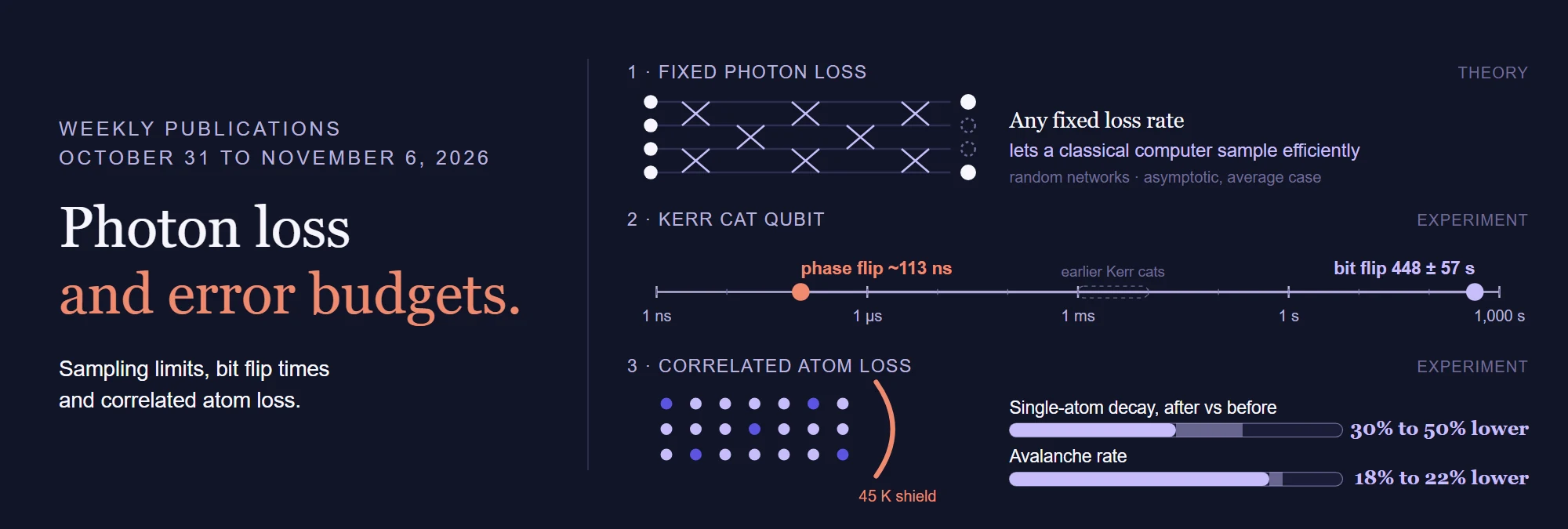
Boson sampling sends photons through a network of beam splitters and asks where they land, and it has been a leading candidate for showing a quantum computer doing something a classical one cannot. Armando Angrisani and Hela Mhiri, from the University of Copenhagen, EPFL and Sorbonne Université, show that under any fixed nonzero loss rate a classical computer can sample efficiently, in polynomial time, with high probability over Haar random networks. That covers single photon and fixed-squeezing Gaussian inputs, fermion sampling with magic inputs, and, for the photonic cases, thermal as well as pure loss.
Its authors note that the runtime bounds grow exponentially as loss weakens, so a polynomial time result does not mean today's experiments can be simulated in practice.
Youngrong Lim at Chungbuk National University reached a matching result in earlier work, posted on Zenodo on October 21 and listed on arXiv this week (arXiv 2611.01434), and notes that it does not by itself show that any particular device can be spoofed.
Both are average case, asymptotic proofs about sampling experiments used as advantage claims, not about error corrected photonic designs. The question for every future sampling claim: how does loss scale as the experiment grows?
Polynomial-time classical simulation of boson and fermion sampling under thermal loss ↗