November 7 to 13, 2026
Cash, control chips and a signed award
A week when cash said more than revenue at five small companies, AMD turned up in three classical-side announcements on one day, and Atom Computing signed a final CHIPS award.
Five smaller quantum companies reported third quarter results this week, and revenue stayed small at all of them. On Thursday, AMD appeared in three announcements about the classical computers around qubits, and Atom Computing signed a final CHIPS award. For each funding figure I asked one question: is it cash on hand, conditional money or revenue still to be recognized?
Earnings
Small caps report, and the funding sources need reading
Xanadu has cash for now and a conditional headline
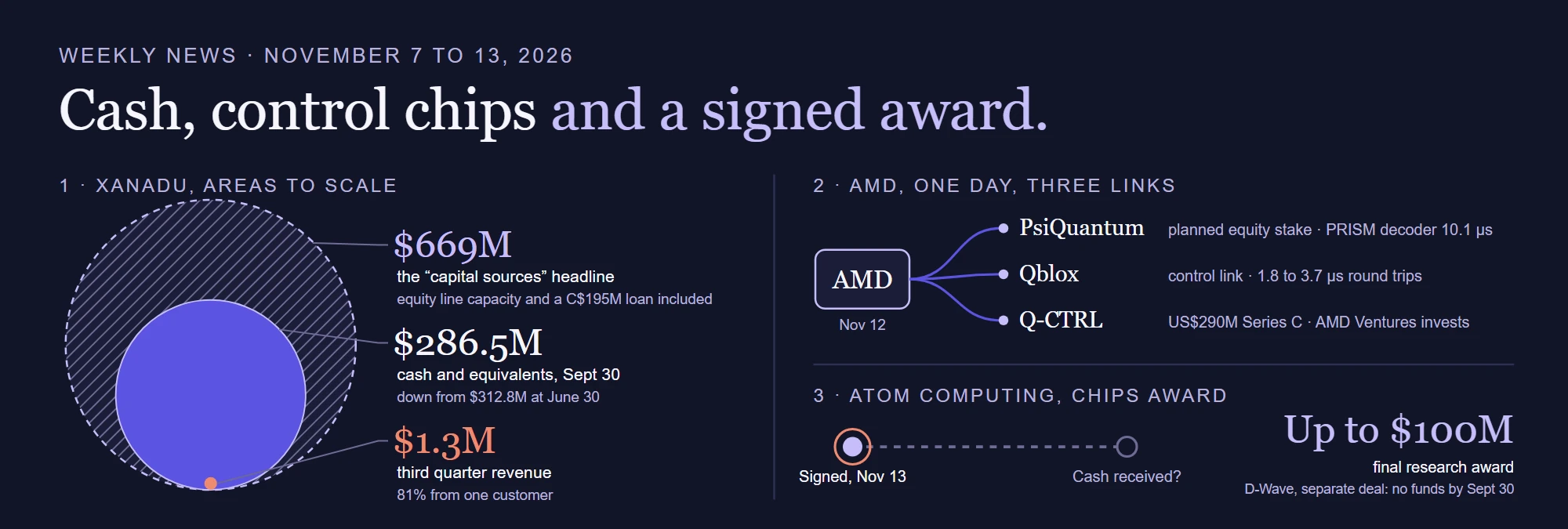
Xanadu reported third quarter revenue of $1.305 million, almost all from professional services and 81% of it from one customer. Cash and equivalents fell to $286.5 million at September 30, from $312.8 million at June 30. The CFO said revenue "is not expected to be a material driver" of operations in the near term.
Xanadu Q3 release ↗ · 6-K, Exhibit 99.2 ↗ · Call transcript ↗
The investor presentation shows "$669M of capital sources." Only the $286.5 million is cash. The rest is up to $232.8 million of unused capacity on its Yorkville equity line, which Xanadu did not draw on in the quarter and weighs "almost on a day-by-day basis," a CAD 195 million government loan that Xanadu puts at about $140 million and that is subject to "annual parliamentary appropriation," and up to $10 million of DARPA funding that is provisionally approved. Most of the headline is conditional, not cash on hand.
Xanadu Q3 investor presentation, slide 27 ↗ · Interim financial statements, page 34 ↗
Rigetti's annual guide rests on one acceptance
Rigetti reported third quarter revenue of $1.4 million, $10.9 million for nine months, and guides to about $20 million for 2026. That leaves about $9.1 million for the fourth quarter, by my arithmetic, and the CFO said the outlook assumes customer acceptance of the C-DAC system in that quarter. The 10-Q describes an $8.4 million C-DAC purchase order.
Rigetti Q3 release ↗ · Rigetti 10-Q, pages 23 and 31 ↗ · Rigetti Q3 call transcript ↗
D-Wave, QCi and Horizon Quantum
D-Wave reported revenue of $4.5 million, up 21%, and bookings of $1.9 million, down 19%. The CFO expects to recognize a substantial portion of its Florida Atlantic University system's revenue in the fourth quarter.
D-Wave Q3 release ↗ · Call transcript, page 6 ↗
Quantum Computing Inc. reported revenue of $9.5 million, $8.8 million of it from businesses acquired in 2026. Gross margin was 4.5%, interest and other income of $13.0 million exceeded revenue, and contract backlog fell to $39.1 million from $42.5 million at June 30.
Horizon Quantum reported no revenue. Its $33.4 million net income included a $43.1 million noncash gain that the release attributes to a fall in its share price. Cash was $102.8 million at September 30.
Five small revenue lines and very different balance sheets. Each company defines its backlog measure differently, and none of it is cash received.
Classical layer
Money moves to the classical side
AMD plans an equity stake in PsiQuantum
On November 12, PsiQuantum and AMD expanded a partnership that makes AMD processors, GPUs, FPGAs and software the classical side of PsiQuantum's photonic machines, and AMD "plans to make an equity investment" of an undisclosed amount. The release points to PRISM, a machine learning decoder whose full design, mapped onto an AMD FPGA, reaches 10.1 microseconds per block against the paper's own 10 microsecond target, on simulated noise.
PsiQuantum and AMD, November 12 ↗ · arXiv 2611.13630 ↗
Qblox, Q-CTRL and IBM
The same day, Qblox measured round trips of 1.8 to 3.7 microseconds between its control hardware and AMD processors, and Q-CTRL raised US$290 million in a Series C led by Salesforce Ventures, with AMD Ventures among the new investors. A day earlier, IBM said its Relay-BP decoder "now meets Starling performance requirements."
Qblox, November 12 ↗ · Q-CTRL, November 12 ↗ · IBM Research, November 11 ↗
Decoding and control are becoming products of their own. The test for each claim is latency on real hardware against that machine's cycle time, and equity from a chip company is a vote of interest, not proof.
Governments
Governments sign, report and fund
Atom Computing signs a final CHIPS award
On November 13, the Department of Commerce announced a final CHIPS research award of up to $100 million to Atom Computing, for hardware and systems integration to "manipulate, control, and address tens of thousands of qubits." Signed does not mean paid: in a different CHIPS arrangement, D-Wave's CFO said this week that no CHIPS Act funds had been received by the end of the third quarter.
NIST, November 13 ↗ · D-Wave Q3 call transcript, page 7 ↗
Reports and national programs
On November 10, the Commission on U.S. Quantum Primacy released a preliminary report calling for steady research funding, NIST led benchmarking and faster migration to post quantum cryptography, with a final report due in spring 2027. South Korea said a superconducting qubit in its Quantum Flagship program reached a coherence time of at least 100 microseconds, against a 2027 target of 50.
SCSP, November 10 ↗ · MSIT, November 10 ↗
Government money is arriving as signed awards. The investor question is when the cash actually lands, and on which milestones it depends.
Briefly
Also this week
IBM · Hardware
IBM plans Nighthawk r3 to run 10,000 operations across 520 qubits, and to link two r3 chips into a 1,040 qubit system in 2027. Nighthawk r2 runs more than 7,500 operations on 120 qubits.
Quantinuum and RIKEN · Hardware
The Reimei machine at RIKEN was upgraded to Quantinuum's H2 with 56 fully connected qubits, and the two signed a memorandum toward a fault tolerant machine.
IonQ · Leadership and filings
IonQ named Gary Merrill CFO effective early December, and said Inder M. Singh is stepping down. A prospectus supplement registers up to 34,580,646 IonQ shares for resale by selling stockholders; IonQ receives no proceeds.
IQM and AMD · Chemistry
On November 9, IQM and AMD split a hydrogen chemistry workflow between an IQM quantum computer and an AMD GPU. IQM says plainly that the run "does not show quantum advantage."
Qunova · Chemistry
Qunova reported an extrapolated ground state energy for an iron sulfur cluster at 80 qubits, on IBM hardware at RIKEN with the Fugaku supercomputer, within chemical accuracy of the leading classical reference.
Diraq · Deployment
Diraq said it installed a silicon spin quantum computer inside an Equinix data center in Sydney.
Post quantum cryptography · Procurement
The US General Services Administration asked vendors about post quantum readiness, with responses due December 7, and Germany's DLR opened a market survey on quantum attacks against lattice based cryptography, due December 9.
Netherlands and France · Programs
QuiX Quantum will lead a Dutch photonic mission through December 2028, with no euro amount given, and France's LNE closed its BACQ project with ten open source application benchmarks.
This week’s research, with the three papers worth reading, is on the Publications page.
Conclusion
The weekly view
Revenue was small everywhere this week, so the balance sheet did the talking. Xanadu has cash for now, and the rest of its $669 million headline depends on government appropriations and on selling shares. Rigetti and D-Wave each tied their fourth quarter to one system. AMD's three moves on Thursday point to where the engineering bottleneck is moving: the decoders and control systems around the qubits. What I'm watching is whether the published latencies hold on real machines, and when signed CHIPS money starts to arrive.