
October 31 to November 6, 2026
Revenue, a gap and a chip
A week when four companies reported four kinds of revenue, IBM put a number on its distance to fault tolerance, and a trapped-ion chip arrived with a customer.
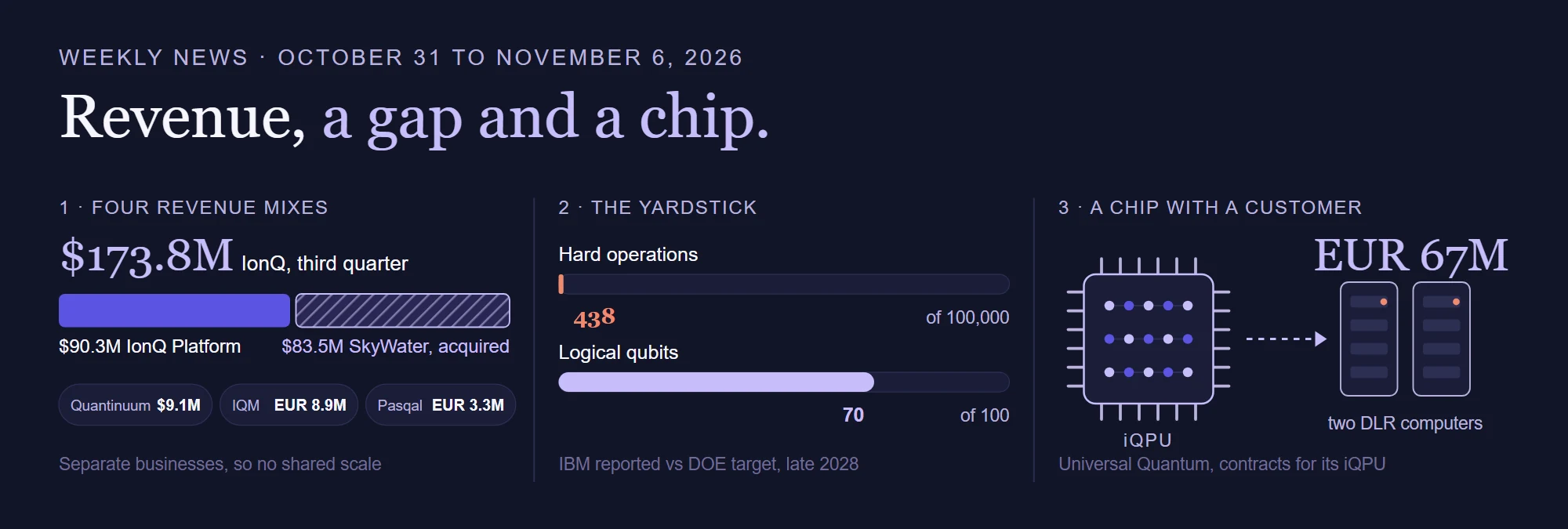
Four companies reported this week, and no two of their revenue lines measure the same thing. In between, IBM put its error correction count next to a federal target, and Universal Quantum launched a chip that already has a customer. For each number I asked one question: is it recognized revenue, future business or an engineering count?
Earnings
Earnings week, four different businesses
IonQ reports record revenue, much of it acquired
IonQ reported third quarter revenue of $173.8 million, up 336% from $39.9 million a year earlier, and raised its full year guidance to $505 million to $515 million. SkyWater, acquired on July 31, contributed $83.5 million in about two months, so this is not organic growth. Net income of $564.0 million came from an $896.2 million noncash warrant gain; operations lost $433.1 million. Remaining performance obligations were $1.168 billion, which is not cash received.
IonQ results and guidance ↗ · IonQ 10-Q ↗
On November 3, IonQ also closed its all-stock purchase of Elisity, a Zero Trust network security company, valued in the announcement at $1.15 billion plus up to $150 million tied to financial metrics. It added no revenue to the third quarter.
IonQ 8-K ↗ · Elisity announcement ↗
Quantinuum has a strong quarter and weaker nine months
Quantinuum reported third quarter revenue of $9.1 million, up 233%, and raised its full year outlook to $31 million to $34 million. Nine month revenue was still down 6.8%, at $22.3 million against $23.9 million. The net loss was $117.9 million, and cash was $1.94 billion at September 30.
IQM has more orders and a heavy fourth quarter ahead
IQM reported third quarter revenue of EUR 8.9 million, up 51%, and EUR 42.2 million of new orders, led by a EUR 33 million contract with CSC's LUMI AI Factory. Backlog was EUR 102.5 million. Its unchanged guidance of EUR 42 million to EUR 47 million implies that about 58% to 62% of the year's revenue has to arrive in the fourth quarter, recognized when customers accept systems or projects reach milestones.
Pasqal reports lower revenue and no QPU sales
Pasqal reported unaudited third quarter revenue of EUR 3.3 million, down from EUR 5.7 million, with no revenue from QPU sales against EUR 3.2 million a year earlier. QPU-related services grew 53% to EUR 3.1 million. Its EUR 69.8 million of “booked and awarded business” mixes grants, tax credits and multi year contracts, so it is not an order backlog. Cash was EUR 312.8 million.
Four revenue figures, four different mixes: acquired foundry work at IonQ, full stack access at Quantinuum, acceptance-driven systems at IQM and services without hardware sales at Pasqal. Side by side, they are not a like for like measure of demand.
Fault tolerance
Fault tolerance gets a public yardstick
IBM, Oak Ridge and AMD open an error correction platform
On November 5, IBM, the Quantum Science Center at Oak Ridge National Laboratory and AMD launched a shared platform for error correction research. It pairs IBM's 120 qubit Nighthawk processor with Oak Ridge's AMD-based Umbra computer. IBM tied it to the Department of Energy target of 100 logical qubits running 100,000 hard operations by late 2028, and reports up to 70 logical qubits and, separately, 438 hard operations.
A stated target with a reported count is more useful than a claimed lead. On the operation count alone, IBM puts the distance at roughly 230 fold. The platform does not close it; it measures how much classical computing error correction will need.
Hardware
A chip with a customer
Universal Quantum launches the iQPU
On November 3, Universal Quantum launched the iQPU, a trapped-ion chip made on a commercial 200 mm semiconductor line, with on chip control electronics and links between chips. The chips will go into the two computers it is building for the German Aerospace Center, DLR, under contracts worth EUR 67 million. The release gives no qubit count or gate fidelity.
IBM's Chicago system is operational
On November 6, IBM said its Quantum System Two, powered by a Nighthawk processor, was running at Hyde Park Labs in Chicago, hosted by the University of Chicago, before a planned move to the Illinois Quantum and Microelectronics Park. It is a deployment milestone, not a new demonstration of fault tolerance or quantum advantage.
The iQPU arrives with a named customer, which most new chips do not. The next evidence is delivery of the DLR systems, with a qubit count and fidelities attached.
Briefly
Also this week
-
IonQ · Cloud access
QuantumCT, Connecticut's statewide quantum initiative, agreed to buy more than 150 hours of IonQ cloud time for the state's universities, labs and companies. No contract value was given.
-
Horizon Quantum · Deal
Horizon Quantum signed a non binding letter of intent to buy Entropica Labs, a Singapore compiler company for error corrected programs, for about $27 million in Horizon shares.
-
D-Wave · Software
D-Wave says its upgraded Stride hybrid solver lands more than 200 times closer to the best known result than its previous version at the same runtime, on routing problems with up to 10,000 locations. That compares it with itself; it is not a speedup.
-
UKRI · Funding
UKRI announced a 12 million pound Quantum Commercialisation Skills Centre led by Imperial College London, and 35 million pounds for quantum networking testbeds, with calls opening in February 2027.
-
NQCC · Software access
The UK's National Quantum Computing Centre licensed Phasecraft's software and named 13 proof-of-concept projects and nine industry access participants. No license value was disclosed.
-
HSBC · Post-quantum cryptography
HSBC named post-quantum cryptography among the first focus areas of a new AI and Emerging Technology Institute in Hong Kong, opening in early 2027. No budget or vendors were named.
-
Quint · Funding
Quint Computing raised a EUR 9.1 million first equity round led by Vsquared Ventures, plus a EUR 2.2 million EIC Pathfinder grant, for a superconducting design meant to cut error correction overhead.
-
QuEra · Research
On QuEra's Aquila neutral-atom simulator, researchers studied sudden changes in spin models with up to 180 qubits. The Nature paper reports a dynamical phase transition in two dimensions.
This week’s research, with the three papers worth reading, is on the Publications page.
Conclusion
The weekly view
Four revenue lines told four different stories. About 62% of IonQ's year over year increase came from SkyWater, Quantinuum's strong quarter sits inside a weaker nine months, IQM needs most of its year in the fourth quarter, and Pasqal grew services in a quarter with no QPU sales. The most useful number of the week was IBM's 438 of 100,000, because it comes with a target and a distance. What I'm watching is the November 10 round of results, and whether IQM's fourth quarter arrives as guided.
-
D-Wave ↗ and Horizon Quantum ↗ report third quarter results before the US market opens. Rigetti ↗ reports after the close.
-
Xanadu ↗ holds its third quarter results event on its US reporting calendar.