
November 14 to 20, 2026
Backlog, schedulers and a federal shopping list
A week when Infleqtion's quarter shrank while its contracted backlog grew, NVIDIA put quantum processors into the supercomputer job queue, and US agencies wrote down what they want to buy.
Infleqtion reported its third quarter and D-Wave filed its 10-Q. At SC26, the supercomputing conference, NVIDIA and several quantum companies made quantum processors schedulable like any other part of a supercomputer. Governments issued requests, bills and guidance rather than money. For each item I asked: what is signed and measured, and what is still a plan?
Earnings
Infleqtion's quarter shrank as its backlog grew
Infleqtion: a smaller quarter and a larger book of signed work
Infleqtion reported third quarter revenue of $9.1 million, up 25% from a year earlier but down from $12.6 million in the second quarter. It posted a gross loss of $1.1 million, against a gross profit of $3.7 million a year earlier, and one customer accounted for 81% of revenue.
Infleqtion Q3 release ↗ · Infleqtion 10-Q ↗ · Q2 release ↗
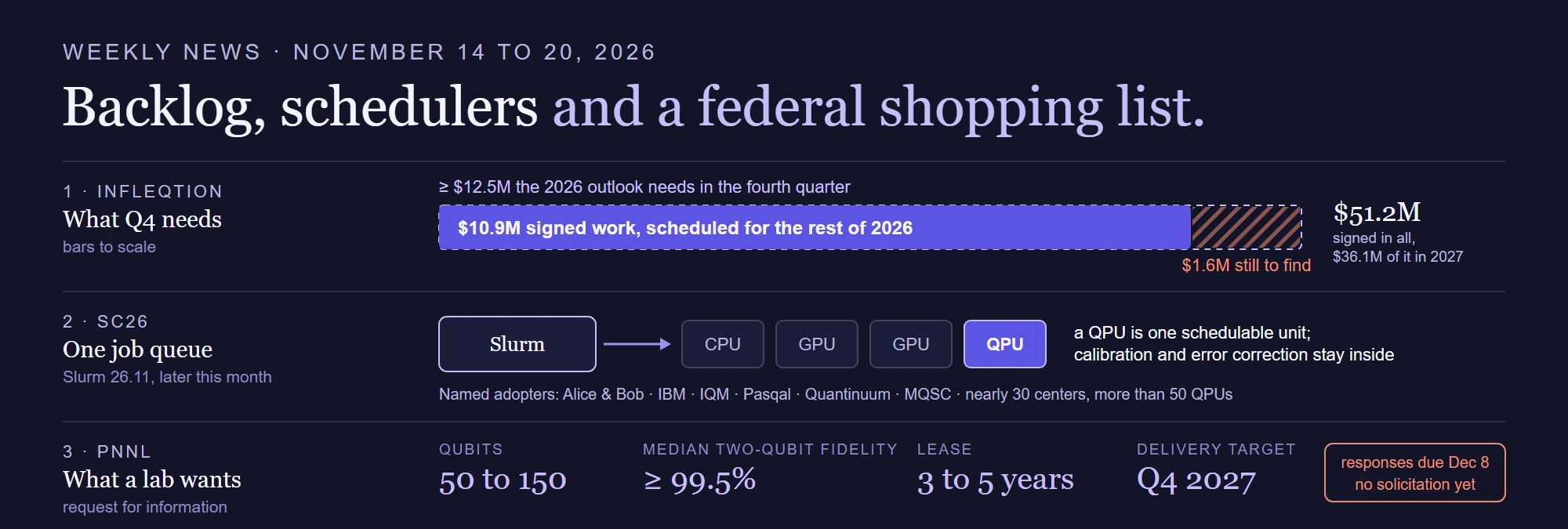
The company kept its 2026 outlook of at least $45.1 million. After $32.6 million in nine months, that needs at least $12.5 million in the fourth quarter, by my arithmetic. The 10-Q schedules $10.9 million of remaining performance obligations (signed work not yet recognized as revenue) for the rest of 2026, about 87% of that need. In total those obligations were $51.2 million, with $36.1 million expected in 2027 and $4.2 million in 2028.
Infleqtion 10-Q, revenue note ↗ · Investor presentation ↗
The cash line needs a footnote. Cash and securities totaled $560 million, but the 10-Q says about $28.3 million of it is payroll tax collected on stock option exercises that "had not yet been remitted" and is "not available to fund the Company's operations." In August, the second quarter release said, "We expect to remit the $27.4 million in Q3." The 10-Q also records an accrual for possible interest on the late payment.
Infleqtion 10-Q, liquidity ↗ · Infleqtion Q2 release ↗
Infleqtion also says it met its target of 30 logical qubits, on 80 physical qubits. The presentation shows the run used error detection, which discards flagged runs: 39 of 88,000 were kept, at a circuit fidelity of 21%.
Infleqtion Q3 release ↗ · Investor presentation ↗
D-Wave's CHIPS money: signed, not received
D-Wave's 10-Q, filed November 16, confirms that no CHIPS award funds had arrived by September 30, and that $46.4 million of the award depends on milestone decisions the Department of Commerce makes "in its sole discretion." D-Wave also asked SEC staff to review its accounting for the award, and that consultation "has not been concluded."
Infleqtion's backlog is real and mostly government work. For the outlook to hold, about $1.6 million of fourth quarter revenue still has to come from outside the scheduled backlog.
Classical layer
Quantum processors join the supercomputer job queue
NVIDIA puts quantum processors into Slurm
On November 16, NVIDIA said Slurm 26.11, the open-source job scheduler many supercomputing centers use, will let centers address quantum processors directly. Alice & Bob, IBM, IQM, Pasqal, Quantinuum and MQSC were named as adopters. NVIDIA says nearly 30 supercomputing centers are deploying more than 50 quantum processors, and that Slurm 26.11 "will be available later this month."
The technical blog sets the limits: Slurm "treats the QPU as a single schedulable unit," and "calibration, error correction, and device control stay within the QPU." It changes access to a machine, not what the machine can do.
NVIDIA, November 16 ↗ · NVIDIA technical blog, November 17 ↗ · Pasqal ↗ · IQM ↗
Decoders and controllers move toward the GPU
The same day, NVIDIA, IBM and Fermilab announced plans for a co-design platform pairing NVIDIA DGX B200 systems with IBM quantum computers, which Fermilab calls a "proposed initial platform." NVIDIA also released TCBP-JOBS, a decoder, the classical program that reads error signals and picks a correction, that it says is "up to 13,000x" faster. The paper shows 10 to 7,400 times speedups against practical settings of the Tesseract decoder, and 13,000 only against its slowest one, which speeds up research simulations, not decoding on a running machine.
NVIDIA, November 16 ↗ · Fermilab ↗ · arXiv 2611.21321 ↗
Quantum Machines linked its OPX1000 controller to an NVIDIA GH200 server and measured a 2.4 microsecond round trip, on pre-sampled error data rather than live qubits, with an early version for customers from December 2026. Altera, OQC and NVIDIA showed an FPGA controller design due in January 2027, and Xanadu cut its Backline round trip to 1.74 microseconds from 2.47.
Quantum Machines ↗ · Altera ↗ · PennyLane blog ↗
None of this improves qubits. It decides how easily a center can run a machine, and whether error correction can keep pace once it runs live.
Governments
Governments write specs, bills and warnings
A DOE lab describes what it wants to lease
On November 16, Pacific Northwest National Laboratory, for the Department of Energy, asked vendors about leasing a superconducting quantum computer. The planning parameters are 50 to 150 physical qubits, a median two-qubit gate fidelity at or above 99.5%, and a lease of three to five years, with delivery targeted for the fourth quarter of 2027. One question asks whether the vendor will let the lab publish independent benchmarks "without vendor approval." It is market research with no budget: "There is no solicitation at this time." Responses are due December 8. A separate DOE request on quantum testbeds, issued November 12, is due December 17.
PNNL request, SAM.gov ↗ · DOE Office of Science request, SAM.gov ↗
A bill, a securities report and a security deadline
The Senate's National Quantum Initiative reauthorization, S. 3597, was reported, with text posted November 18. It extends the initiative to December 30, 2034, and authorizes $85 million a year for NIST quantum work from 2026 to 2030. Authorization is not funding, and this is a procedural step, not passage.
On November 19, IOSCO, the global body of securities regulators, said "no surveyed jurisdiction reported operational deployment" of quantum computing in markets and warned about "quantum washing," meaning overstated claims. It treats 2030 to 2035 as a conservative window for a code-breaking machine. South Korea's intelligence service moved its post-quantum target for critical systems to 2031 from 2035, in draft guidelines.
IOSCO report ↗ · IOSCO release ↗ · Korea NIS ↗
Governments wrote specifications and deadlines, not checks. The PNNL parameters are a public yardstick for vendors, and IOSCO's language raises the bar for how listed companies describe their machines.
Briefly
Also this week
Alice & Bob · Roadmap
Alice & Bob's 2030 target is now 200 logical qubits across nine linked cryostats, double its 2024 plan, at a listed clock ten times slower.
IQM · Product
IQM set out an upgrade path for Halocene from 150 qubits to more than 1,000, with no dates or prices.
SEALSQ · Acquisition
SEALSQ signed a non-binding letter of intent to buy QuintessenceLabs, with no price disclosed and a target to close in the first half of 2027.
BMO and IBM · Finance
BMO claimed "quantum utility" in a machine learning task on IBM hardware, defined as beyond what exact classical methods can practically reproduce. No paper or classical baseline was published.
Infleqtion and memQ · Networking
Infleqtion and memQ signed a memorandum of understanding on networking interoperability, with no money disclosed.
IonQ and IDEMIA · Security
IDEMIA Secure Transactions and IonQ validated that IonQ's quantum key distribution works with IDEMIA's security platform.
AWS · Post-quantum
AWS added post-quantum key exchange to its Site-to-Site VPN service.
QuiX Quantum · Photonics
QuiX Quantum and Taiwanese partners won grant funding for a three-year project to build room-temperature single-photon detectors on chip, amount undisclosed.
This week’s research, with the three themes worth reading, is on the Publications page.
Conclusion
The weekly view
This was a week of plumbing and paperwork. Infleqtion's backlog grew while its quarter shrank, and both filings show how much headline money is conditional. SC26 was about the classical systems around qubits, and governments wrote specifications. I'm watching whether Infleqtion's fourth quarter matches its backlog, and whether latency claims hold on live machines.
The European Commission is expected to consider its proposed Quantum Act, according to its provisional agenda ↗.
NVIDIA says Slurm 26.11 will be available "later this month."
Responses are due on the PNNL lease request.
Responses are due on the DOE testbed request.
Quantum Machines plans to ship its early decoder integration to customers.