
The University of Sydney with IBM Quantum, on IBM's ibm_phoenix; University College London and the UK's National Quantum Computing Centre, on Quantinuum's H2-2 (no Quantinuum authors)
1. Logical qubits start talking to each other
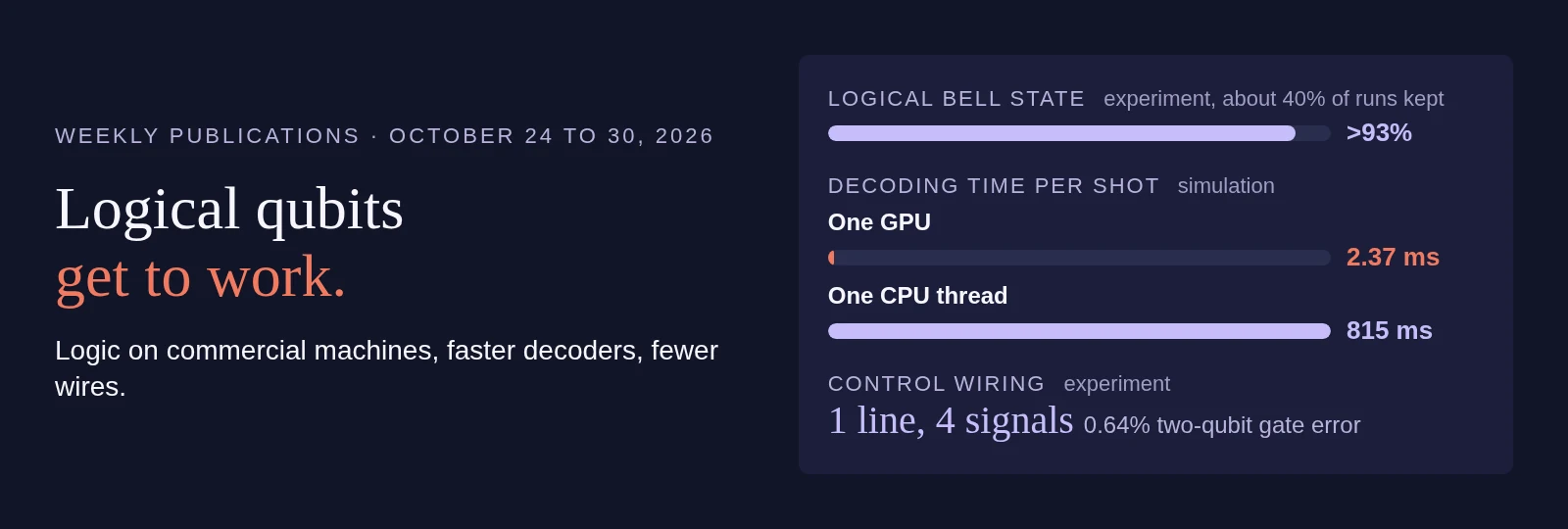
A University of Sydney group, with IBM’s Benjamin Brown as a co-author, ran distance-3 and distance-5 surface codes on ibm_phoenix, a 120-qubit IBM processor it describes as a “commercially accessible device.” Skipping weak qubits cut the distance-5 logical error per round from 1.9% to 0.9%. The team then made logical qubits interact. Lattice surgery, the main proposed way to run gates between surface codes, produced a logical Bell state between distance-3 codes with fidelity above 93% and teleportation across three logical qubits reached 78% to 93%. The 93% counts only runs where the codes were prepared correctly, about 40% of them.
On Quantinuum’s H2-2 trapped-ion machine, researchers from UCL and the UK’s National Quantum Computing Centre, with no Quantinuum authors, did the same kind of move for a denser code (arXiv 2610.39067). A [[10,2,3]] code stores two logical qubits in one block, and seven helper qubits measured one of them with 0.72% error in a single round. With three rounds, 957 verified runs showed no errors, which bounds the error below 0.26%. Each setting ran a few hundred to about a thousand times, after discarding runs that failed verification.
Both results move from storing encoded qubits to operating on them, at small size and on commercial hardware. Both also lean on throwing away bad runs. A real computer can’t discard most of its gates. How much of each run survives?
Entangled logical qubits on a superconducting quantum processor ↗