October 24 to 30, 2026
A deal, a memo and a deadline
A week when Intel paid for quantum software, D-Wave signed a memo that binds no one, and NIST put dates on the federal crypto migration.
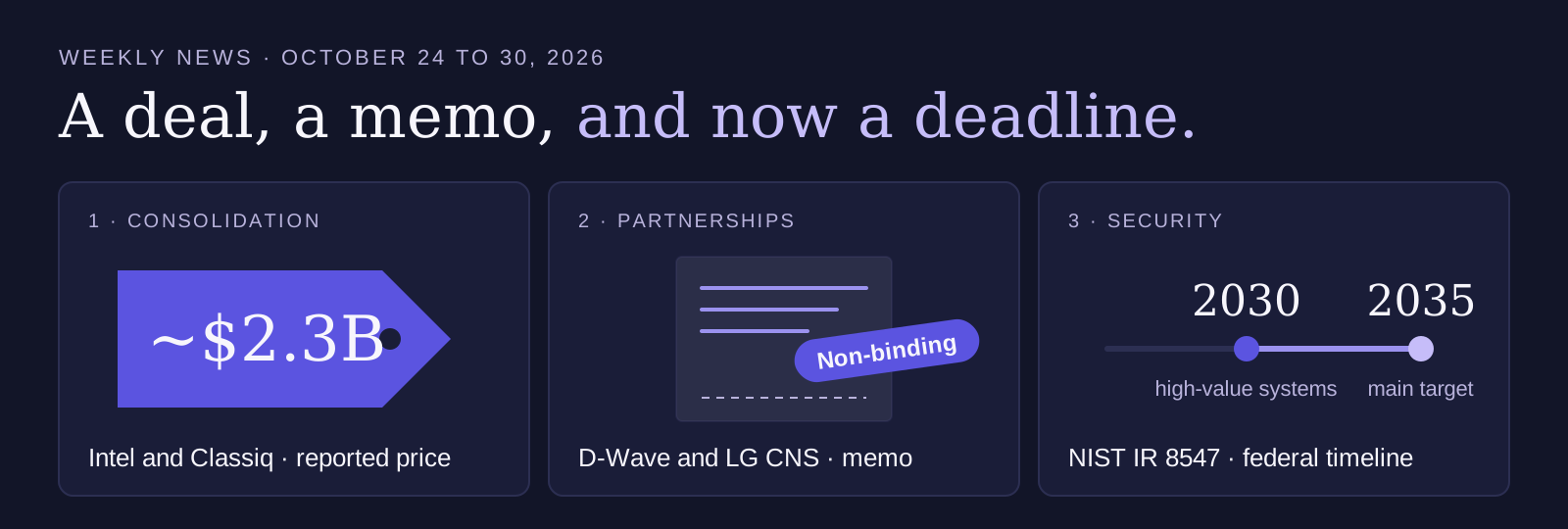
This week the money people, the salespeople and the standards people all had something to say. Intel agreed to buy Classiq, D-Wave signed a memorandum with LG CNS, and NIST told federal systems when the old cryptography has to go. I asked one question of all three. Which of them changes a cash flow, and when?
Software
Intel buys the layer above the hardware
Intel agrees to buy Classiq, a compiler that serves every chip
On October 26, Intel signed an agreement to acquire Classiq, the company whose software turns a description of an algorithm into a circuit that runs on many kinds of quantum hardware. The price was reported at about $2.3 billion, a figure Intel’s release does not give. Closing still needs approvals and is expected in the first half of 2027.
Intel announcement, Oct 26 ↗ · Business Insider, Oct 26 ↗
Think of Classiq as a compiler that does not care whose chip it feeds. Intel builds spin qubits, so the obvious worry for everyone else is that the compiler starts caring. Intel says it will keep supporting Classiq’s integrations with other hardware.
Foxconn states a manufacturing ambition
Foxconn said it wants to become the world’s largest maker of quantum computers, an ambition with no disclosed orders behind it.
A reported $2.3 billion for a software company is a reference price for a layer the listed pure plays mostly do not own. The real test comes a year after closing, when it becomes clear whether Classiq still serves Intel’s competitors.
Partnerships
A memo is not a booking
D-Wave and LG CNS sign a promise to talk
On October 28, D-Wave and LG CNS announced a non-binding memorandum of understanding to bring quantum optimization to companies in South Korea and abroad. No revenue figure was disclosed. An MOU costs little to sign and nothing to walk away from, which is why the number that matters is bookings, the orders customers actually commit to.
Quantinuum and GE Vernova start a research collaboration
Quantinuum and GE Vernova started a research collaboration on high-temperature superconductivity.
Partnerships are options, and earnings are where they get priced. D-Wave reports third-quarter results on November 10, before the market opens. I will be looking at whether bookings recover and whether any of these memos shows up in them.
Post-quantum cryptography
The crypto migration gets a calendar
NIST sets dates for retiring vulnerable cryptography
On October 27, NIST released its report on moving to post-quantum cryptography, NIST IR 8547. It maps which algorithms are vulnerable, which standards replace them, and when the old ones may be disallowed in federal systems. National Security Memorandum 10 set 2035 as the main target. Executive Order 14412 pulled high-value and high-impact systems forward to 2030 for key establishment and 2031 for digital signatures.
pQCee and Carahsoft target public-sector buyers
pQCee and Carahsoft agreed to bring post-quantum products to US public-sector buyers.
A deadline is not a forecast of when a code-breaking quantum computer arrives. It works more like a purchase order with a date on it, and it reaches contractors who sell to the government too. This is the one theme this week where demand has a date attached, and the revenue goes mostly to security vendors and integrators, not to whoever builds the quantum computer.
Briefly
Also this week
Markets · Oct 29
Listed quantum names fell in premarket trading after Alphabet’s third-quarter results, with IonQ down 2.41%, D-Wave 1.95%, Quantum Computing Inc. 2.12% and Rigetti 1.85%.
IBM · Hardware
IBM linked two 120-qubit Nighthawk processors with L-couplers and reports 99% average fidelity for moving quantum states between chips, not for full gates across them.
IonQ · Government funding
IonQ received $7.5 million in follow-on Air Force Research Laboratory funding for quantum networking, already contemplated in its original $21.1 million award.
IQM · Hardware
IQM entangled all 54 qubits of its Emerald processor and made full-chip performance available to cloud users.
PsiQuantum · Photonics
PsiQuantum showed an 8x8 optical circuit switch for AI data centers, built from its quantum photonics work.
IonQ and Quantinuum · Earnings
IonQ and Quantinuum both report third-quarter results on November 5.
SkyWater · Foundry
SkyWater opened OnRamp, a foundry program aimed at young quantum hardware companies.
Shionogi · Drug discovery
Shionogi, a D-Wave customer, received a 40 million yen NEDO prize for drug discovery work that includes quantum annealing.
IDEMIA and KT · Post-quantum cryptography
IDEMIA and KT are piloting quantum-resistant SIM cards for South Korean military networks.
This week’s research, with the three papers worth reading, is on the Publications page.
Conclusion
The weekly view
Of the three stories, only one came with a deadline. The Classiq price tells me what a hardware-neutral software layer is worth to a chipmaker, and the D-Wave memo tells me little until it shows up as bookings. The NIST calendar is the only item with demand on a date, and that demand flows to security vendors first. What I’m watching is the earnings run starting November 5, and the first federal contract that cites the 2030 deadline.
IonQ and Quantinuum report third-quarter results.
D-Wave reports third-quarter results, before the market opens.