← All publication reviewsWeekly Publications

26 September–2 October 2026 · The weekly view

Break-even, dequantization
and the control stack

Where quantum research is concentrating, what this week’s break-even and dequantization results say about the field, and the developments worth watching as an investor.

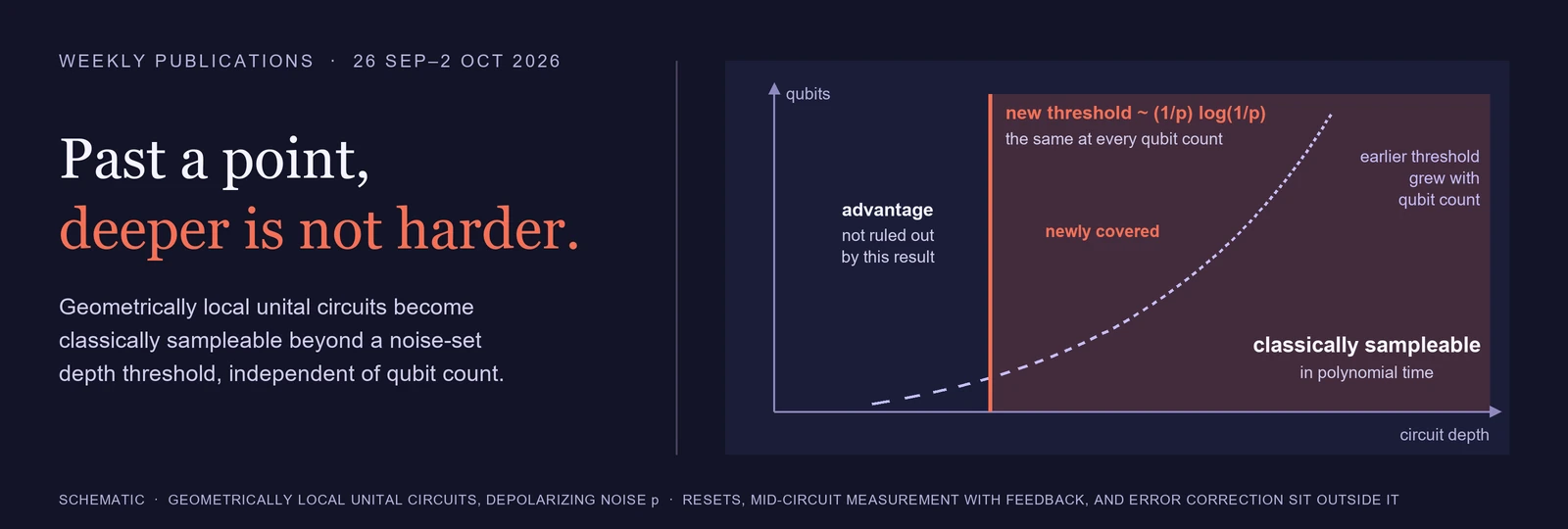
Past a point, deeper is not harder: a schematic of circuit depth against qubit count. An earlier classical-sampling threshold grew with qubit count; the new threshold, scaling as (1/p) log(1/p), is the same at every qubit count, and noisy unital circuits beyond it are classically sampleable in polynomial time under the theorem’s assumptions.
142 (65%) algorithms & software51 (24%) hardware & devices57 (26%) error correction & verificationSelected research ↓

This week’s review covers 217 arXiv papers. Sorted by what each one contributes, 65% are methods, algorithms or software, 24% involve a specific device or platform, and 26% are about keeping results correct. The hardware share fell from 38% the week before, and every paper carries at least one of the three themes.

The most important story is not a single hardware platform. The strongest papers sharpened the boundary between useful quantum computation and classical simulation from several directions at once. In this review, 32 papers sit directly on that boundary, either claiming an advantage or showing that a classical algorithm can do the job.

  1. A 120-qubit chemistry workload reached a claimed break-even.IBM Research Tokyo and partners report QPU wall-clock time comparable to estimated classical resources for electronic dynamics of a periodic molecule. The claim is workload-specific and baseline-sensitive, not broad quantum advantage.
  2. Noisy unital circuits have a depth limit.On a fixed-dimensional lattice, geometrically local unital circuits with single-qubit depolarizing noise become classically sampleable in polynomial time beyond a depth threshold that does not grow with system size.
  3. Impurity models split cleanly.Two concurrent papers make static properties classically tractable while placing the computational difficulty in dynamics, including universal time evolution and hard nonequilibrium Green’s functions.
  4. Spin-qubit initialization became less infrastructure-heavy.RIKEN initialized a silicon spin-qubit pair with a fixed microwave and baseband pulse sequence, without a local reservoir or measurement-based feedback.

Where the research connects

Counts from 217 reviewed papers

The overlap between this week’s themes

Proportional overlap between three leading research themesAreas, including all seven overlap regions, are proportional to publication counts. Algorithms and software only: 115; Hardware and devices only: 37; Algorithms and hardware, without error correction: 8; Algorithms and error correction, without hardware: 15; Hardware and error correction, without algorithms: 2; All three themes: 4; Error correction and verification only: 36. Outside these themes: No publication.Algorithms & software142 publications overallHardware & devices51 publications overallError correction &verification57 publications overallAlgorithms and software only: 115 publications115Hardware and devices only: 37 publications37Algorithms and hardware, without error correction: 8 publications8Algorithms and error correction, without hardware: 15 publications15Hardware and error correction, without algorithms: 2 publications2All three themes: 4 publications4Error correction and verification only: 36 publications36
No publication falls outside these three themes. Areas, including the overlaps, are proportional to publication counts. Each region shows only its combination of labels.

The 51 hardware papers, by platform

  • Superconducting13
  • Photonics12
  • Materials & enabling devices11
  • Trapped ions5
  • Semiconductor & spin qubits4
  • Neutral atoms3
  • Networking systems3

Every paper in the hardware & devices theme, counted once under the platform it works on, so the bars add up to 51. Networking systems are physical network hardware and measurements, such as detectors and key-distribution equipment.

Bars use a common scale from 0 to 15 papers.

The themes are this review’s own classification, read from each paper’s abstract, and they are tags rather than categories: 25 papers carry exactly two of them and 4 carry all three. No paper carries none. They are the same three themes as the previous week’s review, so the shares compare directly. Papers are assigned to the week by first public arXiv availability, not by their raw v1 submission timestamp. For the 26 September 00:00 to 3 October 00:00 Asia/Jerusalem window, this includes every screened paper that first became public during the interval, including papers submitted earlier but delayed by arXiv’s weekend release cycle. Earlier editions dated papers by submission.

A break-even claim with its baseline attached

The most consequential experimental claim of the week comes from IBM Research Tokyo with Mitsubishi Chemical, Keio University and partners. Their workflow compresses short-time local evolution classically, then replicates that circuit structure in space and time to reach long-time dynamics of a periodic molecule. On 120 qubits of IBM hardware, the electronic dynamics of [60]annulene ran in a QPU wall-clock time comparable to the estimated time of two classical methods on tens to hundreds of compute nodes.

The comparison is what makes it worth reading, and also what limits it. The quantum side was measured; the classical side was estimated, assuming near-ideal parallel scaling. The decisive follow-up is what happens when the strongest practical tensor-network and many-body methods run under equally realistic assumptions.

The classical side keeps moving

Several papers pushed the classical frontier forward this week. The sharpest proves that geometrically local unital circuits on a fixed-dimensional lattice, with single-qubit depolarizing noise of strength p, become classically sampleable beyond a depth threshold scaling as p-1log(1/p), independent of system size. A new complexity measure, reactivity, targets the classical attacks that succeed by tracking local information even when entanglement and magic are high. Others give parallel classical simulation of noisy shallow circuits in one dimension, polynomial-time estimation of output probabilities for shallow circuits, and classical algorithms for Gibbs states and for linear statistics of boson sampling.

The other side of the boundary moved too, with provable advantages for decoded quantum interferometry and an unconditional separation between noisy planar quantum circuits and constant-depth classical circuits (the class AC0), not a separation from arbitrary polynomial-time classical algorithms. The useful reading is not that quantum advantage is shrinking. It is that the conditions under which it can exist are being written down precisely, and some of them, such as resets, mid-circuit measurement with feedback and error correction, are exactly what current hardware roadmaps are adding.

Impurity models: easy at equilibrium, universal in motion

Two groups posted concurrent results that reach the same broad conclusion. For constant-size impurity models, an IBM Research team and a team from UC Berkeley, Sandia National Laboratories and the University of Cambridge both make ground-state and thermal properties polynomial-time classical. On the dynamical side, the IBM paper proves universality for time-independent evolution, while the second proves the corresponding hardness for nonequilibrium Green’s functions, including at finite temperature.

Impurity solvers are repeatedly invoked in quantum-materials and embedding roadmaps. This pair says the equilibrium part of that story does not need a quantum computer in the asymptotic sense, and points any search for advantage toward dynamics.

Control is a scaling problem too

The hardware papers this week were fewer, and more of them were about control than about records. Beyond RIKEN’s reservoir-free initialization, a germanium single-hole spin qubit reported geometric-gate control fidelity above 99.9%, and a Grover-based sensing protocol on a single superconducting qubit and cavity at Cornell beat its non-Grover baseline above a 10 MHz detection bandwidth, cutting the signal needed for a decision by more than ten times in favorable settings.

Fault tolerance kept compounding in theory: a scheme for injecting states into codes with constant space and time overhead, two constructions of asymptotically good codes with fully addressable transversal T gates, new bounds on the intrinsic cost of syndrome extraction, and, from IBM Quantum, non-Abelian qLDPC codes with an almost-constant-overhead magic-state fountain. 57 papers carry the error correction & verification tag, and 6 of them report measurements on a real device.

The research footprint

Countries and regions represented in the review

A global view of participation

Hover, tap, or choose a country or region.

United States71reviewed publications
Research participation by country and regionDarker purple shows a larger number of reviewed publications. Gray means not represented in this review. Use the country selector for individual publication counts, including small regions.Afghanistan: Not represented in this reviewAlbania: Not represented in this reviewAlgeria: Not represented in this reviewAmerican Samoa: Not represented in this reviewAndorra: Not represented in this reviewAngola: Not represented in this reviewAnguilla: Not represented in this reviewAntigua and Barb.: Not represented in this reviewArgentina: 1 publication in this reviewArmenia: Not represented in this reviewAruba: Not represented in this reviewAshmore and Cartier Is.: Not represented in this reviewAustralia: 8 publications in this reviewAustria: 2 publications in this reviewAzerbaijan: Not represented in this reviewBahamas: Not represented in this reviewBahrain: Not represented in this reviewBangladesh: Not represented in this reviewBarbados: Not represented in this reviewBelarus: Not represented in this reviewBelgium: 3 publications in this reviewBelize: Not represented in this reviewBenin: Not represented in this reviewBermuda: Not represented in this reviewBhutan: Not represented in this reviewBolivia: Not represented in this reviewBosnia and Herz.: Not represented in this reviewBotswana: Not represented in this reviewBr. Indian Ocean Ter.: Not represented in this reviewBrazil: 1 publication in this reviewBritish Virgin Is.: Not represented in this reviewBrunei: Not represented in this reviewBulgaria: Not represented in this reviewBurkina Faso: Not represented in this reviewBurundi: Not represented in this reviewCabo Verde: Not represented in this reviewCambodia: Not represented in this reviewCameroon: Not represented in this reviewCanada: 5 publications in this reviewCayman Is.: Not represented in this reviewCentral African Rep.: Not represented in this reviewChad: Not represented in this reviewChile: Not represented in this reviewChina: 29 publications in this reviewColombia: Not represented in this reviewComoros: Not represented in this reviewCongo: Not represented in this reviewCook Is.: Not represented in this reviewCosta Rica: Not represented in this reviewCroatia: Not represented in this reviewCuba: Not represented in this reviewCuraçao: Not represented in this reviewCyprus: Not represented in this reviewCzechia: 2 publications in this reviewCôte d'Ivoire: Not represented in this reviewDem. Rep. Congo: Not represented in this reviewDenmark: 1 publication in this reviewDjibouti: Not represented in this reviewDominica: Not represented in this reviewDominican Rep.: Not represented in this reviewEcuador: Not represented in this reviewEgypt: Not represented in this reviewEl Salvador: Not represented in this reviewEq. Guinea: Not represented in this reviewEritrea: Not represented in this reviewEstonia: Not represented in this reviewEthiopia: Not represented in this reviewFaeroe Is.: Not represented in this reviewFalkland Is.: Not represented in this reviewFiji: Not represented in this reviewFinland: 1 publication in this reviewFr. Polynesia: Not represented in this reviewFr. S. Antarctic Lands: Not represented in this reviewFrance: 12 publications in this reviewGabon: Not represented in this reviewGambia: Not represented in this reviewGeorgia: Not represented in this reviewGermany: 30 publications in this reviewGhana: Not represented in this reviewGreece: 1 publication in this reviewGreenland: Not represented in this reviewGrenada: Not represented in this reviewGuam: Not represented in this reviewGuatemala: Not represented in this reviewGuernsey: Not represented in this reviewGuinea: Not represented in this reviewGuinea-Bissau: Not represented in this reviewGuyana: Not represented in this reviewHaiti: Not represented in this reviewHeard I. and McDonald Is.: Not represented in this reviewHonduras: Not represented in this reviewHong Kong: 2 publications in this reviewHungary: 1 publication in this reviewIceland: Not represented in this reviewIndia: 6 publications in this reviewIndian Ocean Ter.: Not represented in this reviewIndonesia: Not represented in this reviewIran: 1 publication in this reviewIraq: Not represented in this reviewIreland: 1 publication in this reviewIsle of Man: Not represented in this reviewIsrael: Not represented in this reviewIsrael: Not represented in this reviewItaly: 8 publications in this reviewJamaica: Not represented in this reviewJapan: 20 publications in this reviewJersey: Not represented in this reviewJordan: Not represented in this reviewKazakhstan: Not represented in this reviewKenya: Not represented in this reviewKiribati: Not represented in this reviewKosovo: Not represented in this reviewKuwait: Not represented in this reviewKyrgyzstan: Not represented in this reviewLaos: Not represented in this reviewLatvia: Not represented in this reviewLebanon: Not represented in this reviewLesotho: Not represented in this reviewLiberia: Not represented in this reviewLibya: Not represented in this reviewLiechtenstein: Not represented in this reviewLithuania: Not represented in this reviewLuxembourg: Not represented in this reviewMacao: Not represented in this reviewMacedonia: Not represented in this reviewMadagascar: Not represented in this reviewMalawi: Not represented in this reviewMalaysia: Not represented in this reviewMaldives: Not represented in this reviewMali: Not represented in this reviewMalta: Not represented in this reviewMarshall Is.: Not represented in this reviewMauritania: Not represented in this reviewMauritius: Not represented in this reviewMexico: Not represented in this reviewMicronesia: Not represented in this reviewMoldova: Not represented in this reviewMonaco: Not represented in this reviewMongolia: Not represented in this reviewMontenegro: Not represented in this reviewMontserrat: Not represented in this reviewMorocco: Not represented in this reviewMozambique: Not represented in this reviewMyanmar: Not represented in this reviewN. Cyprus: Not represented in this reviewN. Mariana Is.: Not represented in this reviewNamibia: Not represented in this reviewNauru: Not represented in this reviewNepal: Not represented in this reviewNetherlands: 6 publications in this reviewNew Caledonia: Not represented in this reviewNew Zealand: Not represented in this reviewNicaragua: Not represented in this reviewNiger: Not represented in this reviewNigeria: Not represented in this reviewNiue: Not represented in this reviewNorfolk Island: Not represented in this reviewNorth Korea: Not represented in this reviewNorway: 1 publication in this reviewOman: Not represented in this reviewPakistan: Not represented in this reviewPalau: Not represented in this reviewPanama: Not represented in this reviewPapua New Guinea: Not represented in this reviewParaguay: Not represented in this reviewPeru: Not represented in this reviewPhilippines: Not represented in this reviewPitcairn Is.: Not represented in this reviewPoland: 3 publications in this reviewPortugal: 2 publications in this reviewPuerto Rico: Not represented in this reviewQatar: Not represented in this reviewRomania: Not represented in this reviewRussia: Not represented in this reviewRwanda: Not represented in this reviewS. Geo. and the Is.: Not represented in this reviewS. Sudan: Not represented in this reviewSaint Helena: Not represented in this reviewSaint Lucia: Not represented in this reviewSamoa: Not represented in this reviewSan Marino: Not represented in this reviewSaudi Arabia: Not represented in this reviewSenegal: Not represented in this reviewSerbia: Not represented in this reviewSeychelles: Not represented in this reviewSiachen Glacier: Not represented in this reviewSierra Leone: Not represented in this reviewSingapore: 11 publications in this reviewSint Maarten: Not represented in this reviewSlovakia: Not represented in this reviewSlovenia: Not represented in this reviewSolomon Is.: Not represented in this reviewSomalia: Not represented in this reviewSomaliland: Not represented in this reviewSouth Africa: Not represented in this reviewSouth Korea: 9 publications in this reviewSpain: 7 publications in this reviewSri Lanka: Not represented in this reviewSt-Barthélemy: Not represented in this reviewSt-Martin: Not represented in this reviewSt. Kitts and Nevis: Not represented in this reviewSt. Pierre and Miquelon: Not represented in this reviewSt. Vin. and Gren.: Not represented in this reviewSudan: Not represented in this reviewSuriname: Not represented in this reviewSweden: 1 publication in this reviewSwitzerland: 11 publications in this reviewSyria: Not represented in this reviewSão Tomé and Principe: Not represented in this reviewTaiwan: 1 publication in this reviewTajikistan: Not represented in this reviewTanzania: Not represented in this reviewThailand: Not represented in this reviewTimor-Leste: Not represented in this reviewTogo: Not represented in this reviewTonga: Not represented in this reviewTrinidad and Tobago: Not represented in this reviewTunisia: Not represented in this reviewTurkey: 1 publication in this reviewTurkmenistan: Not represented in this reviewTurks and Caicos Is.: Not represented in this reviewU.S. Virgin Is.: Not represented in this reviewUganda: Not represented in this reviewUkraine: Not represented in this reviewUnited Arab Emirates: 1 publication in this reviewUnited Kingdom: 19 publications in this reviewUnited States: 71 publications in this reviewUruguay: Not represented in this reviewUzbekistan: Not represented in this reviewVanuatu: Not represented in this reviewVatican: Not represented in this reviewVenezuela: Not represented in this reviewVietnam: Not represented in this reviewW. Sahara: Not represented in this reviewWallis and Futuna Is.: Not represented in this reviewYemen: Not represented in this reviewZambia: Not represented in this reviewZimbabwe: Not represented in this revieweSwatini: Not represented in this reviewÅland: Not represented in this review
Reviewed publications
020406080
Not represented in this review
Affiliation locations; a cross-border collaboration can contribute to several countries. Country or region information is available for 183 of 217 reviewed publications. Map: Natural Earth.

Affiliations were resolved for 183 of 217 papers from the text of each preprint. A missing country here means missing metadata, not an absence of research, and a paper with authors in several countries contributes to each of them.

The United States leads, with China, Germany and Japan behind it. Company-linked work this week centers on IBM, which appears on both the break-even claim and an impurity-model paper, with QuEra on the noisy-circuit sampler and Japanese industrial partners on the chemistry workload.

Selected research, company context

The four results I rank highest this week

IBM

NYSE: IBM

IBM Research Tokyo, with Mitsubishi Chemical, Keio University, Deloitte Tohmatsu, JSR and TCG CREST

IBM claims chemistry break-even on a 120-qubit macrocycle

The workflow optimizes circuits classically for short-time evolution of a small region, then replicates them in space and time to build long-time dynamics of a periodic molecule, without simulating the full evolution classically. The largest case is [60]annulene on 120 qubits of IBM hardware. For its hole-doped nonequilibrium dynamics, the authors report useful accuracy with a QPU wall-clock time comparable to the estimated wall-clock time of two classical methods, Majorana propagation and matrix-product-state time evolution, on tens to hundreds of 36-core compute nodes.

Why it matters. This tests a chemistry workload against named classical methods, which is more informative than another synthetic benchmark. The caveats are the result itself: the classical side is an estimate that assumes near-ideal parallel scaling, the quantum circuits lean on substantial classical tensor-network pre-optimization, and the molecule is a highly structured periodic ring. Break-even here is workload-specific, not broad quantum advantage.

Quantum--classical break-even in electronic dynamics of macrocyclic molecules ↗

Preprint · September–October 2026

QuEra Computing

Private

University of Maryland, UCLA, QuEra Computing, Princeton University and Stanford University

A depth limit for noisy unital circuits

The authors prove that any geometrically local circuit of unital operations on a lattice of fixed dimension, interspersed with single-qubit depolarizing noise of strength p, can be approximately sampled by a polynomial-time classical algorithm beyond a depth threshold scaling as p-1log(1/p), independent of system size. Earlier samplers needed depth growing with the number of qubits; here local accumulation of noise is enough.

Why it matters. It is a negative result for the hope that simply making noisy unitary circuits larger will keep extending quantum advantage. The assumptions bound it: non-unital operations, resets, mid-circuit measurement with feedback, and full error correction sit outside the theorem’s core setting, which is exactly where serious hardware roadmaps are heading.

A polynomial-time classical sampler for noisy quantum circuits from statistical mechanics ↗

Preprint · September–October 2026

IBM

NYSE: IBM

IBM Research

Impurity models: easy at equilibrium, universal in motion

For a constant-size interacting impurity coupled to a bath of free fermions, the authors give polynomial-time classical algorithms for the ground energy and for thermal quantities such as the free energy, improving on the previous quasi-polynomial runtime. Real-time evolution under a fixed, time-independent impurity Hamiltonian, by contrast, is BQP-complete: it can encode universal quantum computation.

Why it matters. Impurity solvers sit inside quantum-materials and embedding roadmaps, so this redraws where quantum value can survive in that workflow: not in the static properties, at least asymptotically, but in the dynamics. A second group posted a concurrent result reaching the same broad split. Practical prefactors, and how this carries into full DMFT workflows, remain open.

Quantum impurity models: easy at equilibrium, universal in motion ↗

Preprint · September–October 2026

Academic research

No company author affiliation · Intel-fabricated device

RIKEN Center for Emergent Matter Science and RIKEN Center for Quantum Computing

Spin-qubit initialization without a reservoir or a feedback loop

In an industrially fabricated Si/SiGe quantum-dot device made by Intel, a fixed sequence of microwave and baseband pulses initializes a silicon spin-qubit pair with no local reservoir access and no measurement-based feedback. Repeated cycles produce the target singlet-associated charge outcome with a median probability of 99.4% across the sampled preparation states, using about 12 μs of microwave bursts and mixing dwells. The authors project sub-microsecond initialization on improved devices.

Why it matters. Dense spin-qubit arrays cannot easily give every interior qubit its own reservoir and feedback wiring, so this is an architectural control result rather than another fidelity record. The test is whether it stays uniform, fast and accurate across a large two-dimensional array.

Reservoir- and Measurement-free Microwave Initialization of Semiconductor Spin Qubits ↗

Preprint · September–October 2026

What I’ll be watching

For the break-even claim, the decisive follow-up is the classical baseline under equally realistic assumptions, and whether the method generalizes beyond periodic one-dimensional structures. For the noisy-circuit theorem, the question is where present and near-term advantage experiments sit relative to its depth and noise regime, and how quickly non-unital operations or error correction change the picture.

For impurity models, I would look for end-to-end embedding resource comparisons that separate asymptotic tractability from practical runtime. For silicon spin qubits, the evidence should be array-level: initialization accuracy, latency and uniformity across many devices. The strongest papers this week were not defined by larger numbers. They made the boundary between quantum capability, classical attack and scalable control more explicit.