Where quantum research is concentrating, what a contested advantage claim and a wave of new codes say about the field, and the developments worth watching as an investor.
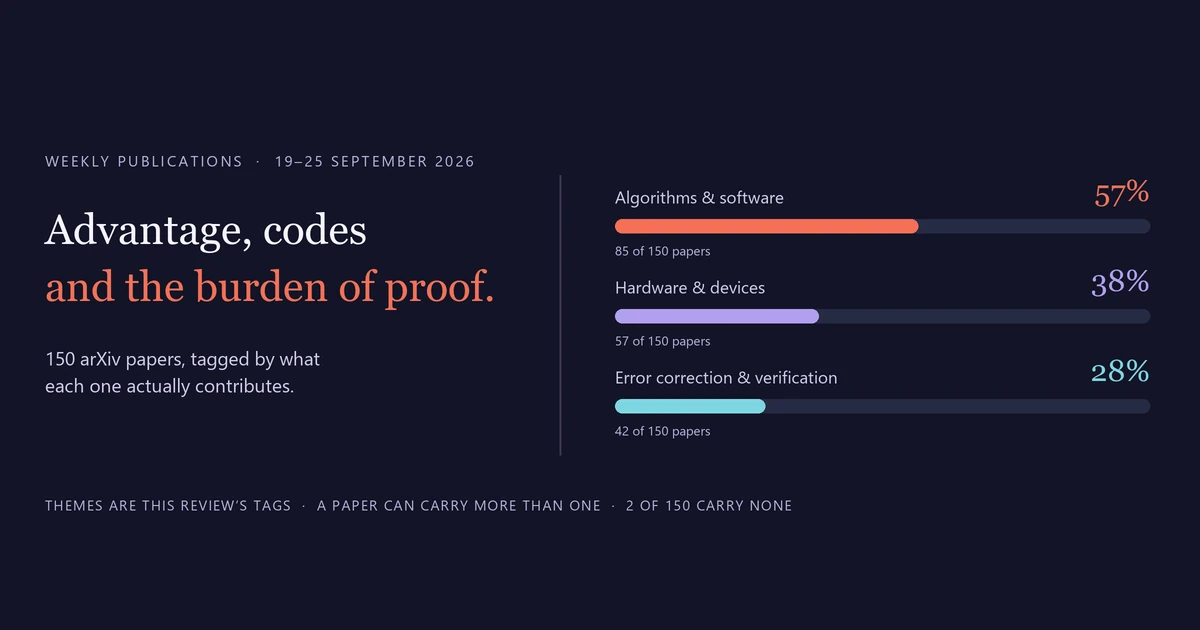
This week’s review covers 150 arXiv papers. Sorted by what each one actually contributes, 57% are methods, algorithms or software, 38% involve a specific device or platform, and 28% are about keeping results correct, through codes, decoders, calibration or verification. Only 2 papers sit outside all three.
The common question is uncomfortable: how do we know that a quantum machine did what it claims? A new advantage claim, a wave of code constructions and an unusually large crop of verification papers all circle the same problem from different sides.
An advantage claim arrived through the standard cloud queue.Random-circuit sampling on 61 qubits of IBM’s Nighthawk r2, with no benchmark-specific calibration, against an estimated classical cost of more than a century on the Frontier supercomputer. The quantum side was measured; the classical number is a model, not a simulation anyone ran.
A new code front is moving unusually fast.A week after an explicit construction of good quantum locally testable codes, five related papers appeared: one applies that construction directly to transversal non-Clifford gates, others reach good codes by new routes, and one uses them for fault tolerance with constant space and logarithmic time overhead.
Error correction is moving from code theory into the hardware stack.Bosonic error correction ran in a fully planar superconducting circuit for the first time, and decoders, lattice surgery and magic-state runtimes produced results aimed at running hardware rather than at proofs.
Where the research connects
Counts from 150 reviewed papers
The overlap between this week’s themes
2 publications fall outside these three themes. Areas, including the overlaps, are proportional to publication counts. Each region shows only its combination of labels.
The 57 hardware papers, by platform
Superconducting14
Photonics14
Trapped ions9
Networking systems6
Neutral atoms6
Semiconductor & spin qubits5
Materials & enabling devices3
051015
Every paper in the hardware & devices theme, counted once under the platform it works on, so the bars add up to 57. Networking systems are physical network experiments: quantum memories, key-distribution links and deployed fiber. Network protocols without hardware are not counted here.
Bars use a common scale from 0 to 15 papers.
The themes are this review’s own classification, read from each paper’s abstract, and they are tags rather than categories: 32 papers carry exactly two of them and 2 carry all three, which is where the week’s connections show. Only 2 papers carry none. Counts cover arXiv announcements from 19 to 24 September, since the last day of the window is announced after this review was compiled.
An advantage claim arrives through a cloud queue
The loudest result of the week is a claim of quantum computational advantage in random-circuit sampling, and the interesting part is not the claim itself. It is where it ran. The team used a commercially available IBM processor through the ordinary cloud stack, with no calibration tuned to the benchmark, which means other people can attempt the same thing.
The honest reading is that the quantum side is measured and the classical side is estimated. Collecting one million samples took 19 seconds. The classical cost is a contraction-cost model, and previous landmark sampling claims have repeatedly been narrowed, sometimes substantially, by better classical algorithms arriving afterwards. Treat it as a claim with a clock on it.
The story is the speed and concentration, not a single family tree. The open question for investors is whether results like these start to change the overhead and logical-gate assumptions behind fault-tolerant architectures. For now it is theory, and the path from a code with good asymptotic parameters to a decoder, a control system and a physical qubit budget is precisely where the difficult engineering begins.
Error correction is moving from code theory into the hardware stack
The clearest physical example is bosonic error correction in a fully planar superconducting circuit. Leading superconducting bosonic-QEC demonstrations have relied on centimeter-scale 3D microwave cavities, which work well but are awkward to integrate. Pairing a long-lived fluxonium with an on-chip spiral resonator puts the same idea into a planar circuit, with the logical lifetime extended by a factor of 1.59 over the same system without active correction.
Around it, the fault-tolerant stack produced engineering rather than proofs. An IonQ team applied a new soft decoder to recent quantum LDPC memory experiments on trapped ions and reports doubled logical lifetimes, at the cost of discarding 2.6% to 5.6% of shots per syndrome round. Other papers spread lattice surgery across separate modules with noisier links between them, build a runtime layer for magic-state cultivation, and read decoder confidence from drifting IBM hardware. In this review, 42 of the 150 papers were classified under error correction or verification, and 7 of those report measurements on a real device.
The question is shifting. Writing efficient codes is getting easier. Whether the hardware, the control electronics and the classical infrastructure can actually run them is the harder test.
Checking the machine is becoming its own field
19 papers this week are, at their core, about learning or verifying what a quantum system is actually doing: Hamiltonian learning, certification of fermionic Gaussian states, tomography of states with both entanglement and magic, and the fidelity estimators behind the advantage claim.
One of them is a caution worth keeping. A study of the variational quantum eigensolver on two IBM Heron r3 processors found evidence that finite-shot optimization can make energies look artificially accurate: seven optimizer-selected values fell below the exact answer, and most of that advantage disappeared when the same points were measured again. When a result is selected for being good, part of what gets selected is luck.
The research footprint
Countries and regions represented in the review
A global view of participation
Hover, tap, or choose a country or region.
United States50reviewed publications
Reviewed publications
012.52537.550
Not represented in this review
Affiliation locations; a cross-border collaboration can contribute to several countries. Country or region information is available for 132 of 150 reviewed publications. Map: Natural Earth.
Affiliations were resolved for 132 of 150 papers from the text of each preprint. A missing country here means missing metadata, not an absence of research, and a paper with authors in several countries contributes to each of them.
The company-linked work this week is spread thin and wide: a San Francisco startup running on IBM hardware, an IonQ decoder team, a Vienna company on a satellite, and national laboratories on both sides of the Atlantic. The largest single-country total is the United States, with Germany, China and Japan behind it.
IBM hardware, accessed through the ordinary cloud queue. Authors are from BlueQubit in San Francisco, EPFL and the XPRIZE Foundation
An advantage claim that anyone can rerun
Using 61 qubits of IBM’s 120-qubit Nighthawk r2 processor, native CZ gates and the standard cloud stack with no benchmark-specific calibration, the team sampled random circuits at depths up to 40 cycles. Two independent fidelity estimators agree across two orders of magnitude of decay. At 36 cycles the cross-entropy fidelity is 2.3×10⁻³, and collecting a million samples takes 19 seconds.
Why it matters. The classical comparison is a cost model, not a simulation anyone ran: roughly 1022 operations per amplitude and 1.2×1027 machine operations in total, which the authors translate into more than a century on the Frontier supercomputer under favorable memory assumptions. Earlier landmark sampling claims have repeatedly been narrowed by better classical algorithms, and this one invites the same test. What is genuinely new is the setting: a commercially available machine, the standard cloud queue, and a result other people can try to reproduce.
Massachusetts Institute of Technology, with ETH Zürich and Université de Sherbrooke
Bosonic error correction leaves the 3D cavity behind
Bosonic codes store a logical qubit in an oscillator, and leading superconducting implementations have relied on centimeter-scale 3D microwave cavities controlled by transmon ancillas. This team pairs a heavy fluxonium, with a bit-flip lifetime of 451 ± 70 μs, with an on-chip spiral resonator far smaller in mode volume. They prepare finite-energy GKP states and stabilize them with measurement-free correction, extending the logical lifetime by a factor of 1.59 ± 0.05.
Why it matters. Hardware-efficient error correction matters because it changes the qubit count a useful machine needs. Moving the architecture into a fully planar circuit makes it far more compatible with planar chip fabrication and integration. The gain is measured against the same system left uncorrected, not against the best available physical qubit, and one resonator is a long way from a processor.
University of Vienna and QUBO Technology, with the German Aerospace Center, IFN-CNR in Milan and the Federal University of Santa Catarina
A photonic processor that survived a rocket launch
A programmable six-mode photonic circuit on a nanosatellite generated, manipulated and detected single photons in orbit, and the team tuned two photons into indistinguishability to observe two-photon interference. Quantum light has been sent through space before, for secure communication and fundamental tests. The authors say this is the first time it has been used in orbit as a computational resource.
Why it matters. Satellites are a plausible early use case for small quantum processors, because onboard computing is hard-limited by size, weight and power, and because a satellite is already a node in a future quantum network. Two photons in six modes computes nothing useful yet. The result is that the hardware maintained the conditions needed for quantum interference after launch and in the thermal and radiation environment of orbit.
The advantage claim has an obvious follow-up: whether a classical group answers it, and how quickly. That answer, either way, is more informative than the claim. For the codes, the test is whether any of this theory produces a decoder and a resource estimate that a hardware group can actually use.
On the hardware side, planar bosonic error correction has to survive the move from one resonator to many, and the verification work has to reach the point where a company’s published number carries an independent check with it. The pattern this week is that the field is getting better at asking for proof. The proofs themselves are still arriving.