Five takeaways from a week of deals, logical qubits and public money.
Last week’s report followed the pieces of the quantum stack starting to connect. This week was about commitments: three system deals, two with 2027 installation dates, a national competition shortlist, a new research center and half-year results. The clearest hardware result came from Infleqtion, and it arrives with an important qualifier.
The commitments are arriving faster than the machines.
01
Deployment
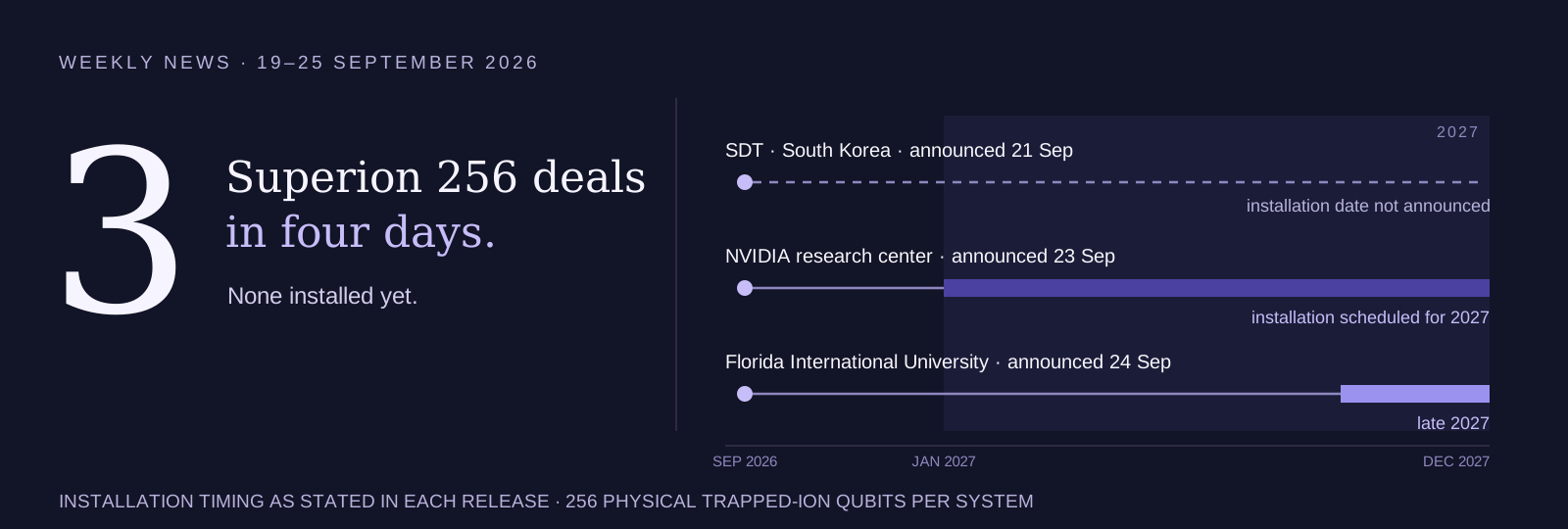
Three Superion deals in four days, none installed yet
IonQ announced three deployment agreements for its Superion 256, a system of 256 physical trapped-ion qubits: a partnership with SDT, a research partnership with NVIDIA and a sale to Florida International University. The two with installation dates both point to 2027, the delivery target IonQ gave when it launched the product line. What the week showed is commitment; what it did not show is delivery.
From announcement to installationInstallation timing as each release states it
Sep 2026Jan 2027Dec 2027
SDT · South KoreaAnnounced 21 Sep. A multi-year partnership: IonQ supplies a Superion 256 for an SDT customer, plus its quantum-memory module; SDT builds an assembly and packaging site in Gumi. Release ↗
No date announced
NVIDIA research centerAnnounced 23 Sep. A research partnership, not a sale: the first on-premises quantum computer at NVIDIA’s Accelerated Quantum Research Center, linked to a GB200 NVL72 over NVQLink. Release ↗
2027
Florida International UniversityAnnounced 24 Sep. A sale: Florida’s first on-premises trapped-ion system, installed after FIU finishes its campus data center. Release ↗
Late 2027
The shaded area marks 2027. “Late 2027” is drawn as September to December. No contract values were disclosed.
The investor question: can IonQ turn these Superion agreements into installed, working systems on the dates it has given?
02
Logical qubits
30 logical qubits, without real-time error correction
How 80 atoms became 30 logical qubitsTen blocks of eight atoms, three logical qubits per block
3
3
3
3
3
3
3
3
3
3
80 atoms → 10 blocks →30 logical qubits
Infleqtion entangled 30 logical qubits on its Sqale neutral-atom computer, in a circuit of about 1,000 physical operations. Outputs the ideal circuit allows appeared about 1,000 times more often than random sampling would produce them. Last week the company designed a larger code in software; this week it ran a smaller one on hardware.
Shown
30 logical qubits entangled in one circuit on a commercial machine
How
A code that detects any single error; runs with a detected error were discarded, and the measurement of one lost atom in a block could be reconstructed afterward in software
Tested on simulated workloads: up to 408 logical qubits, more than a million T gates in one circuit, and 31.5 million rounds of error checking summed across memory blocks. Decoding added under 0.3% to run time at lower error rates and up to 12% at higher ones. Not yet run on data from a real machine; the preprint dates from August.
The two are working to extend Microsoft’s resource estimator to distributed machines linked by optical interconnects, and to advanced codes such as Photonic’s SHYPS. The new capabilities have not been released yet.
Three results with real numbers behind them. Each holds on the case tested, and none is a claim that quantum computers now beat classical ones in general.
Q-CTRL · IBM Nighthawk R2
23 s vs 4 min 25 s
Nighthawk R223 s
Heron R3265 s
A 60-qubit physics simulation run through Q-CTRL’s Fire Opal software, with results within 1% of the Heron run. A hardware-generation comparison on one workload; Q-CTRL also derives a more than 400x lower bound against the classical GPU benchmark from its earlier study.
Spotting changes in radar images of one airfield. The simulated quantum model scored 0.41; with training and inference both on IonQ’s Forte Enterprise it scored 0.32, still above both classical baselines. On interferometric data, all methods were comparable.
On a representative model of Israel Natural Gas Lines’ network, a simulator run recovered the classical maximum-throughput point. A reduced version run on IonQ Forte-1 produced valid candidates close to it. No advantage is claimed.
All three are company-reported. The F1 bars share a 0–0.5 scale; the Q-CTRL bars share a 0–265 second scale.
04
Public money
Governments are choosing their lanes
Germany shortlisted six consortia, two for each of three qubit technologies, in a competition with up to €640 million in planned funding. Its goal is at least two fault-tolerant quantum computers by 2030.
Germany’s Quantum Computing CompetitionSix shortlisted consortia · named where the lead announced it this week
Neutral atoms
LOGIQC · led by planqcError-corrected machine on ytterbium atoms, with universal logical operationsplanqc · 22 Sep ↗
Second consortium
Trapped ions
NFQC-1k · led by QUDORAAt least 1,000 qubits and 50 logical qubits, plus a QPU pilot line; about €122M proposed over up to five yearsQUDORA · 22 Sep ↗
Second consortium
Superconducting circuits
Consortium
Consortium
Next gate: at least one partner in each consortium must show a working system meeting the entry criteria by 31 March 2027. Being shortlisted is not the same as receiving the money; QUDORA’s €122 million is a proposed project volume.
05
Company results
Revenue is still small next to the spending
QTREX · first-half revenue$1.55M
Up about 438%, but all of it came from AME, a business acquired on 6 April, so the jump is not like-for-like growth. Gross margin was 61%, against a $6.4 million net loss. QTREX makes connectivity and electronics for quantum computers; its INSU300 material, launched 23 September, is with two government and defense organizations for validation. Results ↗
Pasqal · first half of 2026€ millions · all bars on one 0–120 scale
Revenue
€4.9M
Operating loss
€59.2M
Booked & awarded
€70.4M
Cash, 30 June
€110.8M
0306090120
Revenue rose 14% and QPU-related services rose 34% to €3.9 million. Booked and awarded business includes grants and tax credits as well as multi-year customer contracts. The solid part of the loss bar is €37.5 million of share-based payments and one-time charges; the hatched part is the remaining €21.7 million. Pasqal results · 24 September ↗
06
New, resurfaced, unverified
What was new this week, and what was not
I found no demonstration of real-time error correction on hardware and no quantum-advantage comparison against a newly run classical baseline. That is an observation about this review’s coverage, not an exhaustive count of everything published worldwide.
New items, older items that resurfaced, and claims that did not check out
New this week
Three Superion 256 deals
30 logical qubits on Infleqtion’s Sqale
Germany’s competition shortlist
Microsoft’s Maryland center opening
Photonic and Microsoft resource estimation
Pasqal and QTREX half-year results
Older work, new coverage
Quantinuum’s anyon gates: a Nature paper from July, covered again 25 Sep
EPB’s IonQ Forte Enterprise: launched 18 Sep, in last week’s report
QuEra and HPE: dated 17 Sep, surfaced again 22 Sep
IonQ’s decoder: announced 22 Sep, from an August preprint
IonQ’s radar result: announced 24 Sep, from a 4 Sep preprint
Did not check out
Alice & Bob “€80M+ EU funding”: no primary source; April’s EIC selection is €10–30M per company, still in negotiation
PsiQuantum “mass production”: no new PsiQuantum announcement; the story retells older chipset news
A D-Wave link to CGI’s Quantum Pathfinder: CGI’s release does not name D-Wave; the CGI and D-Wave partnership is a separate deal
Claims were checked against company releases, filings and the journal or preprint of record.
The weekly view
Deals before machines
Last week the pieces started to connect. This week brought deals, a shortlist and a new research center: commitments that, where dated, pay off in 2027. The clearest hardware result, Infleqtion’s 30 logical qubits, relied on error detection and offline loss correction rather than real-time error correction.