
Funded · wafers running
Anderon IBM
A 300 mm quantum foundry: a $1 billion CHIPS award plus $1 billion from IBM.
IBM announcement · 16 September ↗12–18 September 2026
Five takeaways from quantum computing’s push toward shared infrastructure.
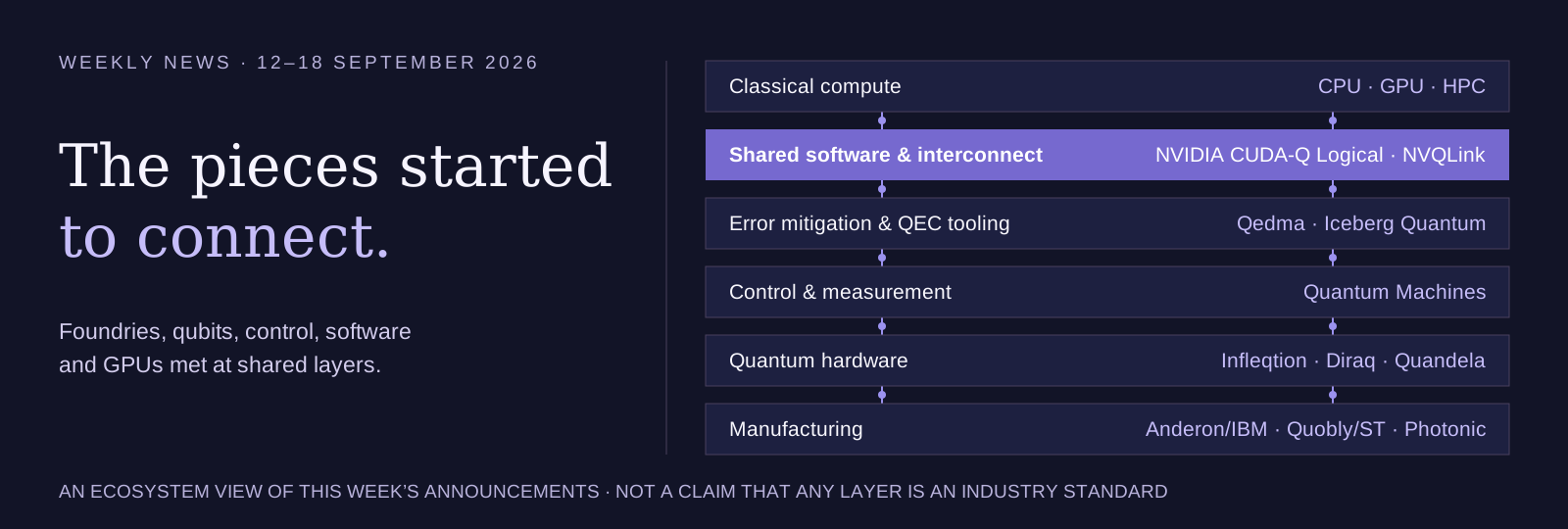
Last week’s report followed the factory being built around the quantum computer. This week, more pieces of that factory started connecting to one another: software across different hardware platforms, quantum processors linked directly to GPUs, quantum chips moving through 300 mm semiconductor lines, and physical systems arriving in new regions.
The stack is becoming more connected before the quantum computer itself becomes broadly useful. Most of the week’s progress sits in the layers around the qubit. The proof that those layers add up to useful computation is still ahead.
Software & integration
NVIDIA was everywhere this week. CUDA-Q Logical extends its open-source CUDA-Q platform into the design of fault-tolerant systems, while NVQLink connects quantum hardware directly to classical computing infrastructure.
The point is not that NVIDIA has already become the operating system of quantum computing. It is that companies using very different qubit technologies are starting to meet at the same software layer, with very different levels of evidence behind what each one showed.
The investor question: can NVIDIA turn early cross-platform adoption into a durable software position before the hardware architecture settles?
Ran a CUDA-Q program end to end across live qubits, its control hardware, GPUs and CPUs over NVQLink. Source ↗
Live hardware demoIntegrated its QESEM error-mitigation software into CUDA-Q, available first with Quantinuum hardware. Source ↗
Software integrationUsed CUDA-Q Logical to construct and validate a [[98,18,4]] qLDPC code: 18 logical qubits encoded in 98 data qubits. A code design, not an 18-logical-qubit hardware run. Source ↗
Code constructionMapped Iceberg Quantum’s Pinnacle error-correction architecture onto Diraq’s silicon-spin hardware constraints. The model reaches 1,000 logical qubits with 150,000 physical qubits; NVIDIA says this is roughly 10x below Diraq’s previous estimate. Source ↗
Resource estimateDescribed an architecture for placing photonic QPUs beside GPU and HPC resources over NVQLink. Source ↗
Architecture white paperEvidence labels are this report’s reading of each announcement. The banner shows where each company sits in the stack; it is an ecosystem view, not a claim that CUDA-Q is already an industry standard.
Manufacturing
The wafer scale used throughout advanced semiconductor manufacturing
The largest manufacturing announcement came from IBM. Anderon, IBM’s pure-play quantum foundry, finalized a $1 billion CHIPS award with the U.S. Department of Commerce for its Albany, New York operation, and IBM is adding $1 billion of its own. IBM says the first quantum wafers are already running through the facility.
The number to watch is not only the $2 billion. It is 300 mm.
Quobly supplied a second example from silicon spin qubits: qubit readout, single-qubit gates and two-qubit gates on one QSOI chip made on STMicroelectronics’ commercial 300 mm FD-SOI line. No gate fidelities were disclosed; Quobly says performance metrics will follow in a scientific publication. So this does not show that commercial fabs can already produce high-quality quantum processors at scale. It shows something earlier in the chain: basic quantum operations survived the move onto an industrial process.
Funded · wafers running
A 300 mm quantum foundry: a $1 billion CHIPS award plus $1 billion from IBM.
IBM announcement · 16 September ↗Demonstrated · no fidelities yet
Readout plus one- and two-qubit gates on a chip from a commercial 300 mm FD-SOI line.
Quobly announcement · 16 September ↗Proposed · not yet funded
Project VANGUARD: a multi-tenant Canadian semiconductor facility of up to C$500 million.
Photonic announcement · 14 September ↗Different qubits, same problem. At some point, physics has to become manufacturing.
Applications
IonQ and Synopsys reported up to 14.6% less wall-clock time for large engineering simulations in Ansys LS-DYNA. The quantum algorithm does not simulate the vehicle, material or mechanical system. It helps reorder a large system of equations before the classical solver does most of the work, and a better ordering reduces the work required later.
Using a partition generated on IonQ Forte, the Drill model’s downstream LS-DYNA wall-clock time fell by about 12%. The larger 14.6% result came from MPS simulation, a classical emulation of the quantum step run on NVIDIA GPUs. A net end-to-end advantage including quantum execution depends on amortizing the reordering step over many subsequent solves.
The more useful point is the benchmark itself. The team measured whether the quantum step improved the total application workflow, rather than reporting the speed of an isolated quantum subroutine. That is closer to the question a customer will eventually ask: did adding the QPU make the whole job faster? The answer so far is more qualified than the headline, and this is not a quantum-advantage demonstration.
Both bars share a 0–15% scale. The paper’s abstract reports gains of at least 5.9% for every model tested. Paper first posted March 2026; IonQ announced the results on 17 September.
Deployment
These are not frontier-scale machines suddenly appearing everywhere. IQM’s Spark in particular is aimed at education, training and experimentation.
But physical access changes what an ecosystem can build. Cloud access lets someone submit a circuit. A machine in the building trains engineers who know how to operate it, integrate it, maintain it and experiment around it.
The map is widening before the machines have become broadly useful. That may be exactly how an industry learns to use a new kind of computer.
1 · Chattanooga, United States
EPB’s Quantum Center now puts local quantum-computing access in the same facility as its commercial quantum network.
EPB announcement · 18 September ↗2 · Campinas, Brazil
IQM’s first quantum-computer sale in South America. The Eldorado Research Institute installs it in the first quarter of 2027, with access to IQM’s 54-qubit cloud system.
IQM announcement · 17 September ↗3 · Tokyo, Japan
TOYO bought its second IQM system and plans to open both machines to companies, universities, startups and researchers.
IQM / TOYO announcement · 15 September ↗What moved, what did not
This week brought foundries, software frameworks, QPU-GPU links, system sales, error-correction tooling and application experiments. What I did not find was a new demonstration of fault-tolerant quantum computing, or a new quantum-advantage result that changed the near-term computing picture. That is an observation about this review’s coverage, not an exhaustive count of everything published worldwide.
Many of the strongest announcements sat one layer removed from that goal: a code construction, an architecture mapped onto hardware limits, a live integration demo, design tools for fault-tolerant systems, a foundry, basic operations on a commercial chip process, and a workflow gain that is not quantum advantage. These are not small things. They are pieces of the machine around the machine, but not yet proof that the pieces together produce economically useful quantum computation.
The right-hand column is scoped to this review week. It is not a claim that these have never been reported.
That distinction is not pessimism. It is where the evidence currently stops.
The weekly view
Last week, the factory was arriving before the product. This week, more of the factory started connecting. The foundry is talking to the qubit designer and the QPU to the GPU. Error-correction codes are being mapped onto real hardware constraints, a quantum algorithm has been inserted into an industrial workflow, and physical systems are moving into new regional ecosystems.
None of this proves that useful quantum computing has arrived. It does make the next test more concrete: it is no longer enough for each piece to work separately.
Now the pieces have to work together.