Bigger registers make the headlines. This week’s research asks what it takes to control them, keep their errors interpretable, and turn improved components into reliable computation.
This review covers 60 distinct papers that appeared in arXiv’s dated announcement listings during the reporting window. It is a selected research corpus, not a count of all quantum papers published worldwide. The themes overlap: 40 papers concern hardware or devices, 29 algorithms or software, and 26 error correction or verification.
Five results make the week’s central distinction particularly clear.
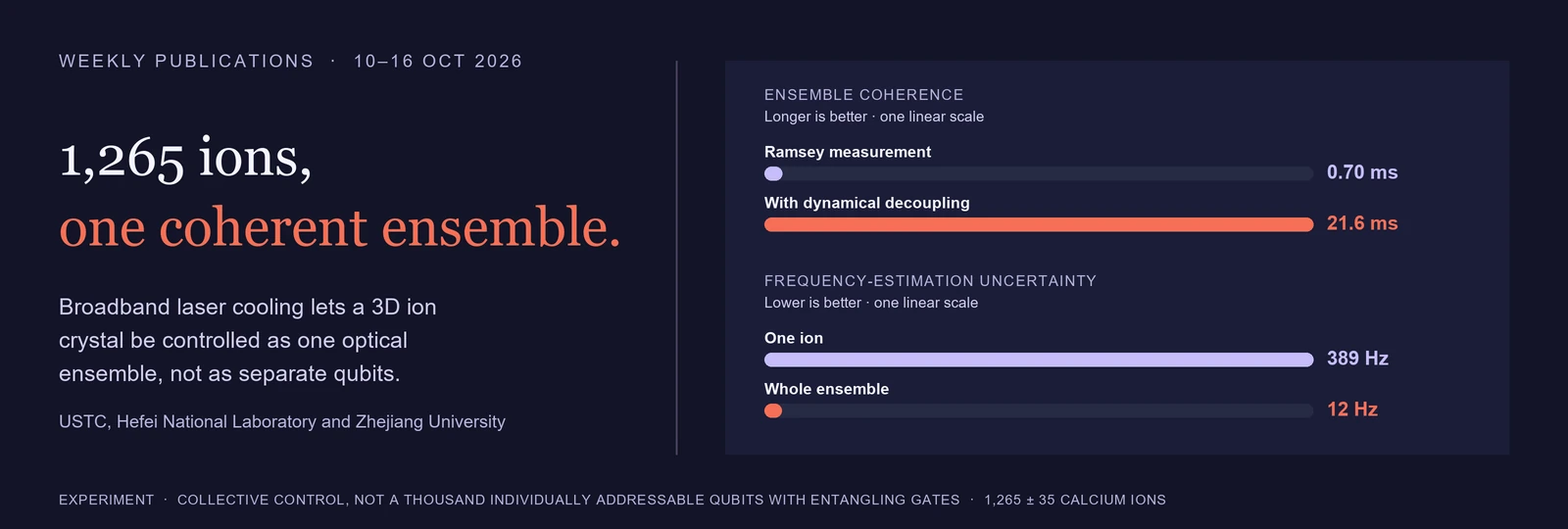
A thousand-ion crystal becomes a coherent optical ensemble.USTC, Hefei National Laboratory and Zhejiang University · Experiment
A small encoded addition circuit beats its physical counterpart, but discards many attempts.Sandia National Laboratories and the University of New Mexico · Experiment on Quantinuum hardware
Defects inside superconducting circuits retain energy for seconds.Karlsruhe Institute of Technology and the University of Stuttgart · Experiment
A microwave-photon experiment joins entangled states with a deterministic fusion operation, while entanglement in the largest state was certified only in one measurement branch.Tsinghua University and Hefei National Laboratory · Experiment
And an AI-guided search finds arithmetic circuits that need far fewer expensive gates on paper, including a cheaper modular-inversion circuit used in elliptic-curve arithmetic.Harvard University, Anthropic and QuEra Computing · Resource estimates, no hardware run
These are different kinds of progress. The useful comparison is between what each experiment controls now and what its next application would demand.
Where the research connects
Counts from 60 reviewed papers
The overlap between this week’s themes
No publication falls outside these three themes. Areas, including the overlaps, are proportional to publication counts. Each region shows only its combination of labels.
The 40 hardware papers, by platform
Superconducting16
Trapped ions7
Semiconductor & spin5
Neutral atoms4
Materials & enabling devices3
Cross-platform or unassigned2
Photonics1
Networking systems1
Other hardware1
05101520
Every paper in the hardware & devices theme, counted once under its primary platform, so the bars add up to 40. Microwave-photon fusion is counted with superconducting circuits, rather than being presented as an optical-photon processor.
Bars use a common scale from 0 to 20 papers.
The three themes are editorial labels assigned from each paper’s title and abstract. Hardware includes device proposals and simulations as well as experiments. Papers may carry more than one label, so percentages do not add to 100%. The exact overlap is 20 hardware-only papers, 5 algorithms-only, 4 verification/error-correction-only, 9 algorithms-and-hardware-only, 11 algorithms-and-error-correction-only, 7 hardware-and-error-correction-only, and 4 carrying all three labels. These shares describe this week’s corpus, not a shift in worldwide research activity. Papers are assigned to the week by first arXiv announcement: the 10 October 00:00 to 17 October 00:00 Asia/Jerusalem window, which holds the arXiv listings dated 12, 14, 15 and 16 October. ArXiv’s holiday schedule explains why a normal weekday schedule cannot simply be assumed.
The research footprint
Countries and regions represented in the review
A global view of participation
Hover, tap, or choose a country or region.
United States25reviewed publications
Reviewed publications
07.51522.530
Not represented in this review
Affiliation locations; a cross-border collaboration can contribute to several countries. Country or region information is available for 60 of 60 reviewed publications. Map: Natural Earth.
Author-affiliation evidence was checked for all 60 papers. Country sets are fully resolved for 57; three retain an unlocated corporate affiliation. Each paper counts once per verified country, producing 76 country–paper attributions across 20 countries. Gray means no verified affiliation in this cohort, not an absence of research. Hardware vendors and acknowledgments are not author affiliations.
United States 25; China 10; United Kingdom 9; Germany 8; France 4; Japan 3; South Korea 3; Switzerland 2; Denmark 1; India 1; Spain 1; Ireland 1; Netherlands 1; Finland 1; Brazil 1; Algeria 1; Australia 1; Austria 1; Singapore 1; Portugal 1.
Five results worth reading closely
Selected research, with company context
Academic research
No company author affiliation
University of Science and Technology of China and Hefei National Laboratory, with Zhejiang University
1. A thousand ions under coherent optical control
A three-dimensional ion crystal packs many atoms into a small volume, but it also creates thousands of collective vibrations. Those motions complicate control of the ions’ optical transitions. USTC/Hefei National Laboratory and Zhejiang University researchers address that problem with broadband laser cooling, then manipulate a crystal containing 1,265±35 calcium ions as a coherent ensemble.
The important achievement is collective control at this scale. Ensemble coherence reaches 21.6 milliseconds with a dynamical-decoupling sequence, compared with 0.70 milliseconds in an ordinary Ramsey measurement. Frequency-estimation uncertainty falls from 389 Hz for one ion to 12 Hz for the ensemble. Most sampled vibrational occupations are low, although two resolved collective modes remain above one phonon.
For investors following trapped-ion platforms, this expands the experimental toolbox. It does not demonstrate a thousand individually addressable computational qubits with entangling gates. The immediate opportunities are collective sensing and quantum simulation; applying the approach to a general-purpose processor would require more control and readout capabilities.
The next question is whether useful entangling interactions and spatially resolved measurements can be added without losing the benefits of the large crystal.
Quantinuum’s Helios-1 hardware. Authors are from Sandia National Laboratories and the University of New Mexico
2. Better arithmetic, with rejected attempts in the denominator
Sandia/University of New Mexico researchers ran one- to five-bit addition on Quantinuum’s Helios-1. Error-detecting codes protect the computation, while an additional check verifies that a temporary carry returns to its expected value. The algorithm itself helps expose errors.
Among accepted runs, encoded addition outperformed corresponding unencoded circuits through three bits. The one-bit result reached an estimated failure probability of (6.0±5.9)×10⁻⁵, versus (3.5±1.3)×10⁻³ for the physical circuit, after filtering anomalous burst-error jobs. The logical estimate rests on a single observed failure.
The trade-off matters. Acceptance declined from just over 60% for one-bit addition to approximately 1% for five bits, and the four- and five-bit circuits did not retain the performance advantage. The experiment used classical inputs and early measurement, rather than coherent arithmetic embedded inside a larger algorithm.
This is evidence that algorithm design and error detection can work together on real hardware. For Quantinuum, the harder milestone is extending that advantage to longer, reusable computations with practical yield. Quantinuum provided the processor; the authors’ affiliations are Sandia and UNM.
arXiv announcement October 14 · Experiment on Quantinuum hardware
Academic research
No company author affiliation
Karlsruhe Institute of Technology and the University of Stuttgart
3. The defects can remember longer than the qubits
Microscopic defects can exchange energy with a superconducting qubit and disturb its behavior. Researchers at KIT and the University of Stuttgart use transmons as probes of three unusually long-lived two-level systems, then vary the qubit–defect detuning to separate the defects’ intrinsic relaxation from decay mediated by the qubit.
The fitted intrinsic lifetimes are about 0.3 seconds, greater than 2 seconds, and about 4 seconds. The transmons themselves have relaxation times around 100 microseconds. These are defect energy-relaxation lifetimes, not seconds-long superconducting-qubit coherence or a demonstrated quantum memory.
Why is this useful? An environment that retains an excitation can affect successive operations rather than behaving as a fresh, independent error source each time. Understanding these objects therefore matters to noise modeling as well as materials engineering.
The researchers do not establish the defects’ unique microscopic identity. Their weak coupling is consistent with positional defects, but other origins remain possible. Controlled access is intriguing; whether these systems can store quantum information depends on coherence and controllability that have yet to be demonstrated.
arXiv announcement October 16 · Experiment with model-based lifetime extraction
Academic research
No company author affiliation
Tsinghua University and Hefei National Laboratory
4. Joining microwave-photon states without probabilistic fusion
Large entangled graph states can be built by joining smaller states. The difficulty is that conventional photonic fusion often succeeds only probabilistically. This experiment uses superconducting circuits to perform a deterministic Bell-state projection on flying microwave-photon qubits, joining smaller time-bin cluster states with programmable connections.
The distinction between a deterministic operation and a deterministic high-quality output is essential. For the largest demonstrated state, involving 13 photonic qubits and 11 graph vertices, genuine multipartite entanglement was certified in one ancilla-outcome branch. The other branches did not pass that test.
The advance is a new way to connect resources while resetting and reusing the matter qubits, easing the burden on the emitter’s coherence. It is not a demonstration that optical-photon companies can immediately adopt the same device: the experiment operates with microwave photons and superconducting hardware.
The question to watch is whether state quality and usable production rate stay strong as more fusion steps are chained together. The paper is new to the week’s arXiv corpus, not a new October journal result.
arXiv announcement October 15 · Experiment; journal publication September 30
QuEra Computing
Private
Anthropic
Private
Harvard University, Anthropic and QuEra Computing
5. An AI search redesigns quantum arithmetic
Researchers at Harvard, Anthropic and QuEra pair a large language model, which writes programs that build circuits, with an independent evaluator that checks correctness and counts resources. Starting from a task description and a blank program, the search (Claude Mythos 5 running inside the open-source OpenEvolve framework) designed circuits for eight subroutines drawn from optimization, chemistry, simulation and number theory.
In seven of the eight tasks, the discovered circuits use both fewer Toffoli gates and fewer qubits than published baselines. The combined Toffoli × qubit cost falls by 4.1× to 39×. For the Reed–Solomon decoder used in decoded quantum interferometry, the Toffoli count falls from 5.1 million to 440,000. The eighth task produced a new reversible circuit for prime-field modular inversion, the dominant cost in elliptic-curve point addition, built on the classical divsteps algorithm: about 4.0 million Toffolis on 935 qubits for the complete benchmark circuit. Prior constructions trade gates against qubits differently, so the authors report no single improvement factor for that task.
The trade-off matters here too. Several circuits save resources by allowing rare failures on unusual inputs, about 10⁻⁴ per run for the decoder, and for most tasks correctness rests on large sampled test sets with statistical bounds. The cost metric is a proxy: real runtime also depends on circuit depth, routing, magic-state supply and the error-correction architecture.
For investors, the relevance is twofold. Cheaper subroutines reduce the hardware eventually needed for useful algorithms, and cheaper elliptic-curve arithmetic feeds directly into estimates for attacks on today’s public-key cryptography. The paper does not estimate when such attacks become possible. The next question is whether independent groups reproduce these circuits and fold them into complete, end-to-end resource estimates.
arXiv announcement October 16 · Resource estimates; no hardware run
The wider week
Error correction is becoming a control-stack problem
Several papers work on the classical machinery surrounding logical qubits. Patchwork combines automated lattice-surgery compilation with a partitioning scheme for parallel decoding. Its evidence is simulation; it provides a route toward real-time operation rather than a delivered real-time hardware system.
PPVM integrates quantum-circuit simulation, noise and classical control, including atom-loss channels relevant to neutral-atom processors. QuasiStim targets another modeling gap: coherent errors and relaxation that cannot always be replaced accurately by randomized Pauli errors. Together, they make a practical point. A useful digital model must represent more than ideal gates and an average error probability.
Logical gate set tomography addresses the same concern experimentally, reconstructing logical operations rather than relying on one fidelity number. Its hardware and emulator results must be distinguished; the larger simulated datasets give greater sensitivity to subtle error structure.
Magic-state costs can be attacked from both sides
Logical CCZ state cultivation designs and simulates a factory that prepares resources for Toffoli gates directly. Gap-Priced T-States instead co-optimizes factory choices and postselection against an algorithm’s error budget. These are architectural and simulation results, not new factory demonstrations on hardware.
Magna develops a classical simulator for assessing acceptance and fidelity in magic-state factories. Meanwhile, LLM-guided circuit discovery, lead result 5 above, attacks the other side by reducing the number of expensive operations an algorithm needs in the first place. The common investor relevance is the eventual cost of an executed algorithm, not simply the size of its qubit register.
More capable hardware also needs less cumbersome support
Fast parallel atom rearrangement brings real-time hologram calculation ahead of a spatial light modulator’s update rate, so control computation no longer sets that particular transport bottleneck. A Rydberg array coupled to an optical cavity combines strong atom–atom interactions with an optical interface for measurement and communication.
At a different level of integration, UCSB’s photonic cold-atom engine brings light generation, control and delivery into a compact module. These papers address different parts of a system. None, by itself, demonstrates a complete compact commercial quantum computer or sensor.
Better classical comparisons remain part of quantum progress
These items fall outside the arXiv-announcement method but matter to readers of this review.
Google magic-state cultivation, Science, October 15. About 40× lower magic-state error than injection alone on the Willow chip, with about 8% of attempts retained; the advantage did not survive transfer into a larger code. Its preprint dates from December 2025, so it is not counted in this week’s corpus. Science · arXiv 2512.13908 · covered in the Weekly News review
RIKEN silicon qubits, Nature Physics, October 16. Simultaneous high-fidelity single-qubit gates across a five-qubit silicon array driven through a shared control line, relevant to wiring overhead in spin-qubit processors. doi:10.1038/s41567-026-03466-2
AI tools from Google and IBM, October 13 (company blogs, not papers). Google reported that Gemini 4 Argon produced a formally verified arcsin subroutine with more than 100× lower spacetime cost than a published baseline; IBM Research reported a 52× reduction in estimated decoder latency from AI-agent hardware design. Google · IBM Research
The strongest common thread is the gap between a component that works and a computation that remains useful when all the costs are included.
For trapped ions, watch controllability and accepted computation yield alongside register size. For superconducting devices, watch the structure and persistence of errors alongside average coherence. For photonic protocols, watch the quality and rate of usable output states alongside whether an individual operation is deterministic. For algorithms, watch whether AI-discovered circuits are independently reproduced and how they change complete resource estimates, including those for cryptography. For every platform, ask whether compilation, decoding, measurement and classical comparisons preserve the claimed improvement.
Those are concrete next milestones. They make progress easier to judge without treating every promising component as a finished machine.